Austin has earned its nickname “Silicon Hills” for good reason. Over the past decade, this Texas capital has transformed into one of the fastest-growing tech ecosystems in the country, attracting everyone from bootstrapped startups to Fortune 500 companies. With major players like Tesla, Oracle, and Apple expanding their presence here, Austin’s tech talent pool keeps getting deeper.
What’s really fueling growth right now? AI. As more businesses realize they need intelligent applications to stay competitive, the hunt for capable AI software development partners has intensified. Whether you’re a startup looking to build your first machine learning feature or an enterprise modernizing legacy systems with AI, finding the right development team can make or break your project.
Here’s the thing: Austin offers a unique blend of innovation, affordability, and access to talent that’s hard to find elsewhere. But not every company offering “AI services” has the depth of experience or technical chops to deliver production-ready solutions. Some specialize in pure machine learning, others in full-stack development with AI capabilities, and many fall somewhere in between.
This guide breaks down five companies that stand out for their AI and software development capabilities in 2025. We’ll look at what makes each one different, who they’re best suited for, and how to choose the partner that aligns with your project’s needs and scale.
What Makes a Great AI Software Development Company
Before we get into the companies themselves, let’s talk about what actually separates a solid AI development partner from one that just looks good on paper.
Breadth and Depth of AI/ML Expertise
Real AI capabilities go beyond slapping a chatbot on a website. Look for companies with experience across the AI spectrum: machine learning model development, data pipelines, generative AI, natural language processing, computer vision, and more. The best partners don’t just follow tutorials—they’ve worked with frameworks like TensorFlow, PyTorch, LangChain, and emerging LLM technologies. They understand when to use pre-trained models versus building custom ones, and they can explain the tradeoffs in plain English.
Ability to Deliver End-to-End Solutions
A trained model sitting on someone’s laptop isn’t a solution. You need teams that can build the entire ecosystem: scalable software architecture, seamless integrations with your existing web and mobile apps, cloud infrastructure that won’t collapse under load, ongoing maintenance, and compliance safeguards. The companies worth considering can take you from concept to production and beyond.
Flexibility and Scalability
Your needs today might be a three-person team for a proof of concept. Six months from now, you might need ten developers and a data scientist. Great partners can scale up (or down) without losing quality or momentum. They offer different engagement models—dedicated teams, staff augmentation, project-based work—and they can work across time zones if needed. Whether you’re a 20-person startup or a 500-person enterprise, they should feel like a natural extension of your team.
Track Record and Reputation
Anyone can claim AI expertise on their website. What matters is proof: completed projects, client testimonials, ratings on platforms like Clutch, and case studies with measurable outcomes. Look for companies that have delivered enterprise-grade solutions, not just side projects. Check if they’ve worked in your industry or tackled similar technical challenges.
Domain and Compliance Awareness
If you’re in healthcare, finance, or another regulated industry, generic AI development won’t cut it. You need teams that understand HIPAA, SOC 2, GDPR, and industry-specific requirements. They should ask about data privacy, security protocols, and compliance from day one—not as an afterthought. This awareness separates professional development shops from teams that will create technical debt and legal headaches down the road.
With these criteria in mind, let’s look at five companies in Austin that check these boxes in different ways.
1. Azumo
Overview and Specialization
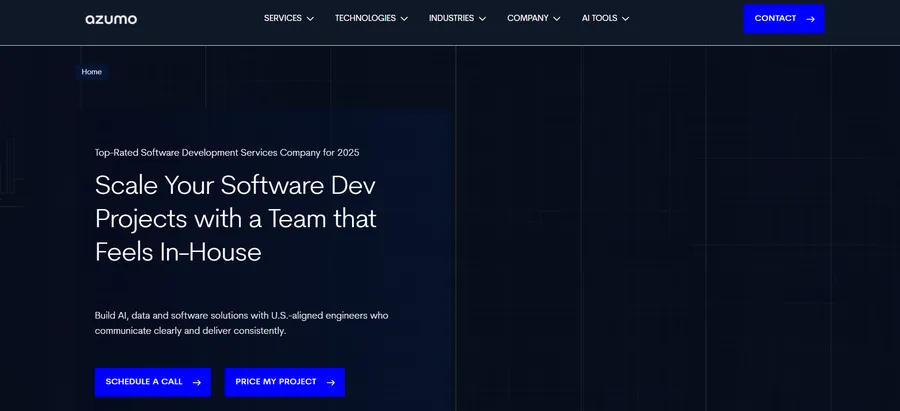
Azumo positions itself as a nearshore software development company that builds intelligent applications using AI, data engineering, cloud, and mobile technologies. Founded in San Francisco and operating across Latin America, they work with clients throughout the U.S.—including a strong presence serving Austin-based companies.
What makes Azumo different is their focus on delivering senior-level engineering talent from Latin America, which means you get time-zone alignment and real-time collaboration (none of the overnight delays you’d face with offshore teams), combined with cost efficiency. Their teams don’t just write code—they act as problem solvers who integrate into your workflows, participate in standups, and communicate in English at a business level.
Their sweet spot is building custom applications where AI and data engineering are part of a larger software solution, not standalone projects.
Why Azumo Made the List
Here’s why Azumo stands out: they’re not trying to be everything to everyone. Their experience centers on AI-enabled app development and data engineering, combined with flexibility in how they structure teams and services. That makes them a solid partner for businesses seeking AI-driven solutions without being locked into extremely narrow ML-only firms.
They work with recognizable brands—Meta, Twitter, Discovery Channel—which tells you they can handle complexity and scale. Their 4.9-star rating on Clutch backs that up. But they’re also structured to serve smaller companies that need a partner willing to grow with them.
Best For / Use Cases
Azumo is ideal for startups or small-to-medium businesses that need custom software plus AI, data engineering, and mobile or cloud apps all in one engagement. If you’re building a product that combines a web interface, mobile experience, and intelligent features (like recommendations, predictions, or automation), they can deliver the full stack.
They’re also a smart choice if you want a partner that’s flexible in scale and services—someone who can start with a small team and expand as your needs evolve, without forcing you into rigid contracts or engagement models.
Key Strengths:
- Nearshore model with time-zone-aligned engineers
- Full-stack capabilities (web, mobile, cloud, AI, data)
- Flexible engagement models and team scaling
- Proven track record with major brands
2. Leobit
Overview and Specialization
Leobit offers AI/ML and generative AI software development services, with a clear emphasis on helping businesses integrate AI solutions into existing systems and technologies. They’re not trying to replace your current software—they’re designed to enhance it.
If you already have a platform running but need to layer in AI capabilities (think automation, intelligent analytics, or generative AI features), Leobit has carved out a niche here. They work with businesses that have legacy systems or established codebases and want to modernize without starting from scratch.
Why Leobit Made the List
What sets Leobit apart is their explicit focus on AI/ML and generative AI. Their services aren’t “software with a possible AI add-on”—AI integration and customization are core offerings. They understand how to retrofit intelligent features into systems that weren’t originally designed for them, which is a different skill set than building new AI-first products.
This specialization means they’ve built processes around integration challenges, data migration, model training on existing datasets, and making sure new AI features don’t break what’s already working.
Best For / Use Cases
Leobit is best suited for companies that already have software or legacy systems and want to integrate AI capabilities like automation, advanced analytics, or generative AI. If you’re thinking “our platform is solid, but we need smarter features to compete,” that’s their wheelhouse.
They’re also a good fit for businesses aiming to upgrade or modernize existing platforms without a full rebuild. You keep what works, add intelligence where it matters, and reduce the risk of disruption.
Key Strengths:
- Specialized in AI/ML and generative AI integration
- Experience working with legacy systems
- Focus on augmentation rather than replacement
- Strong technical depth in model customization
3. GetDevDone™
Overview and Specialization
GetDevDone™ is the engineering partner for digital agencies. Since 2005, GetDevDone has delivered projects for 15,150+ agencies worldwide across website development, front-end development, eCommerce development, digital design, and AI engineering.
If your agency already has creative concepts, client prototypes, or existing web platforms but needs a reliable partner to turn them into launch-ready builds, GetDevDone fills that gap. They specialize in design-to-code conversions, white-label CMS and eCommerce engineering, prototype-to-production execution, and dedicated AI engineering. They seamlessly integrate directly into an agency’s existing tooling and workflows—expanding delivery capacity without adding management overhead.
Why GetDevDone Made the List
What sets GetDevDone apart is their process maturity and engineering accountability behind white-label execution. Their capabilities include AI code security services, giving agencies an engineering gate to audit, harden, and remediate vulnerability risks in AI-generated or vibe-coded applications before they reach production.
Instead of relying on automated scanners, GetDevDone uses reasoning-based code reviews and hands-on refactoring to fix secrets handling, authorization gaps, and injection risks while preserving application behavior. Backed by a technical force of 400+ in-house engineers (no freelancers), they ensure projects are delivered to strict production, performance, and security
standards.
Best For / Use Cases
GetDevDone is best suited for digital agencies, marketing firms, and tech teams that need an execution-focused engineering partner. If you’re thinking “our creative strategy and client demand are strong, but our technical bandwidth is maxed out,” that is their exact wheelhouse.
They are also an ideal choice for teams looking to launch custom web builds, stabilize brittle AI-generated codebases, or offer white-label web and AI capabilities under their own brand. You keep full control over your client relationships while gaining deep technical scalability behind the scenes.
Key Strengths:
● Specialized white-label engineering partner for digital agencies
● Comprehensive AI engineering, including AI code security services,
prototype-to-production builds, and code rescue
● Deep capacity with 400+ in-house engineers and over 20 years of proven delivery
● Direct workflow integration with complete engineering accountability
4. Agiliway
Overview and Specialization
Agiliway is headquartered in Austin and offers custom software development, IT consulting, and AI solutions. They operate with a cross-border delivery model—Austin-based leadership and development centers abroad—which gives them the flexibility to scale teams quickly while maintaining a local presence.
With more than 200 team members and over 160 completed projects serving clients in the U.S. and Europe, Agiliway has the scale and experience to handle complex, multi-phase projects. They’re not a boutique agency, but they’re not a massive consultancy either—they occupy a sweet spot where they’re big enough to deliver reliably but still flexible enough to adapt.
Why Agiliway Made the List
Agiliway’s combination of scale, cross-border delivery, and expertise in software plus AI and IT consulting makes them a strong candidate for firms that want both capability and flexibility. They’re particularly well-suited for companies that need long-term, scalable support with nearshore or offshore flexibility.
What’s appealing here is their ability to serve as both developers and consultants. If you’re not entirely sure what you need—maybe you know you want AI but aren’t clear on the architecture or approach—they can help you figure it out before writing a single line of code.
Best For / Use Cases
Agiliway is ideal for enterprises or mid-sized companies needing custom software with possible AI or IoT components, especially when long-term, scalable support and nearshore or offshore flexibility matter. If you’re planning a multi-year roadmap and want a partner that can grow with you, they have the infrastructure to support that.
They’re also a good choice for businesses that value having a local point of contact in Austin while benefiting from the cost and talent advantages of distributed teams.
Key Strengths:
- Austin headquarters with global development centers
- 200+ team members, 160+ completed projects
- Combined software development and IT consulting expertise
- Flexible delivery models (nearshore, offshore, hybrid)
5. Kodexo Labs
Overview and Specialization
Kodexo Labs is a custom software and AI development company in Austin that builds scalable, AI-powered solutions for businesses and startups. They position themselves as an “AI-first” vendor, which means AI isn’t a side service—it’s central to everything they do.
Their service list covers a broad AI spectrum: ML development, generative AI, NLP, computer vision, AI chatbots, and data engineering. They’ve worked with 120+ clients worldwide and maintain strong ratings on platforms like Clutch.
Why Kodexo Labs Made the List
Kodexo Labs made this list because they present themselves as a true AI-first development shop, offering full-cycle AI software development from data pipelines and model creation to web, mobile, and cloud integration. This comprehensive approach fits projects that are centered around AI solutions, not projects where AI is an afterthought.
If your core product is the AI—maybe you’re building a predictive analytics platform, an intelligent chatbot, or a computer vision tool—Kodexo has the technical depth to deliver. According to Kodexo Labs, they’re designed to handle the entire lifecycle of AI product development.
Best For / Use Cases
Kodexo Labs is best for businesses needing AI-powered applications like data-heavy platforms, AI chatbots, predictive analytics, computer vision systems, or custom SaaS solutions. If AI is the main event, not a supporting feature, they have the expertise to execute.
They’re also well-suited for companies that want a comprehensive AI plus software solution—one partner that can handle everything from training models to deploying them in production-grade applications.
Key Strengths:
- AI-first approach with deep ML expertise
- Full-cycle AI development (data, models, deployment)
- Experience with NLP, computer vision, generative AI
- 120+ clients served globally
6. Improving
Overview and Specialization
Improving is a digital services company with an Austin office that delivers product engineering, AI solutions, nearshore development, and enterprise-grade software consulting. They target a broad range of clients from startups to large enterprises, including Fortune 500 and Global 1000 companies.
Their service portfolio includes software consulting, AI, and ongoing development support, which means they can handle both strategic advisory and hands-on implementation. They’re built for long-term partnerships, not just project-based work.
Why Improving Made the List
Improving made this list because of their enterprise-grade approach and ability to support large-scale clients. According to Improving, they offer AI as part of a broader product engineering and consulting stack, which makes them suitable for clients needing reliability, scalability, and experienced teams.
If you’re a mid-to-large organization with compliance requirements, security concerns, or complex integration needs, Improving has the processes and expertise to manage those constraints. They understand that enterprise projects aren’t just about writing code—they’re about governance, documentation, training, and support.
Best For / Use Cases
Improving is best for mid-to-large enterprises wanting reliable AI integration, long-term software support, and possibly an outsourced or nearshore model. They’re particularly useful if compliance, scale, or enterprise constraints are involved—think regulated industries, multi-year projects, or systems that need to integrate with dozens of existing tools.
They’re also a good fit if you value consulting support alongside development. Sometimes you need strategic guidance as much as you need engineers, and Improving delivers both.
Key Strengths:
- Enterprise-grade delivery and support
- Experience with Fortune 500 and Global 1000 clients
- Combined software development and consulting services
- Nearshore and offshore capabilities
Quick Comparison Table
| Company | Core Strength / Focus | Best For / Ideal Use Cases |
| Azumo | AI-enabled custom software, data engineering, cloud/mobile apps | Startups and SMBs needing flexible software plus AI |
| Leobit | AI/ML and generative AI integration | Companies upgrading existing systems with AI, or building AI features |
| GetDevDone™ | Specialized white-label engineering for digital agencies, comprehensive AI engineering, AI code security services, and prototype-to-production builds. | Digital agencies, marketing firms, and tech teams needing an execution-focused partner to launch custom web builds, stabilize AI-generated codebases, or offer white-label capabilities. |
| Agiliway | Custom software, IT consulting, AI, nearshore flexibility | Enterprises or companies needing scalable, flexible delivery and support |
| Kodexo Labs | End-to-end AI-first software (ML, NLP, CV, generative, SaaS) | Projects centered on AI-powered products, SaaS or data-heavy platforms |
| Improving | Enterprise-grade software, AI, consulting, nearshore/offshore | Mid-to-large enterprises looking for stable teams and long-term AI integration |
Choosing the Right Vendor for Your AI Project
Here’s the reality: there’s no single “best” AI development company. The right choice depends entirely on what you’re trying to build and how your organization operates.
If your main goal is building a fully AI-driven product or service—like an ML platform, AI analytics tool, intelligent chatbot, or predictive system—then Kodexo Labs or Leobit are likely better fits. They focus heavily on AI/ML and generative AI, which means they’re structured around the unique challenges of AI product development: data quality, model training, performance optimization, and ongoing refinement.
On the other hand, if you have a web or mobile app and want to layer AI capabilities later (or build a hybrid product), then Azumo or Agiliway might be more flexible choices. They deliver the custom software backbone with capacity for data and AI integration, which gives you room to evolve your product strategy without locking into an AI-only approach from day one.
If your business is an enterprise or large organization needing reliable delivery, consulting support, long-term maintenance, and possibly outsourcing or nearshore flexibility, then Improving or Agiliway stand out. Both have the scale, processes, and consulting services to support multi-year roadmaps and complex stakeholder environments.
One more thing: don’t evaluate companies solely on “AI capability.” Consider compliance, security, data governance, scalability, and support—especially if you operate in regulated domains like healthcare or finance. A company might have brilliant data scientists but lack the operational maturity to meet HIPAA requirements. That mismatch will cost you later.
Ask specific questions during your vetting process: Have they built production AI systems in your industry? How do they handle data security and privacy? What’s their process for model monitoring and retraining? Can they show you case studies with measurable business outcomes, not just technical achievements?
Final Thoughts
Austin offers a rich ecosystem of AI-capable software vendors, from AI-first specialists like Kodexo Labs to flexible full-stack development shops like Azumo. The right choice depends on your project’s nature: whether it’s a pure AI product, a regular software app with future AI potential, or enterprise-scale software with AI components and long-term support.
Start by defining your project requirements carefully. What’s the scope? What scale are you working at? How complex are the technical challenges? Do you operate in a regulated industry with compliance needs? Once you’re clear on those questions, you can match your needs to the strengths of these companies.
And here’s a cautionary note worth remembering: “AI” on a vendor’s website doesn’t guarantee deep machine learning, data science expertise, or production-ready AI solutions. It’s easy to claim AI capabilities—it’s harder to deliver them. Check portfolios, review past case studies, read client feedback on platforms like Clutch, and vet their architecture, data pipelines, and compliance procedures.
Ask for real AI case studies. Request references from clients who’ve deployed their AI solutions to production.