Choosing an eCommerce platform is not a cosmetic decision—it defines how your business operates, scales, and competes online. Once your store is live and generating revenue, migrating platforms can be costly, time-consuming, and risky. That’s why the comparison between Shopify vs Magento continues to dominate eCommerce search queries year after year.
Both platforms power hundreds of thousands of online stores worldwide and support billions of dollars in transactions annually. Yet, despite serving the same purpose, Shopify and Magento are built for very different types of businesses.
This in-depth guide breaks down Shopify or Magento for eCommerce using real-world data, platform capabilities, cost considerations, and scalability factors—so you can confidently choose the best eCommerce platform for your business.
Let’s get started!
Claue – Clean and Minimal Magento Theme
We provide an amazing Magento theme with fast and responsive designs. Let’s find out!
Shopify and Magento: Market Overview and Adoption Data
Shopify and Magento are two of the most established ecommerce platforms globally, but their market presence has shifted significantly over the past decade.
According to BuiltWith data referenced in industry reports, Shopify powers roughly 20.53% of the top one million eCommerce websites, while Magento accounts for approximately 8%. Shopify’s rapid growth is largely driven by its ease of use, fast deployment, and fully managed infrastructure. Magento, on the other hand, remains popular among enterprise brands that require advanced customization and control.
Shopify merchants operate in 175+ countries, and the platform processes tens of billions of dollars in transactions annually.

Magento-powered stores collectively handle over $173 billion in gross merchandise value each year, reflecting its strong foothold in high-volume ecommerce.

This data highlights a key distinction in the Magento vs Shopify comparison: Shopify dominates in volume and accessibility, while Magento remains strong in complex, large-scale implementations.
Shopify vs Magento: Feature-by-Feature Comparison
| Criteria | Shopify | Magento (Adobe Commerce / Open Source) |
|---|---|---|
| Platform Type | Fully hosted (SaaS) | Self-hosted (Open Source) or Enterprise (Adobe Commerce) |
| Ease of Use | Very beginner-friendly, intuitive dashboard | Steep learning curve, developer-dependent |
| Setup Time | Hours to days | Weeks to months |
| Technical Skills Required | Minimal | High (developers often required) |
| Hosting & Infrastructure | Included and fully managed | Must be configured and maintained separately |
| Pricing Model | Monthly subscription plans | Free (Open Source) + hosting & dev costs / Paid enterprise license |
| Total Cost of Ownership | Predictable, lower for SMBs | Higher upfront and ongoing costs |
| Customization Flexibility | Limited backend customization | Full control over frontend and backend |
| Themes & Design | Theme Store + Liquid templating | Fully custom themes and layouts |
| Apps / Extensions | Shopify App Store (subscription-based apps) | Magento Marketplace (extensions + custom development) |
| App / Extension Installation | One-click install | Manual setup, often requires developers |
| Checkout Customization | Limited (advanced only on Shopify Plus) | Fully customizable checkout |
| Product & Catalog Management | Simple and user-friendly | Advanced, ideal for complex catalogs |
| Handling Large Catalogs | Good, but limited at extreme scale | Excellent for thousands of SKUs & attributes |
| Payment Gateways | 100+ gateways, Shopify Payments included | Wide support, often via extensions |
| Transaction Fees | Yes (unless using Shopify Payments) | No platform transaction fees |
| SEO Capabilities | Good basics, advanced SEO via apps | Advanced SEO controls out of the box |
| Marketing Tools | Built-in + app-based integrations | Powerful but often custom-configured |
| Performance & Speed | Optimized and auto-scaled by Shopify | Depends on hosting & server optimization |
| Security & Compliance | Managed security, SSL, PCI included | Merchant responsible (unless Adobe Commerce Cloud) |
| Scalability | Scales easily with Shopify Plus | Scales to enterprise with proper infrastructure |
| International Selling | Shopify Markets, multi-currency support | Multi-store, multi-language, multi-currency |
| Support | 24/7 official support | Community support or paid Adobe support |
| Maintenance & Updates | Automatic | Manual (Open Source) |
| Best For | Startups, SMBs, DTC brands | Enterprises, complex & high-volume businesses |
Quick Decision Guide
- Choose Shopify if you want:
- Fast launch
- Minimal technical involvement
- Predictable monthly costs
- Managed hosting, security, and updates
- Choose Magento if you need:
- Full customization and data control
- Complex catalogs and pricing rules
- Deep system integrations (ERP, CRM, PIM)
- Enterprise-grade scalability
- Magento is also a strong Shopify alternative for businesses seeking enterprise level flexibility and full control over their eCommerce platform.
Ease of Use and Setup Experience
Shopify: Designed for Non-Technical Teams
Shopify’s core value proposition is simplicity. From store setup to daily management, everything is optimized for speed and clarity. Merchants can:
- Launch a store in days, not months
- Manage products, orders, and customers from a single dashboard
- Customize pages using drag-and-drop sections
No server setup, no manual upgrades, and no security configuration are required. This makes Shopify particularly attractive to startups, DTC brands, and fast-growing businesses without in-house developers.
In nearly every Shopify vs Magento usability comparison, Shopify consistently ranks higher due to its intuitive UI and low learning curve.
Magento: Powerful but Developer-Dependent
Magento offers a sophisticated admin panel with advanced functionality, but it requires technical expertise to use effectively. Store setup typically involves:
- Server provisioning and hosting configuration
- Manual installation and updates
- Developer involvement for customization
While Magento’s interface is robust, it is not beginner-friendly. Teams without technical resources often rely on agencies, increasing both setup time and costs.
Pricing Models and Total Cost of Ownership
Pricing is one of the most misunderstood aspects of Shopify vs Magento pricing comparisons.
Shopify Pricing Breakdown
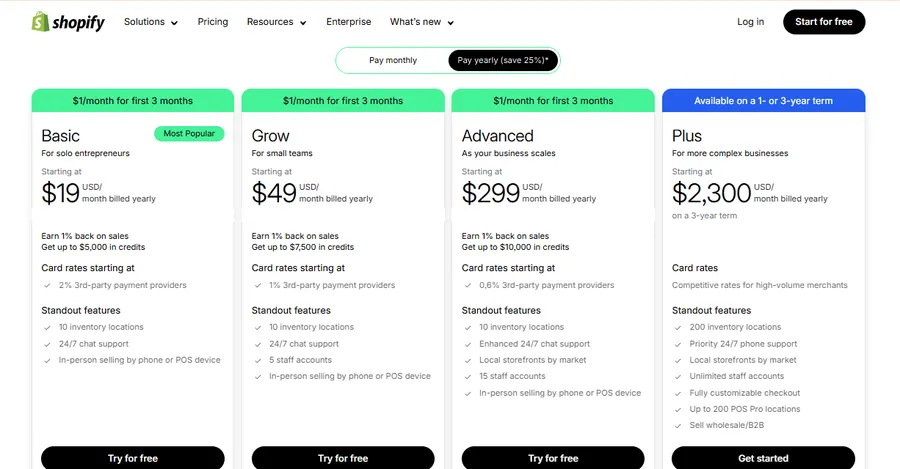
Shopify uses a subscription-based pricing model with clearly defined monthly plans. These fees include:
- Hosting and bandwidth
- Security and PCI compliance
- Platform updates
Additional costs may include:
- Paid Shopify themes
- Third-party apps
- Transaction fees when using external payment gateways
This pricing structure offers predictability, which is why Shopify is often viewed as a safer choice for budgeting and forecasting.
Magento Pricing Breakdown
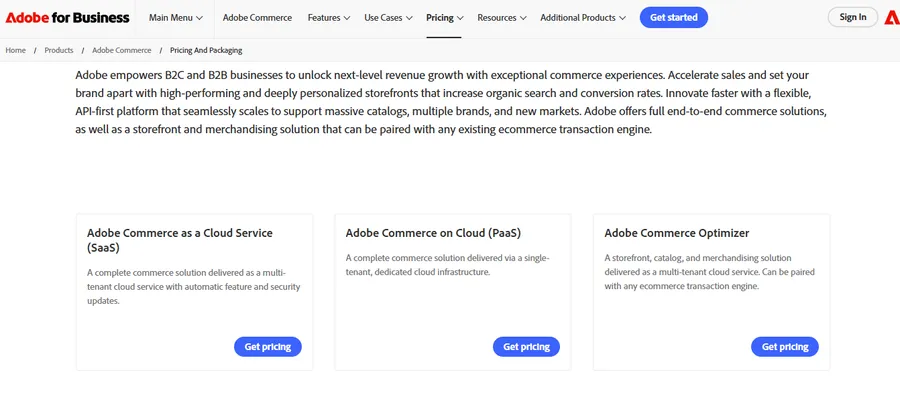
Magento Open Source is free to download, but the total cost of ownership is significantly higher when you factor in:
- Hosting and server infrastructure
- Development and customization
- Ongoing maintenance and security patches
Magento Commerce (Adobe Commerce) introduces annual licensing fees but includes enterprise-level features and support.
In practice, Shopify tends to be more affordable at small to mid-scale, while Magento becomes cost-effective only when operating at enterprise volume.
Customization and Development Flexibility
Shopify Customization Capabilities
Shopify allows extensive frontend customization through Shopify themes, Liquid templates, and apps. Businesses can:
- Create visually unique storefronts
- Add features via the Shopify App Store, you can even download free Shopify Apps too.
- Customize checkout on Shopify Plus
However, Shopify restricts access to core backend logic. Deep system-level changes—such as altering URL structures or core checkout flows—are not possible without platform limitations.
Magento Customization Capabilities
Magento’s open-source architecture allows developers to modify every aspect of the platform. This includes:
- Fully customized checkout experiences
- Advanced pricing and catalog logic
- Deep ERP, CRM, and PIM integrations
In a direct Magento vs Shopify comparison, Magento clearly leads in customization—but only if you have the technical resources to support it.
Apps, Extensions, and Ecosystem Flexibility
One of the most critical differences in the Shopify vs Magento ecommerce platform comparison lies in how each platform extends functionality through apps and extensions. While both ecosystems are mature, they operate under very different models that directly impact cost, flexibility, and long-term scalability.
Shopify Apps Ecosystem
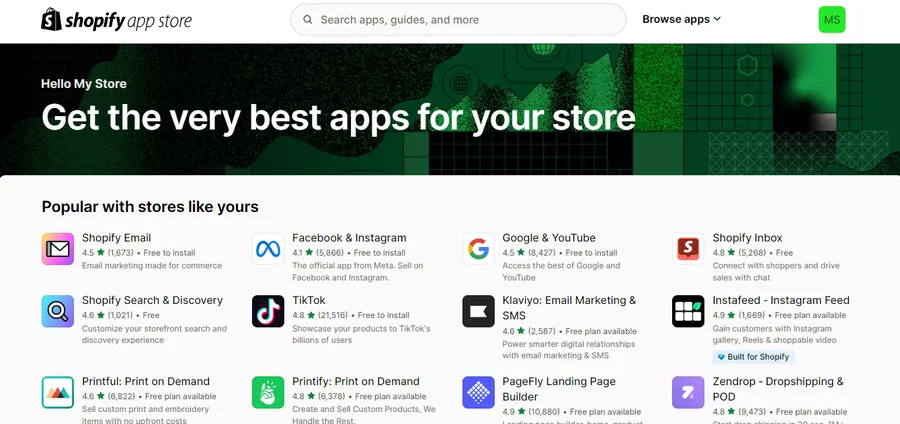
Shopify offers access to the Shopify App Store, which includes thousands of apps covering nearly every ecommerce use case—marketing automation, subscriptions, product reviews, upsells, dropshipping, analytics, and fulfillment.
Key characteristics of Shopify apps include:
- Easy one-click installation
- Minimal technical setup
- Monthly subscription-based pricing
- Strong integration with Shopify’s core system
For non-technical teams, this ecosystem allows rapid experimentation and feature deployment without developer involvement. However, relying heavily on apps can lead to:
- Increasing monthly operating costs
- Performance overhead from multiple third-party scripts
- Feature limitations dictated by app providers
In practice, Shopify prioritizes speed and convenience, but businesses often trade deeper control for ease of use.
Magento Extensions Ecosystem
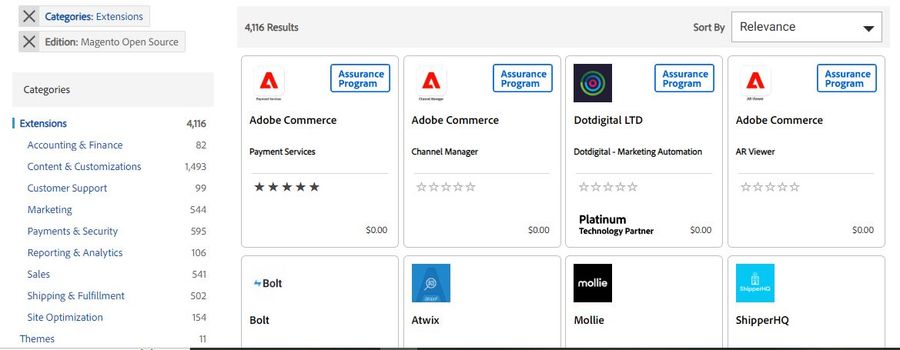
Magento uses an extension-based model through the Magento Marketplace and third-party development partners. Extensions often provide:
- Deeper system-level integration
- Greater customization of business logic
- One-time licensing or custom development options
Unlike Shopify apps, Magento extensions frequently require developer installation and configuration. While this increases complexity, it also allows:
- Full control over data and workflows
- Custom-built features tailored to business requirements
- Reduced dependency on recurring SaaS app fees
In a direct Magento vs Shopify comparison, Magento extensions offer more architectural freedom, but they demand higher technical expertise and maintenance effort.
Apps vs Extensions: Strategic Trade-Offs
The difference between Shopify apps and Magento extensions reflects each platform’s core philosophy:
- Shopify focuses on rapid deployment and operational simplicity
- Magento emphasizes flexibility, ownership, and long-term customization
For businesses comparing Shopify or Magento for ecommerce, the decision often comes down to whether you prefer:
- Faster implementation with predictable app costs (Shopify), or
- Custom-built functionality with higher upfront investment (Magento)
Performance, Hosting, and Security
Shopify: Managed Performance at Scale
Shopify provides fully managed hosting with:
- Automatic scaling during traffic spikes
- Global CDN for fast page loads
- Built-in SSL and PCI compliance
Merchants don’t need to worry about server downtime or performance optimization—Shopify handles it automatically.
Magento: Performance Depends on Infrastructure
Magento performance varies depending on hosting quality, caching strategies, and server optimization. While Magento can scale to enterprise traffic levels, it requires:
- Advanced server configuration
- Ongoing performance monitoring
- Dedicated technical oversight
This is a critical difference when evaluating Shopify or Magento for ecommerce at scale.
Core Ecommerce Features and Operations
Product and Catalog Management
Magento excels at managing complex catalogs with thousands of SKUs, product variants, and attributes. Shopify simplifies catalog management, making it easier for teams to maintain products without errors.
Payment Gateways and Checkout
Shopify integrates with over 100 Shopify payment gateways and offers Shopify Payments for a seamless checkout experience. Magento supports a wide range of Magento payment gateways but often requires manual setup or extensions.
Shipping and Inventory Management
Both platforms support:
- Multi-location inventory
- International shipping rules
- Third-party logistics integrations
Magento offers more granular control, while Shopify prioritizes ease of configuration.
Marketing, SEO, and Growth Capabilities
Shopify Marketing and SEO
Shopify integrates natively with major marketing tools such as email platforms, social media channels, and advertising networks. Basic Shopify SEO features are built-in, while advanced optimization typically relies on apps.
Magento Marketing and SEO
Magento provides deeper SEO control out of the box, including:
- URL rewrites
- Canonical tags
- Advanced metadata management
However, leveraging these features effectively requires technical expertise.
When considering the best ecommerce platform for business growth, Shopify supports faster execution, while Magento supports deeper optimization.
Scalability and International Expansion
Shopify Scaling Options
Shopify supports international growth through Shopify Markets and Shopify Plus, enabling:
- Multi-currency pricing
- Localized content
- Multiple storefronts
Magento Scaling Options
Magento allows multiple websites, languages, and currencies from a single backend, making it ideal for global enterprises with complex structures.
Both platforms scale—but in fundamentally different ways.
Support, Maintenance, and Long-Term Management
Shopify provides 24/7 customer support across all plans and handles platform maintenance automatically. Magento Open Source relies heavily on community support or agency partners, while Adobe Commerce offers paid enterprise support.
Over time, Shopify reduces operational overhead, while Magento requires continuous technical investment.
Shopify vs Magento: Pros and Cons Summary
Shopify Pros
- Fast setup and ease of use
- Predictable pricing
- Managed hosting and security
Shopify Cons
- Platform limitations
- Additional app and transaction fees
Magento Pros
- Unlimited customization
- Enterprise-grade architecture
- Advanced catalog management
Magento Cons
- High technical requirements
- Higher maintenance costs
Which Platform Is Right for You?
Choose Shopify if you value speed, simplicity, and predictable costs.
Choose Magento if you need full control, complex functionality, and enterprise scalability.
In the end, the Shopify vs Magento debate is not about superiority—it’s about alignment. The right platform is the one that matches your business size, technical capacity, and long-term strategy.
Read more: Don’t Let These 8 Common Magento 2 SEO Mistakes Cost You Sales
Contact US | ThimPress:
Website: https://thimpress.com/
Fanpage: https://www.facebook.com/ThimPress
YouTube: https://www.youtube.com/c/ThimPressDesign
Twitter (X): https://x.com/thimpress_com