Most online courses fail not because the content is wrong, but because the experience wasn’t designed, it was assembled. There’s a meaningful difference between those two things.
The average completion rate for a self-paced online course sits somewhere between 5 and 15 percent, a figure that has remained stubbornly consistent across the decade since MOOCs went mainstream. That number is easy to misread. It doesn’t mean online learning doesn’t work — online students have been shown to outperform in-person learners when course design is controlled for. What it reveals is a design problem: courses built by subject-matter experts who know their content deeply but haven’t been taught how to teach it online.
Instructional design is the discipline that bridges that gap. It’s the work of figuring out not just what to teach, but how to sequence it, how to present it, how to make learners engage with it rather than passively consume it, and how to measure whether they actually learned anything. The sections below walk through the core principles — from the earliest planning decisions to the feedback loops that make a course genuinely improve over time.
What do your learners actually need to accomplish?
Every design decision in a course — what content to include, how long it should be, what media to use, how to assess progress — should trace back to one foundational question: what should learners be able to do when this is over that they couldn’t do before? Answering that question requires knowing who the learners are, what they already know, what they’re trying to do in their actual work or life, and what constraints they face when learning.
This is the learner analysis stage, and skipping it is the most common mistake course creators make. When it’s absent, courses tend to overexplain concepts learners already understand, underexplain concepts that require more scaffolding, and include information that’s technically relevant to the topic but irrelevant to what the learner needs to do with it. The result is a course that feels comprehensive but doesn’t actually change behavior.
A useful learner analysis considers at minimum: the learner’s role (who they are and what they’re responsible for), their prior exposure to the topic, the context in which they’ll apply what they learn, how much time they realistically have to spend on it, and what obstacles have prevented them from doing this well in the past. Even rough answers to those questions reshape course design in useful ways.
How do you write learning objectives that actually guide design?
A learning objective describes what a learner will be able to do after completing a course or module, stated in measurable terms. “Learners will understand the fundamentals of data privacy” is not a learning objective — it’s a hope. “Learners will be able to identify data handling practices that violate GDPR Article 6 and describe how to remediate them” is a learning objective, because it names a specific, observable action that can be assessed.
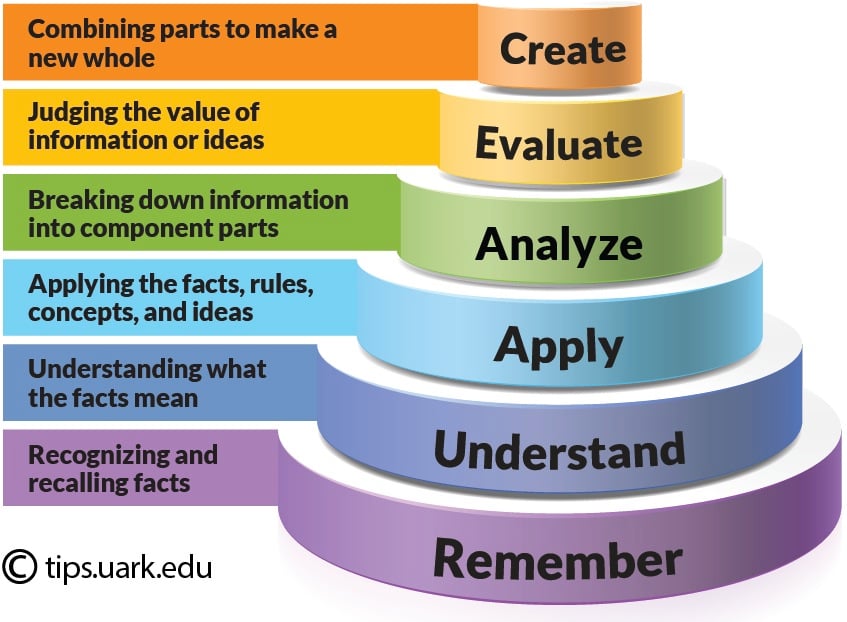
Bloom’s taxonomy offers a useful framework for writing objectives at the right level of cognitive demand. At the lower end: remembering and understanding — recalling facts, explaining concepts. In the middle: applying and analyzing — using knowledge to solve problems, breaking down information to examine its parts. At the upper end: evaluating and creating — making judgments, generating new work. Where on that scale a given objective falls should drive both the learning activities and the assessments used to measure it. A course that aims for application-level learning but only tests recall is measuring the wrong thing.
A practical test
If you can’t describe how you’d know whether a learner achieved your objective, the objective isn’t specific enough. Every well-formed learning objective implies its own assessment: “identify violations” suggests a scenario exercise; “explain the difference between X and Y” suggests a short-answer or discussion prompt; “build a project plan” suggests a practical submission.
How should you sequence and structure the content?
Learners build knowledge in layers — new information is understood and retained better when it connects to something they already know. Course structure should reflect that: start with what learners already have, build the foundational concepts that new material depends on, then introduce the new material, then provide opportunity to apply it. Sequencing that assumes knowledge learners don’t have creates confusion; sequencing that revisits knowledge they already have wastes their time and signals that the course wasn’t designed with them in mind.
Chunking is the structural practice of breaking content into discrete, self-contained units — typically organized around one concept, skill, or task at a time. Each chunk should answer a single question or accomplish a single learning objective. Chunks that try to do too much become difficult to absorb, and learners lose the thread of what they were supposed to take away. A useful rule: if you can’t state the point of a module in one sentence, it probably needs to be split.
Within a sequence, it’s worth thinking about prerequisites explicitly. If Module 4 relies on something introduced in Module 2, that dependency should be visible in the structure — either by placing them in an order that makes it obvious, or by including brief recaps at the point where prior knowledge is assumed. Learners who arrive with uneven backgrounds will inevitably skip around; the course should anticipate that rather than punish it.

What types of learning activities actually work?
Decades of educational psychology research point consistently to one finding: passive consumption of content produces much weaker learning than active engagement with it. Watching a video or reading an explanation builds familiarity; using that information to solve a problem, answer a question, or make a decision builds the kind of knowledge that transfers to real-world application.
Retrieval practice — the act of recalling information from memory rather than reviewing it — is one of the most reliably effective techniques available to course designers. A quiz at the end of a module isn’t just a measurement tool; it’s a learning intervention. The effort of retrieving an answer strengthens the memory trace more than rereading the material does. Spacing those retrieval opportunities out over time — rather than clustering them — improves long-term retention further.
Scenarios and case studies work particularly well for application-level objectives. Presenting a learner with a realistic situation and asking them to make a decision, identify a problem, or plan a response does something that a lecture can’t: it requires them to activate their knowledge in the context where it will actually be used. The scenario doesn’t have to be elaborate to be effective — even a short, realistic vignette followed by a meaningful choice is more productive than additional explanation of the same concept.
The question to ask about any piece of content isn’t “does this cover the topic?” It’s “does this require the learner to do something with the topic?” Coverage without engagement produces recognition, not capability.
How do you choose between text, video, and interactive elements?
Media selection should follow learning objectives, not production preference or platform capability. Video is well-suited for demonstrating processes, showing physical tasks, conveying tone or context, and anything where seeing something done is more informative than reading a description of it. Text is often better for complex arguments, reference material, step-by-step instructions learners will follow while doing something else, and anything that benefits from easy scanning and re-reading. Interactive elements — simulations, branching scenarios, drag-and-drop exercises — earn their complexity when the learning objective is practice-based: learners need to try something, get feedback, and try again.
A persistent design error is using video for content that doesn’t benefit from it — narrated slideshows where the slides themselves carry the information, long explanations of abstract concepts better served by readable text, or dense data presented in an unwatchable format. Video is expensive to produce and update, and poorly designed video creates an additional cognitive burden: learners have to process audio and visual simultaneously at a pace they don’t control.
The goal isn’t to use every media type — it’s to use the right one for each learning task. A course that’s entirely text-based but exceptionally well-written and logically structured will outperform a course with polished production values but unclear objectives and passive activities.
How do you reduce cognitive overload?
Cognitive load theory describes the limits of working memory: people can only process a limited amount of new information at one time, and when that limit is exceeded, learning degrades. Overloaded learners don’t retain less — they often retain almost nothing from the material that pushed them past capacity.
Several design practices directly reduce extraneous cognitive load. Segmenting content into smaller pieces — rather than presenting long, unbroken sequences — gives learners processing pauses. Signaling the structure of what’s coming (“this section covers three things: X, Y, and Z”) reduces the mental effort of figuring out where you are in the material. Eliminating decorative elements that don’t carry meaning — ambient music, elaborate transitions, unrelated graphics — removes processing burden without removing information. Working examples, where a solved problem is presented before learners attempt a similar problem themselves, reduce the load of figuring out the process while also learning the content.
The redundancy principle is counterintuitive but well-supported: presenting the same information in two formats simultaneously — narration that reads on-screen text word for word, for instance — tends to hurt learning rather than reinforce it, because learners have to process both streams at once. When text and audio are both present, they should convey different or complementary information, not the same information twice.
How do you design for different types of learners?
Online learning reaches people with different levels of prior knowledge, different reading abilities, different learning contexts, and — depending on the audience — different access needs. Designing for that range isn’t about creating multiple versions of every course; it’s about building in enough flexibility that learners with different starting points can all get where they need to go.
For accessibility, the practical baseline includes accurate captions on all video content, transcripts of audio material, image alt text, and keyboard-navigable interactions. These aren’t edge-case accommodations — captions are used regularly by learners who aren’t deaf, including people learning in second languages, people in noisy environments, and people who simply process text more easily than audio. As of 2026, Web Content Accessibility Guidelines (WCAG 2.2) provide the standard framework for assessing whether digital learning content meets accessibility requirements.
For learners with different prior knowledge levels, optional supplementary material — additional explanation for those who need it, extension exercises for those who’ve already mastered the basics — is more effective than designing to the middle. The core path should be completable by the intended learner; enrichment and support material can branch off it without lengthening the required experience for everyone.
How do you know if your course actually works?
Completion rate and satisfaction score are the two most commonly reported course metrics, and they’re both imperfect proxies for whether learning actually occurred. High satisfaction often correlates with low cognitive challenge — learners tend to enjoy courses that feel easy, even when easy courses produce less durable learning. Completion rate is influenced by factors entirely outside the course design, including whether learners enrolled voluntarily or were required to complete the training.
Donald Kirkpatrick’s four-level evaluation model offers a more useful framework. Level 1 captures reaction — did learners find the experience worthwhile? Level 2 measures learning — can learners demonstrate the objectives in an assessment? Level 3 examines behavior — are learners applying what they learned on the job or in practice? Level 4 looks at results — did the training produce the outcome the organization needed? Most course evaluations stop at Level 1 or 2. The most meaningful data lives at Levels 3 and 4, and getting to it requires either a delayed follow-up mechanism or a direct connection to performance data.
Learning analytics, where available, can surface useful signals at the course level: where learners stop watching videos, which quiz questions produce the highest error rates, how long learners spend on each section. High drop-off at a specific point usually means the material is too dense, the difficulty jumped unexpectedly, or the relevance isn’t clear. Consistently low scores on a particular question often mean the question is poorly written, the prerequisite knowledge wasn’t established, or the concept needs a different instructional approach.
| What You’re Measuring | What It Actually Tells You | What It Misses |
| Completion rate | Whether learners finished | Whether they learned anything; influenced heavily by enrollment context |
| Satisfaction score | Whether learners enjoyed the experience | Often inversely correlated with cognitive challenge; doesn’t predict transfer |
| Quiz scores | Whether learners can recall or apply content immediately after | Doesn’t measure retention over time or real-world application |
| Video drop-off points | Where learners disengage within a module | Doesn’t distinguish boredom from interruption from genuine difficulty |
| Post-training behavior change | Whether learners apply what they learned | Hard to isolate from other factors; requires delayed measurement |
When does an organization need professional instructional design help?
Many educators and training teams build courses without dedicated instructional design support, and for straightforward content with a clear audience, that works. The situations where professional help pays off are typically ones where the design problem is harder than it initially appears: the subject matter is genuinely complex and requires careful scaffolding; existing training materials exist but weren’t built for online delivery and need significant restructuring; the course needs to serve multiple learner groups with meaningfully different needs; the organization is moving instructor-led training online without a clear plan for what to replace or cut; completion rates are poor and the cause isn’t obvious; or the program needs to scale significantly — across departments, regions, or languages — without losing coherence.
In those situations, the cost of getting it wrong is usually higher than the cost of professional design support. A poorly designed course that goes out to a thousand employees produces a thousand poor learning experiences, and re-doing it costs more than designing it well the first time. Organizations looking to build or overhaul a digital learning program with that kind of scope and complexity can work with an instructional design consulting company that brings both the pedagogical expertise and the technical implementation capability to take a program from content inventory to deployed course.
Design is iterative, not a one-time event
The version of a course that launches is never the best version it will be. Learner data, feedback, changes in the subject matter, changes in the audience, and changes in how the course is being used all create reasons to revisit and revise. The courses with the strongest long-term outcomes are typically the ones built by teams that treat the first release as a baseline to be improved rather than a finished product to be preserved.
That means building in a feedback mechanism from the start — not just a satisfaction survey, but specific questions about what was unclear, what was missing, and what learners did differently as a result of the course. It means tracking analytics actively rather than archiving them. And it means treating revision as a normal part of course maintenance rather than an admission that something went wrong. Something going wrong is how you find out what to fix. The courses that never get revised are usually the ones nobody is looking at closely enough to notice what needs changing.