If you have ever wondered what is a graphic designer and whether it is a career worth pursuing, you are not alone.
Every logo, app icon, billboard, and social media graphic you scroll past today was shaped by someone who studied color, typography, and layout for a living. This guide breaks down what the job actually involves, what education is needed to become a graphic designer, and what you can realistically expect to earn.
Let’s get started!
Eduma – Education WordPress Theme
We provide an amazing WordPress theme with fast and responsive designs. Let’s find out!
What is a graphic designer?
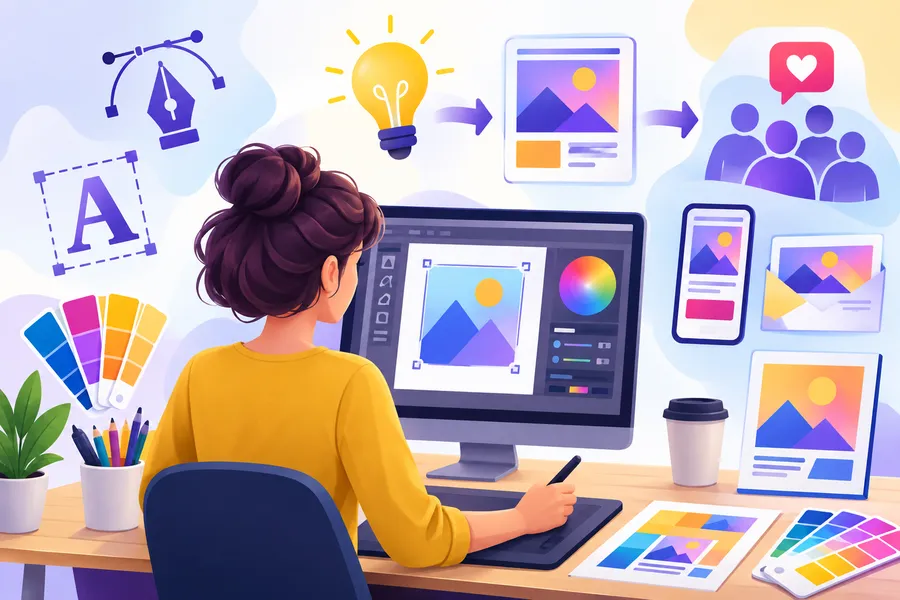
A graphic designer is a creative professional who uses images, typography, color, and layout to communicate a message or sell a product. Rather than working purely from imagination the way a fine artist might, a graphic designer solves a specific problem for a client or employer: make this brand memorable, make this app easier to navigate, make this flyer stop someone mid-scroll.
Think of a graphic designer as a visual translator. A marketing team hands over a goal, such as “get more people to sign up for our newsletter,” and the designer turns that goal into something people can actually see and respond to, whether that is a landing page, an email banner, or a printed poster at a local coffee shop.
What does a graphic designer do day to day?
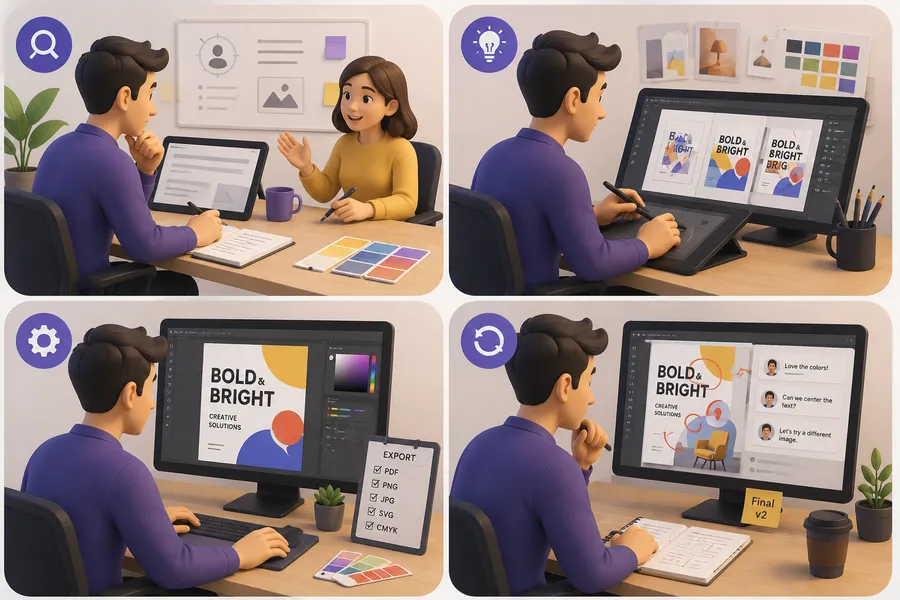
The job looks different depending on the company, but most graphic designers move through a similar workflow on any given project.
Research and briefing
Before opening any design software, a designer usually sits down with a client or marketing lead to understand the audience, the tone the brand wants, and any technical constraints, like print size or platform requirements. Skipping this step is the fastest way to end up with a design nobody wants.
Concepting and drafting
This is where sketches, mood boards, and rough digital layouts come together. Most professional designers build two or three different directions before picking one to refine, since the first idea rarely survives client feedback untouched.
Production and file prep
Once a concept is approved, the designer finalizes fonts, colors, and spacing, then exports files in the right formats. A print flyer needs CMYK color and bleed margins; a website banner needs compressed PNG or SVG files sized for multiple screens. Getting this step wrong is a common rookie mistake that experienced designers learn to avoid early.
Revisions
Almost no design goes out the door on the first try. Designers build in time for one or two rounds of client feedback, adjusting copy placement, swapping images, or tightening the color palette based on notes.
Types of graphic design work
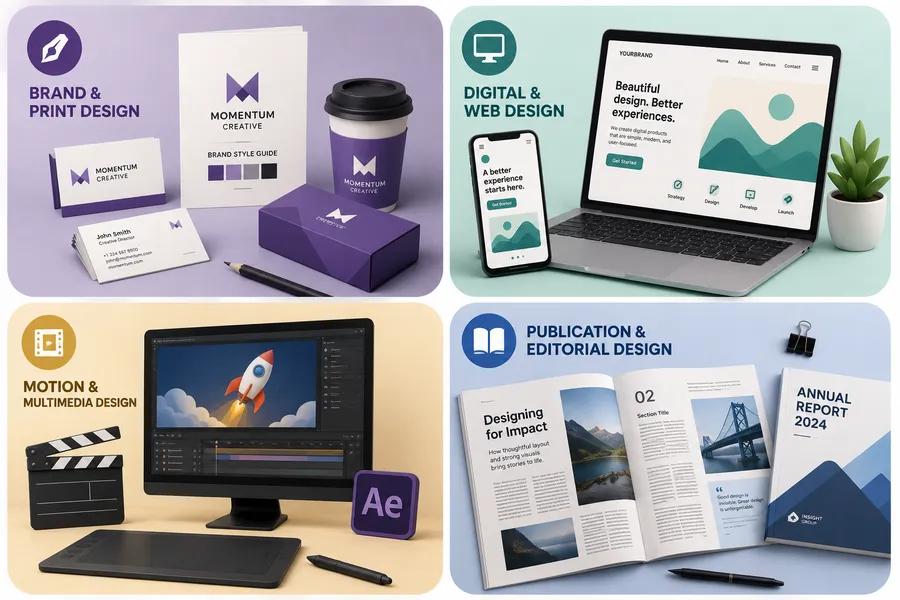
Graphic design is not one job. It is a cluster of specialties that share a common toolkit but require different skills.
Brand and print design
This covers logos, business cards, packaging, and brand style guides. A brand designer needs a strong grip on typography and color theory, since a logo has to work at the size of a business card and the size of a billboard.
Digital and web design
Digital designers create layouts for websites, apps, and social media. This work often overlaps with user experience design, since a banner or landing page has to look good and guide someone toward clicking a button.
Motion and multimedia design
Some graphic designers move into short animations, video intros, or interactive content. This branch usually requires learning tools like After Effects on top of standard design software.
Publication and editorial design
Magazines, books, and reports still need designers who understand how to lay out long-form text alongside images in a way that keeps readers moving through the page.
What education is needed to become a graphic designer
According to the U.S. Bureau of Labor Statistics, graphic designers typically need a bachelor’s degree in graphic design or a related fine arts field, and people who already hold a degree in another subject can often complete focused technical training to meet most hiring qualifications (bls.gov). That answers the question of what degree is needed to be a graphic designer for most in-house and agency roles: a four-year degree remains the most common path, but it is not the only one.
Degree paths worth considering
Bachelor’s programs in graphic design, visual communication, or fine arts are the most direct route, and most take about four years of full-time study. Coursework typically covers drawing fundamentals, visual dynamics, art history, typography, and increasingly, basic front-end skills for designers who want to work on digital products. Some schools also offer accredited programs through the National Association of Schools of Art and Design, which can matter if you plan to apply to design-focused employers or agencies.
An associate degree or a focused certificate program is a shorter alternative, usually one to two years, and works well for people who want to build production-level skills quickly, such as file prep, print-ready formatting, and core software fluency, without committing to a full bachelor’s degree.
Can you become a graphic designer without a degree
Yes, and this is increasingly common, especially for freelance and agency-adjacent work. What matters most to hiring managers is a strong, focused portfolio that shows real problem-solving, not just pretty visuals. Many self-taught and bootcamp-trained designers land freelance clients or junior roles by building 5 to 8 strong case studies rather than a long list of credentials.
That said, a portfolio-first path takes longer to become credible without formal training behind it, and some in-house corporate roles still filter applicants by degree requirement before they even look at portfolios. If you are self-teaching, structured online courses can shorten that gap considerably, since they give you deadlines, feedback, and a syllabus instead of an open-ended list of tutorials.
If you are building a site to host and sell design courses, whether you are a design school or an individual instructor, a theme built specifically for online learning saves months of setup work. Eduma, ThimPress’s WordPress LMS theme, comes with course builder tools, quiz and certificate features, and instructor dashboards already wired up, so a graphic design academy can go from idea to enrolling its first students without hiring a developer.
| Education path | Typical length | Best for |
|---|---|---|
| Bachelor’s degree (BFA or BA) | 4 years | In-house roles, agencies, corporate design teams |
| Associate degree or certificate | 1 to 2 years | Fast entry into production or freelance work |
| Self-taught with online courses | 6 months to 2 years | Freelancers and portfolio-first career changers |
| Bootcamp or intensive program | 3 to 9 months | Career switchers who need structured, fast training |
What is graphic designer salary in 2026
What is the average salary of a graphic designer right now depends heavily on which data source you check and which experience level you are looking at, but a clear pattern shows up across sources: entry-level pay sits in the low to mid $40,000s, and experienced designers in strong markets or specialized niches can clear $80,000 or more.
Glassdoor puts the average graphic designer salary at around $62,811 a year in the United States, with typical pay landing between roughly $49,700 at the 25th percentile and $79,800 at the 75th percentile (glassdoor.com). Robert Half’s 2026 salary guide lists starting salaries for graphic designers in the $52,000 to $79,500 range depending on experience and skill level (roberthalf.com). On the lower end, ZipRecruiter’s tracking shows an average annual pay near $55,950, with the middle half of designers earning between about $41,500 and $65,000 (ziprecruiter.com).
The spread mostly comes down to three factors: years of experience, industry, and location. A designer at a legal firm or in government work tends to out-earn one at a small retail brand, and designers in major metro areas typically see higher numbers than the national average, though cost of living usually eats into that gap.
| Experience level | Typical annual salary range |
|---|---|
| Entry level (0 to 1 year) | $40,000 to $52,000 |
| Early career (1 to 4 years) | $50,000 to $65,000 |
| Mid-career (3 to 5 years) | $55,000 to $75,000 |
| Senior (5+ years) | $75,000 to $96,000+ |
Freelancers see a wider range since they set their own rates. Independent graphic designers commonly charge anywhere from $30 to $100 an hour depending on niche and client type, with brand identity and packaging work usually commanding the higher end of that scale.
Job growth for traditional graphic design roles is fairly flat overall, but that number hides a split in the field. Print-heavy work is shrinking as fewer companies produce physical catalogs and directories, while demand keeps climbing for designers who can move fluidly between print, web, and app interfaces. In practice, this means the designers pulling ahead of the salary averages listed above are usually the ones who added at least one adjacent skill, whether that is basic UI design, motion graphics, or enough front-end knowledge to speak the same language as a developer.
Skills every graphic designer needs
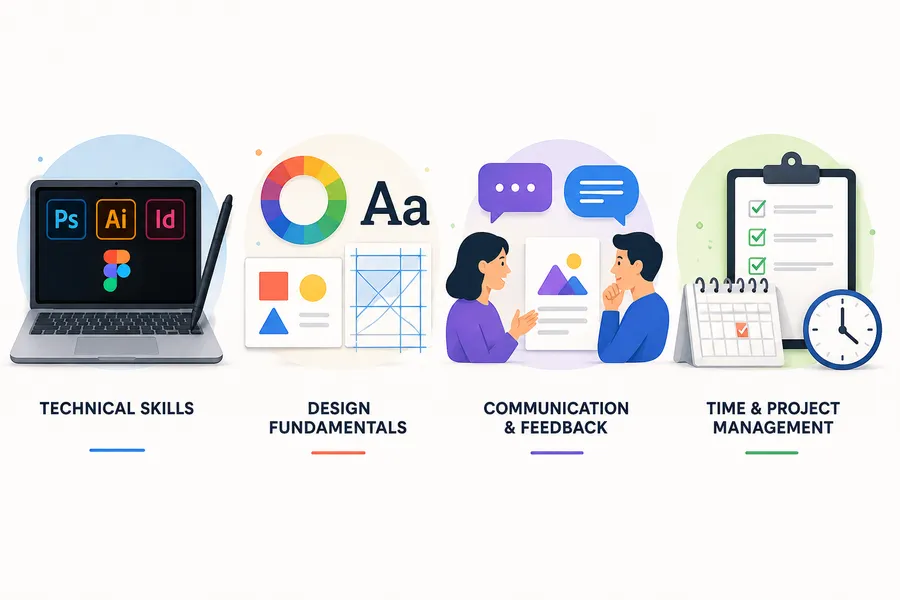
Technical skills
Fluency in Adobe Creative Cloud, particularly Photoshop, Illustrator, and InDesign, is still the baseline expectation at most companies. Figma has also become close to mandatory for anyone doing digital or product-adjacent design, since it is the standard tool for handing off designs to developers.
For practical guidance, see this guide on how to create a one-page website using Figma.
Design fundamentals
Software is replaceable. What separates a strong designer from a mediocre one is a solid grip on color theory, typography, grid systems, and visual hierarchy, the underlying principles that determine why one layout feels balanced and another feels cluttered.
Communication and feedback handling
Designers spend a surprising amount of time explaining their choices and taking notes from people who are not designers. Being able to explain why a particular font or color works for a brand, without getting defensive about feedback, is a skill that gets you rehired.
Time and project management
Most designers juggle several projects with overlapping deadlines. Learning to estimate how long a project will actually take, and communicating early when a deadline is at risk, matters as much as raw creative talent for anyone hoping to build a stable freelance business or hold down an in-house role.
How to start a career in graphic design
A career in graphic design takes a mix of creative skills, practical experience, and a strong portfolio. Here are the key steps to get started:
- Learn the fundamentals first. Before diving into software tutorials, spend time on the core principles: color, type, layout, and composition. These transfer across every design tool you will ever use.
- Pick a starter toolkit. Photoshop and Illustrator remain the industry standard for most entry-level roles, with Figma essential if you want to work on digital products.
- Build 5 to 8 focused portfolio pieces. Quality beats quantity. A tight portfolio around one or two niches, such as branding or social media design, reads as more hireable than twenty scattered pieces.
- Take on real projects early. Volunteer for a local nonprofit, redesign a friend’s small business menu, or take on a few discounted freelance gigs to get real client feedback into your portfolio.
- Decide whether a degree fits your situation. If you are aiming for in-house corporate roles or agency work, a bachelor’s degree still opens more doors. If you are freelancing or targeting startups, a strong portfolio can carry more weight than a diploma.
- Keep learning after you land your first role. Design trends, software, and client expectations shift constantly, so ongoing courses and community feedback (Dribbble, design Discord communities, or a mentor) keep your skills current.
FAQs
What education is required to be a graphic designer?
Most employers expect a bachelor’s degree in graphic design, visual communication, or a related fine arts field, though a strong portfolio combined with technical training can substitute for a degree in many freelance and startup roles. Community college certificates and associate degrees are also common for designers focused on production work rather than brand strategy.
Can you become a graphic designer without going to art school?
Yes, many working designers are self-taught or trained through online courses and bootcamps rather than traditional art school. Hiring managers generally care more about a focused, well-executed portfolio than where or how you learned the fundamentals, especially for freelance and small-agency work.
How long does it take to become a graphic designer?
A bachelor’s degree path takes about four years, while self-taught or bootcamp routes can get someone freelance-ready in six months to two years depending on how much time they put into daily practice and portfolio building.
Is graphic design a good career in 2026?
Graphic design remains a viable career, particularly for designers who branch into digital, UI-adjacent, or motion work rather than relying solely on print. Overall growth for the traditional graphic designer role is modest, but demand is shifting toward designers who can also handle web layouts, app interfaces, and short-form video content.
Conclusion
So, what is a graphic designer? Someone who turns a brand’s goals into visuals people actually respond to, whether that is a logo, a landing page, or a product package on a store shelf. The path in usually runs through either a bachelor’s degree or a focused, self-taught portfolio, and the pay reflects that range, from roughly $40,000 for a first job to well over $80,000 for senior or specialized designers. If you enjoy solving visual problems and can handle client feedback without taking it personally, it is a career with genuine room to grow, especially if you keep your skills pointed toward where design work is actually headed: digital products, not just print.
Read more: 10 Best Directory Plugin for WordPress
Contact US | ThimPress:
Website: https://thimpress.com/
Fanpage: https://www.facebook.com/ThimPress
YouTube: https://www.youtube.com/c/ThimPressDesign
Twitter (X): https://x.com/thimpress_com