
A resume can look polished and still struggle before a recruiter ever sees it.
That is because many employers use applicant tracking systems, or ATS platforms, to collect, organize, and screen applications. If your resume is difficult for those systems to interpret, important experience or skills may not be surfaced as clearly as you intended.
AI has made resume creation much faster. It can help organize experience, improve unclear wording, and turn rough career notes into a professional first draft. But an AI-generated resume still needs the right structure, relevant terminology, credible achievements, and a final human review.
The goal is not simply to create a resume quickly. It is to create one that works for both the technology screening it and the person who eventually reads it.
Here is a practical way to do that.
What does an ATS-friendly resume actually mean?
An ATS-friendly resume is structured so an applicant tracking system can reliably identify information such as your work experience, skills, education, job titles, and dates.
That usually means using recognizable section headings, straightforward formatting, and terminology that reflects the role you are applying for.
But ATS optimization is sometimes misunderstood.
It does not mean filling your resume with as many keywords as possible. It does not mean writing exclusively for software. And it certainly does not mean every resume should look identical.
A good ATS-friendly resume makes information easy to understand for both systems and people.
The best place to start is not with the template. It is with the job itself.
Step 1: Start with the job description
Before opening a resume builder or rewriting a single bullet point, read the job description carefully.
The description gives you a picture of what the employer considers important. Look for the skills, responsibilities, tools, and outcomes that appear repeatedly.
Imagine you are applying for a digital marketing role. The description may emphasize paid acquisition, campaign optimization, analytics, and reporting. Another marketing role might focus on content strategy, brand development, and partnerships.
Both jobs belong to the same broad field, but the resumes should not emphasize exactly the same experience.
The job description helps you decide which parts of your background deserve the most visibility.
This is also where keyword optimization begins. If an employer consistently uses a particular term for a skill or responsibility and that term accurately reflects your experience, using the same language can make the connection easier for both the ATS and the recruiter.
The key word is accurately. Never add a skill simply because it appears in the job description.
Step 2: Build a clear resume structure
Once you understand the role, organize the resume using sections that are easy to recognize.
Most candidates will need some variation of a professional summary, work experience, skills, education, and relevant certifications or projects.
Standard headings work well because there is little ambiguity about what each section contains.
“Work Experience” is generally clearer than something creative such as “My Professional Journey.” “Skills” is easier to interpret than “What I Bring to the Table.”
There is room for personality in a resume, but section headings are usually not where you need to express it.
Keep dates consistent, use a clear hierarchy, and make sure job titles and company names are easy to distinguish from supporting information.
Good structure benefits everyone. It helps screening systems identify information correctly and allows a recruiter to scan the document quickly.
Step 3: Turn responsibilities into achievements
One of the easiest ways to strengthen a resume is to stop describing only what you were responsible for and start showing what happened because of your work.
Consider this:
Basic
Managed customer support.
That describes the responsibility, but very little else.
A clearer version might be:
Managed customer support across email and live chat for a growing customer base.
And if you have a verified outcome:
Managed customer support across email and live chat, helping reduce average response time by 22%.
The final version gives the recruiter more evidence.
A useful structure is:
Action + task + outcome
Not every bullet needs a percentage. Outcomes might include a project completed, a process improved, time saved, customers supported, revenue influenced, an audience reached, or a new responsibility earned.
Specificity matters more than trying to make every achievement sound extraordinary.
And when AI is involved in drafting these bullets, one rule is particularly important: do not allow the tool to invent results.
If you do not know that response time fell by 22%, do not use the number.
A straightforward achievement you can defend is much stronger than an impressive statistic you cannot explain later.
Step 4: Use AI to create a stronger first draft
This is where AI can remove a lot of the repetitive work involved in resume creation.
An AI resume builder can help turn raw work history into a more structured resume, suggest clearer achievement-focused bullet points, and provide a stronger starting point for the role you are targeting.
Instead of staring at a blank page and trying to remember how to describe every position you have held, you can begin with the information you already know: your job titles, responsibilities, projects, skills, and achievements.
Quillbot’s Resume Builder can help organize that information into a clearer resume structure and refine rough descriptions into more concise, professional content.
AI is particularly useful when you know what you did but are struggling to explain it.
For example, you may start with:
Helped with onboarding new customers and answered their questions.
AI can help you recognize that the bullet needs a clearer action and more specific context. You can then improve it using information you actually know about the work.
What AI should not do is create accomplishments that never happened.
The strongest AI-assisted resume uses technology to improve presentation while keeping every underlying fact firmly grounded in the candidate’s real experience.
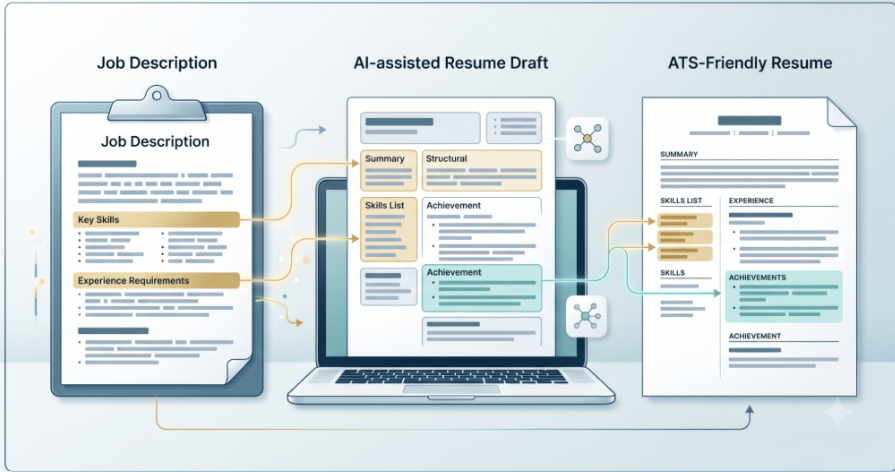
AI can speed up resume creation, but the final version still needs accurate experience, role-specific information, and an ATS-friendly structure.
Step 5: Use keywords naturally
Keywords matter because they help connect your experience to the language used in the job description.
But adding the right words is different from keyword stuffing.
Suppose a role asks for experience in project management, stakeholder communication, and Salesforce.
If you have those skills, they should appear naturally where they make sense. Salesforce might be listed in your skills section and mentioned in a bullet describing how you used it. Stakeholder communication may be demonstrated through a project where you coordinated multiple teams.
That provides context.
Simply repeating “project management” several times does not prove that you can manage a project.
Think of keywords as labels that help an employer find relevant evidence. The evidence itself still has to come from your experience.
This is another reason tailoring matters. Different employers may describe similar skills differently, and matching their terminology where appropriate can make your resume easier to interpret.
Step 6: Keep the formatting simple enough to parse
Resume design can improve readability, but more design is not always better.
Highly visual templates may look impressive, especially in creative industries, but complicated layouts can sometimes make information harder for screening systems to interpret.
Keep the hierarchy clear. Use recognizable headings, consistent spacing, standard fonts, and restrained visual elements.
Be careful with important information placed only inside graphics, decorative elements, or complex layouts. A recruiter may be able to understand what you intended immediately, while software may not interpret the design in the same way.
That does not mean your resume needs to look dull.
A clean, well-spaced document can still feel professional and distinctive. The purpose of design is to make the information easier to consume, not to compete with it.
If an employer specifies a file format, follow those instructions as well. There is little value in optimizing every detail of the resume and then submitting it in a format the application system does not expect.
Step 7: Tailor the resume before every application
An ATS-friendly resume should not become a generic resume.
Before submitting it, return to the job description and compare the employer’s priorities with what appears on your page.
Does the professional summary reflect the role you are targeting? Are the most relevant skills easy to find? Do your first few work-experience bullets show the type of experience the employer cares about most?
You usually do not need to rebuild the entire document.
Often, tailoring means adjusting the summary, moving a few achievements higher, changing the emphasis of certain bullets, and removing information that does not strengthen this particular application.
Your career history should remain consistent.
The presentation of that history can change based on relevance.
Step 8: Review the resume as both software and a human would
The final review should consider two perspectives.
First, look at the structure. Are the main sections obvious? Are relevant skills and job titles expressed clearly? Is the formatting consistent? Are important keywords connected to actual experience?
Then stop thinking about the ATS.
Read the resume as a recruiter.
Within a quick scan, can you understand what the candidate does? Is it obvious why their experience relates to this particular role? Are achievements specific enough to mean something? Does the resume contain evidence rather than only broad claims?
A resume that performs well in a screening system but communicates very little to a person has not solved the real problem.
ATS optimization helps the application reach the recruiter. Good writing gives the recruiter a reason to keep reading.
Common ATS resume mistakes to avoid
Most ATS problems come from trying to optimize too aggressively or from focusing on appearance before clarity.
A resume can become weaker when candidates copy phrases from the job description without showing where those skills were used. The same happens when every possible keyword is pushed into a skills section in the hope of improving a score.
Overdesign can create another problem. If the most important information is buried inside graphics or an unnecessarily complicated layout, the resume becomes harder to interpret.
AI introduces its own risk. Generated content can sound polished enough that candidates overlook whether a claim is actually true or whether the language accurately reflects their level of experience.
An ATS-friendly resume should be optimized, but it should still be straightforward, specific, and believable.
What should you check before submitting?
Before you send the application, take one final pass through the document.
Make sure the structure is easy to follow and that the strongest experience appears where a recruiter will notice it quickly. Check that keywords from the job description are used only where they genuinely match your background and that achievements focus on real outcomes rather than inflated language.
Pay particular attention to anything AI helped write. The wording may be stronger than your original draft, but the facts still need to be yours. Every metric, skill, project, responsibility, and result should be something you can comfortably explain if it comes up during an interview.
Finally, ask whether the resume makes sense for this specific opportunity rather than merely looking like a well-written general resume.
If the answer is yes, the optimization has probably done its job.
Build for the ATS, but write for the person
AI and applicant tracking systems have changed how resumes are created and screened, but the purpose of a resume has not changed very much.
It still needs to show an employer why a candidate may be worth speaking to.
AI can help organize experience, improve unclear wording, and reduce the effort required to create or tailor a resume. ATS-friendly structure can make that information easier for systems to identify. Neither replaces the need for relevant experience, accurate claims, and clear communication.
The strongest approach combines all three.
Use the job description to understand what matters. Use AI to make the drafting process more efficient. Keep the structure simple enough for an ATS to interpret. Then review the final version as a human would.
A successful resume does not merely make it through the system. It makes the person on the other side want to know more.