Are you struggling to decide between Push Notifications vs Email for your marketing strategy?
Many brands waste time choosing one over the other, missing out on the massive conversion potential of an omnichannel approach.
While email marketing remains the industry standard for long-form content and broad reach, push notifications have emerged as a high-precision tool for driving immediate, in-the-moment action.
The core problem isn’t which channel is “better”—it’s that they serve fundamentally different purposes in the customer journey.
If you rely solely on email, you risk missing the immediate conversion window that push notifications capture.
If you ignore email, you lose the depth and relationship-building required for long-term retention.
In this article, we compare push notifications vs email across key performance metrics, costs, and use cases.
We will help you move past the “either/or” debate and show you how to combine these channels to boost engagement, reduce your cost-per-conversion, and drive more revenue from your existing audience.
Let’s get started!
Eduma – Education WordPress Theme
We provide an amazing WordPress theme with fast and responsive designs. Let’s find out!
Push Notifications vs Email: Quick Overview
Before diving deep into the specifics, it is essential to understand the foundational differences between these two powerful communication channels.
Key Differences at a Glance
- Delivery Method: Push notifications appear directly on a user’s device lock screen or notification center. Emails are delivered to an inbox (like Gmail or Outlook), requiring the user to actively open an app to view them.
- Content Format: Push notifications are short, urgent, and heavily restricted in length (usually 40–120 characters with a small image and button). Emails support full HTML layouts, rich media, long-form copy, and extensive branding.
- Audience Reach: Email has virtually universal reach; anyone with an email address can receive one. Push notifications require the user to have your native mobile app installed and to have explicitly opted in to receive alerts.
When to Use Each Channel
Choosing between these channels depends entirely on the message you are sending.
When looking at push notifications vs email marketing, the general rule is: use email for long-form storytelling and broad reach, and use push notifications for time-sensitive, behavior-triggered alerts that require instant action.
Understanding Push Notifications
To effectively leverage mobile engagement, you must understand exactly how push alerts function and where they excel.
What Are Push Notifications?
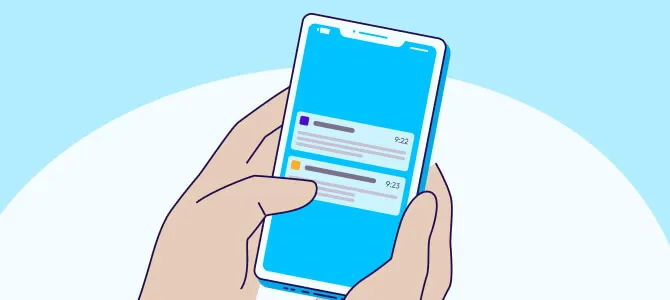
Push notifications are short, actionable messages sent from a mobile app directly to a user’s device.
They are delivered through system-level services like Apple Push Notification Service (APNs) on iOS and Firebase Cloud Messaging (FCM) on Android.
These messages appear as banners or on the lock screen, even when the user is not actively using your app.
Users must explicitly opt-in to receive them, making the audience smaller but highly qualified.
Push Notification Benefits
There are several distinct push notification benefits that make them an indispensable tool for modern brands:
- Instant Delivery and High Visibility: Because they land directly on the lock screen, they bypass spam filters entirely. Delivery rates on native apps are often above 95%, meaning nearly all of your messages are seen instantly.
- Real-Time Engagement: Push messages get faster responses due to mobile immediacy. They are unmatched for driving urgent action.
- High Conversion for Triggers: Behavior-triggered notifications (like abandoned carts or price drops) reach customers at peak intent, often converting at exceptionally high rates.
Limitations of Push Notifications
- Short Content Length: You cannot tell a long story. You have a few lines of text to convince the user to tap.
- Requires an App and Opt-In: You can only reach people who have downloaded your app and agreed to receive notifications. iOS opt-in rates hover around 44–51%, meaning half your app users may never see them.
- Risk of Overuse: Because they are so intrusive, sending too many push notifications can lead to users muting your app or uninstalling it entirely.
Understanding Email Marketing
Despite the emergence of new communication channels, email continues to serve as the foundational pillar of digital retention strategies.
What Is Email Marketing?
Email marketing involves collecting user email addresses and sending commercial messages directly to their inboxes.
It is the most established digital marketing channel, supported by powerful platforms that allow for complex automation, segmentation, and personalization.
Email Marketing Advantages
The email marketing advantages are well-documented and historically proven:
- Broad Reach: You are not restricted by device type or app installations. Your potential audience is your entire customer and prospect list.
- Rich Content Support: Email is a digital canvas. You can embed product grids, videos, high-resolution photography, and long-form copy to educate your audience.
- Strong, Proven ROI: Industry benchmarks consistently show email returning roughly $36 to $44 for every $1 spent. It is an incredibly reliable channel for generating total revenue.
Limitations of Email Marketing
- Inbox Competition and Deliverability: You are fighting for attention against hundreds of other brands. Furthermore, industry estimates put average inbox placement at roughly 80%. Between spam filters and promotions tabs, 1 in 5 emails may never reach the primary inbox.
- Lower Immediate Engagement: Email is asynchronous. People read emails on their own schedule, making it a poor choice for flash sales that end in an hour.
- Email Fatigue: Workers receive over 100 emails daily, and 81% of consumers report unsubscribing from brands that over-communicate.
Push Notifications vs Email: Key Performance Metrics
Data reveals exactly how customers interact differently with their inboxes compared to their mobile lock screens.
Open Rates and Visibility
Push notifications are seen instantly on a device, giving them near-total visibility. Emails, on the other hand, depend on users opening them, with average open rates typically around 20–30%.
Click-Through Rates (CTR)
When analyzing email marketing vs push notifications, push notifications often achieve higher click-through rates for short, targeted messages. Emails usually have lower CTR but can drive more total engagement due to their broader reach.
Conversion and ROI
Email drives the majority of direct messaging revenue because it reaches a massive audience. It is a volume game with a high overall ROI.
Push notifications generate a smaller total volume of revenue, but they boast a vastly superior per-message efficiency. Push drives immediate, high-converting actions from your most loyal VIP customers.
Cost Comparison: Push Notifications vs Email
Budget allocation is a primary concern for marketing teams deciding where to focus their efforts.
Push Notification Costs
The fundamental advantage of native push notifications is that the marginal cost per message is exactly zero. Services like APNs and FCM are free. While you may pay a flat monthly fee for a third-party management platform, you do not pay per message. Whether you send 10,000 or 1,000,000 notifications to your app users, your cost remains the same.
The primary investment is in building and maintaining the mobile app itself.
Email Marketing Costs
Email marketing costs scale linearly with your success. Email Service Providers (ESPs) or mass texting services charge based on contact volume and send limits. As your subscriber list grows from 10,000 to 100,000, your monthly software costs will increase significantly.
Which Is More Cost-Effective?
Both channels are highly cost-effective compared to paid advertising.
Email requires ongoing scaling costs but delivers massive total revenue.
Push requires an upfront investment (an app) but becomes incredibly cost-efficient at scale due to its zero per-message cost.
Best Use Cases for Each Channel
To maximize your marketing efforts, you must align the channel with the intent of the message.
When to Use Push Notifications
- Flash Sales and Time-Sensitive Promos: When a sale lasts only 24 hours, push gets the message in front of customers instantly.
- Cart Abandonment: A push notification landing on a lock screen minutes after a user leaves their cart can recover up to 20% of abandoned checkouts.
- Real-Time Updates: Transactional alerts, order out-for-delivery notifications, or location-based geofenced offers.
- Back-in-Stock Alerts: Reaching customers exactly when a highly desired item becomes available again.
When to Use Email Marketing
- Newsletters and Content: Long-form storytelling, brand updates, and educational sequences.
- Product Launches and Collections: Showcasing multiple new arrivals with high-quality photography and detailed descriptions.
- Customer Nurturing: Welcome series, onboarding drip campaigns, and post-purchase follow-ups that users may want to search for later.
- Broad-Reach Promotions: Major holiday sales intended to reach your entire historical customer database.
Combining Push Notifications and Email for Better Results
The most sophisticated brands do not view this as a competition. They utilize an omnichannel strategy.
Omnichannel Strategy
Brands running both channels in an omnichannel setup consistently outperform those relying on email alone.
Relying solely on email leaves a gap in your marketing stack for instant, high-urgency communication.
Using both ensures you cater to different user preferences, bypass the limitations of spam filters, and guide the customer smoothly from discovery to purchase.
Example Workflow
Think of email as the brochure and push as the tap on the shoulder.
- For an Event/Sale: Send an email two days prior with the full catalog, stunning visuals, and sale details. Send a push notification one hour before the sale ends to drive the final conversions.
- For Abandoned Carts: Send a push notification 30 minutes after abandonment to catch the user while they are still on their phone. If they don’t convert, follow up 24 hours later with an email containing a visual summary of the cart and a discount code.
Common Mistakes to Avoid
Even the best channels fail if executed poorly. Avoid these common pitfalls to protect your audience engagement.
Overusing Push Notifications
Because push is so intrusive, fatigue sets in fast. Research shows that sending more than 5 push notifications per week can cause up to 64% of users to stop using or uninstall your app. Reserve push for truly valuable, urgent updates.
Sending Too Many Emails
Inbox fatigue is real. If you blast your entire list daily with irrelevant offers, your open rates will plummet, your spam complaints will rise, and your deliverability will suffer. Focus on quality and segmentation over sheer volume.
Lack of Personalization
Generic blasts perform poorly on both channels. Tailored messages perform up to 4x better. Use customer data to send personalized recommendations, acknowledge loyalty tiers, and trigger messages based on exact browsing behavior.
FAQs: Push Notifications vs Email
Are push notifications more effective than email?
It depends on the metric. Email drives more total revenue because it reaches a larger audience and supports richer content. However, push notifications have higher per-message efficiency and vastly superior conversion rates for behavior-triggered alerts like abandoned carts.
Do push notifications replace email marketing?
No, they complement each other. Email provides universal reach and long-form storytelling. Push reaches a smaller, higher-value audience with immediate, zero-cost messages. The best marketing stacks require both.
Which channel has better ROI?
Email has the highest proven, long-term overall ROI (often 36:1) due to its massive reach. Push notifications, however, offer an incredible short-term ROI on triggered events because they cost absolutely nothing per send once your app is established.
Can I use push notifications and email together?
Yes. In fact, a coordinated omnichannel strategy is highly recommended. Use email to build awareness, educate, and nurture relationships, while deploying push notifications to create urgency and drive immediate conversions.
Conclusion
When analyzing Push Notifications vs Email, it becomes clear that searching for a single “winner” is the wrong approach.
Email remains the undisputed workhorse of digital marketing. It provides the broadest reach, allows for the richest content, and reliably generates the highest total revenue.
Push notifications serve as your precision tool. They offer immediate lock-screen visibility, carry zero per-message costs, and boast the highest conversion rates of any triggered messaging channel.
The most successful brands do not choose between them; they integrate them. By using email to nurture relationships and push notifications to drive urgent conversions, you create a robust, omnichannel customer journey that maximizes both immediate sales and long-term loyalty.
Turn your website into an app, build your email list, and let both channels do what they do best.
Read more: A Guide to The 14 Best Email Marketing Platforms
Contact US | ThimPress:
Website: https://thimpress.com/
Fanpage: https://www.facebook.com/ThimPress
YouTube: https://www.youtube.com/c/ThimPressDesign
Twitter (X): https://x.com/thimpress_com