Building a website is the easy part. The real challenge shows up the moment you publish it and realize nobody’s visiting. If you’ve been searching for how to promote your website without wasting time or budget on tactics that don’t move the needle, you’re in the right place.
This guide walks through the channels that actually work in 2026, from organic search to paid ads to email, and shows you how to combine them into a plan you can run without a marketing team.
Let’s get started!
Eduma – Education WordPress Theme
We provide an amazing WordPress theme with fast and responsive designs. Let’s find out!
Why website promotion matters more in 2026
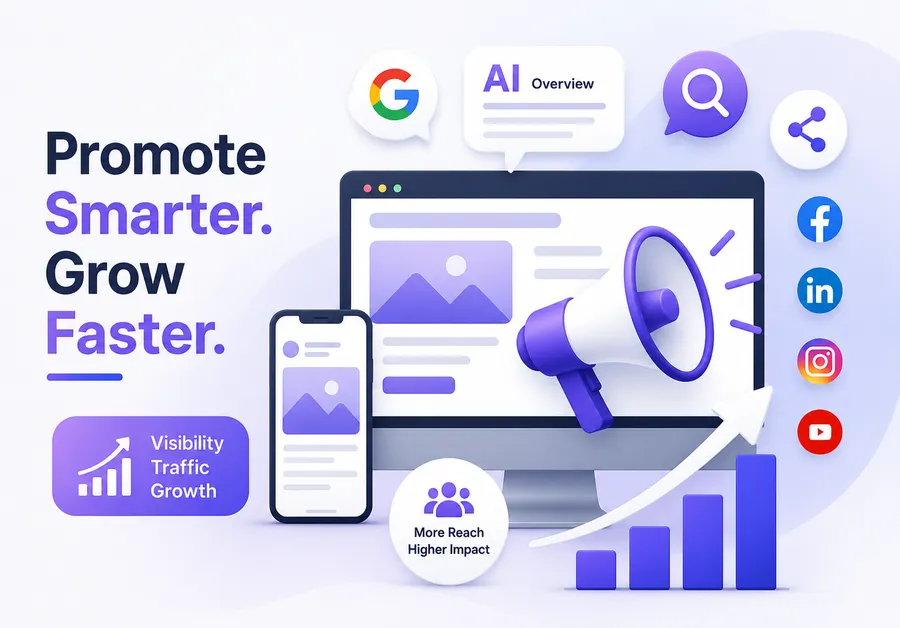
Publishing content and waiting for Google to notice used to work. It doesn’t anymore. Search results now surface AI-generated summaries before a single blue link appears, and competition for attention has spread across a dozen platforms instead of two or three.
Organic search still accounts for roughly half of all website traffic, and it remains the highest-converting channel available to most businesses, with over 53% of all website traffic coming from organic search, confirming that SEO is the most effective channel for online visibility and engagement.
That’s good news if you’re willing to put in the work, but it also means you’re competing against every other site chasing the same audience. Mobile plays a growing role in that equation too, since as of early 2025, over 62% of all web traffic was accessed through mobile phones. If your promotion strategy doesn’t account for how people actually browse today, you’re leaving traffic on the table before you’ve even started.
Build a foundation that’s ready for traffic
Before you spend a single dollar or hour on promotion, make sure the site itself can handle and convert the visitors you’re about to send it. A slow, cluttered, or poorly structured site wastes every click you earn.
Start with your theme and page speed. A bloated page builder with unused animation scripts will tank your Core Web Vitals scores before you ever run a campaign. Check your Largest Contentful Paint and Cumulative Layout Shift in Google PageSpeed Insights, and aim for an LCP under 2.5 seconds.
If you’re on WordPress, go to Appearance > Themes and confirm you’re not running a theme loaded with features you never use, since each one adds render-blocking CSS and JavaScript that slows the page down.

If your site is built around online courses or a membership model, the theme matters even more, since it has to handle content delivery, quizzes, and payment flows without breaking. ThimPress’s Eduma theme is built specifically for this use case, with native LearnPress integration, a clean course builder, and templates already optimized for enrollment and completion rates, so you’re not stitching together a dozen plugins just to sell a course.
Once your foundation is solid, install an SEO plugin like Rank Math or Yoast, connect Google Search Console, and set up Google Analytics or Site Kit so you can actually see where your traffic comes from once the promotion work starts paying off.
How to get organic traffic to your website through SEO
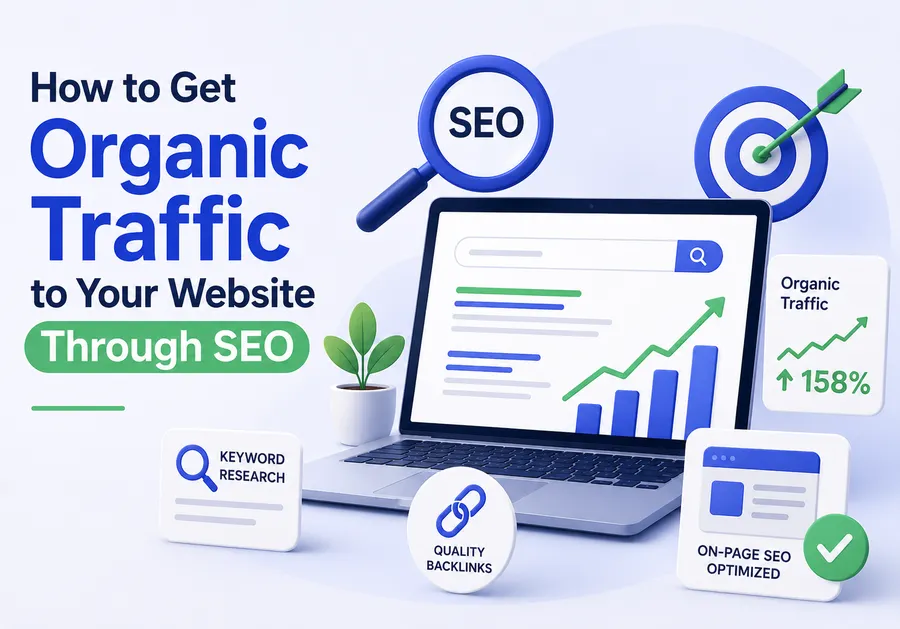
SEO is still the closest thing to compounding interest in marketing. Content you publish today can keep bringing in visitors two or three years from now, long after a paid ad or a social post has disappeared from anyone’s feed.
Start with keyword research that reflects real searches
Open Google Search Console or a keyword tool and look for phrases your audience actually types, not the words you assume they use. A local bakery owner searching for “how to promote my site” is thinking about the same problem as an ecommerce founder, but the content that answers each of them looks different. Group keywords by intent: informational searches want a guide, commercial searches want a comparison, and transactional searches want a clear path to buy or sign up.
Fix on-page SEO basics before chasing new content
Every page needs a unique title tag, a meta description under 160 characters, and one clear H1. Use your target keyword naturally in the first 100 words, in at least one subheading, and in your image alt text. Internal linking matters more than most site owners realize: linking a new blog post back to a relevant product or service page passes authority and keeps visitors moving through your site instead of bouncing after one page. The average bounce rate on pages reached through organic search sits close to 47%, since the average bounce rate for websites reached by organic search is 46.9%, which is a strong argument for tightening your internal links and making the next step obvious.
Earn backlinks and authority signals
Google still weighs backlinks heavily when deciding who ranks. Reach out to sites in your niche with a specific pitch, not a generic “check out my site” email. Offer a genuinely useful resource, a data point from your own testing, or a guest post that adds something the site doesn’t already have. Quality beats quantity here. Ten links from relevant, trafficked sites outperform a hundred links from directories nobody reads.
How to promote your website on social media
Social media won’t replace SEO, but it’s often the fastest way to get your first hundred visitors while your organic rankings build in the background.
Pick the platform where your audience already spends time
Don’t try to run five platforms at once with a two-person team. If you sell a visual product, Instagram and Pinterest will outperform LinkedIn every time. If you’re B2B, LinkedIn and niche communities on Reddit or Slack will beat TikTok. Pick one or two platforms, post consistently, and only expand once the first one is working.
Repurpose content instead of starting from scratch every time
A single blog post can become a carousel, three short-form videos, a thread, and a newsletter section. This is how small teams promote a business without burning out. Write the long-form piece once, then break it into platform-native formats that point back to the original page.
Engage before you promote
Algorithms across every major platform now favor accounts that engage in conversations, not just accounts that post links. Spend time commenting on relevant posts in your niche before you ever ask for a click. It builds the trust that makes people actually visit when you do share your site.
How to advertise a site with paid campaigns
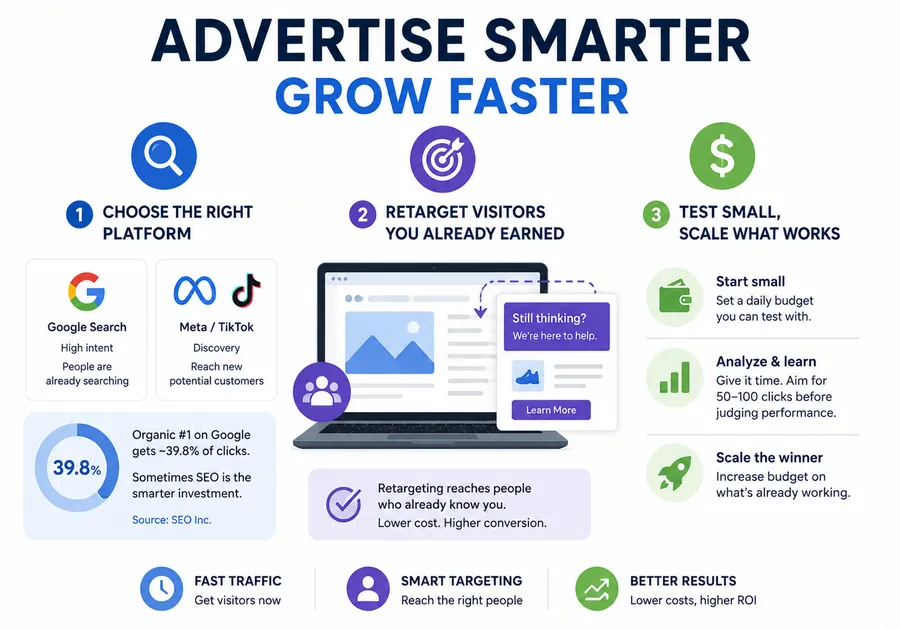
Paid advertising is the fastest lever you have, and it’s the right call when you need traffic now instead of in six months.
Choose the ad platform that matches intent
Google Search ads capture people who are already looking for what you offer, which makes them the highest-intent option when you know how to advertise a site with a tight budget. Meta and TikTok ads work better for discovery, putting your product in front of people who weren’t searching but fit your target profile. The organic top result on Google still earns close to 40% of clicks, with an estimated click-through rate around 39.8% for the first position, which is worth remembering before you assume a paid ad is always the better spend. Sometimes the smarter move is investing that budget into ranking organically for your highest-intent keyword instead.
Retarget the visitors you already earned
Most first-time visitors won’t convert on the first visit. Set up a retargeting pixel through Google Ads or Meta and build a simple campaign that follows up with anyone who visited your site but didn’t take action. Retargeting campaigns typically cost less per click than cold campaigns because you’re speaking to an audience that already knows who you are.
Set a budget you can actually test with
Start small. Run a campaign for a week with a modest daily budget, check which ad copy and audience combination performs, then scale the winner. Don’t judge a campaign on day one. Give the algorithm enough data, usually 50 to 100 clicks, before you decide whether it’s working.
Email marketing to promote your business
Email doesn’t get the attention social media gets, but it consistently delivers the best return of any channel available to small and mid-sized businesses.
Every industry benchmark points the same direction here. Email marketing returns roughly $36 for every dollar spent on average, delivering an average ROI of 36 times, or $36 in revenue for every $1 spent, which puts it well ahead of most paid channels once you account for cost per acquisition. Build your list with a specific lead magnet, not a generic “subscribe to our newsletter” box. A checklist, template, or short course tied to what your visitor was already looking for converts far better than a vague signup form.
Once someone’s on your list, send a welcome sequence that delivers value before you ever ask for a sale. Segment your list by behavior, not just by when someone signed up, and send fewer, better emails instead of blasting your entire list weekly. If you’re on WordPress, plugins like MailPoet or Fluent CRM let you manage this without leaving your dashboard.
Local and community promotion tactics
If your business serves a specific area, local promotion often outperforms broad digital campaigns for the same budget.
Claim and fully complete your Google Business Profile, including photos, hours, and a description that uses the same language your customers would search for. Ask happy customers for reviews directly after a purchase or service, since review volume and recency both influence local rankings. Join local Facebook groups, Nextdoor, or industry-specific forums where your audience already asks for recommendations, and answer questions there without immediately pitching your site. Trust built in a community translates directly into visits when you do mention what you do.
Guest posting, PR, and backlink outreach
Getting featured on someone else’s platform puts your site in front of an audience you haven’t built yet.
Look for smaller, relevant blogs and podcasts first rather than chasing major publications right away. A guest post on a niche site with 5,000 engaged monthly readers often sends more qualified traffic than a passing mention on a huge site with a broad, unrelated audience. Pitch a specific angle, not a generic “can I write for you” email. A reliable guest post provider can also help identify relevant sites and coordinate outreach. Editors respond to writers who’ve clearly read their site and understand what their readers care about.
Digital PR works the same way. If you have first-party data, a survey, or a case study with real numbers, journalists and bloggers are far more likely to link to it than to a generic opinion piece.
Comparing promotion channels
Every channel has a different cost, speed, and skill requirement. Use this table to decide where to start based on your budget and timeline.
| Channel | Speed to results | Typical cost | Best for |
|---|---|---|---|
| SEO / organic content | 3 to 12 months | Low cash, high time | Long-term, compounding traffic |
| Paid search ads | Days | Medium to high | Immediate, high-intent traffic |
| Social media organic | Weeks to months | Low cash, high time | Brand awareness, community building |
| Paid social ads | Days | Medium | Discovery, retargeting |
| Email marketing | Weeks | Low | Repeat visitors, highest ROI |
| Guest posting / PR | 1 to 3 months | Low cash, high effort | Backlinks, credibility |
| Local / community | Weeks | Low | Location-based businesses |
How to measure whether it’s working
Promotion without measurement is just guessing with extra steps. Connect Google Search Console to track which keywords bring in impressions and clicks, and check Google Analytics to see which channel actually converts visitors into leads or sales, not just which one sends the most traffic.
Watch three numbers closely: organic traffic growth month over month, conversion rate by channel, and cost per acquisition for anything paid. A channel that sends a thousand visitors who never convert is worth less than a channel that sends a hundred visitors and closes ten sales. Give each new tactic at least a month before deciding whether to keep it, since SEO and social both take time to show their real impact.
Quick action checklist
- Confirm your site loads in under 2.5 seconds and is mobile-friendly
- Set up Google Search Console and Analytics before you promote anything
- Publish content around the specific keywords your audience searches
- Pick one or two social platforms and post consistently
- Build a lead magnet and start collecting email addresses
- Test a small paid ad campaign with a retargeting pixel
- Claim your Google Business Profile if you serve a local area
- Pitch three relevant sites for a guest post or backlink this month
FAQs About How to Promote Your Website
How long does it take to see results from promoting a website?
Paid ads can bring visitors within days, but organic strategies like SEO and content marketing typically need three to six months before you see meaningful traffic growth. Consistency matters more than speed here, since search engines reward sites that publish reliably over time rather than in bursts.
What’s the cheapest way to promote a website with no budget?
Organic social media, community engagement in relevant forums or Facebook groups, and on-page SEO cost nothing but time. Focus on answering real questions your audience is searching for and sharing that content where they already spend time, since this builds momentum without any ad spend.
Do I need to be on every social media platform to promote my business?
No. Spreading effort across five platforms usually produces worse results than doing one or two platforms well. Pick the platform where your specific audience is most active and post consistently there before expanding.
How do I know if my website promotion strategy is actually working?
Track organic traffic growth, conversion rate by channel, and cost per acquisition for any paid campaigns, using Google Analytics and Search Console. If a channel isn’t producing leads or sales after a fair testing period, usually four to six weeks, it’s worth reallocating that time or budget elsewhere.
Conclusion
There’s no single trick that makes a website take off overnight. Real growth comes from stacking a few channels that work well together: solid SEO that compounds over time, social content that builds trust, email that keeps visitors coming back, and paid ads that fill the gaps while the organic work catches up. Start with one or two channels from this guide, measure what’s actually converting, and expand from there. The businesses that win at promoting their website aren’t the ones doing the most, they’re the ones doing a few things consistently and paying attention to what the data tells them.
Read more: TOP 5 Website To Find WordPress Coupon Codes & Deals
Contact US | ThimPress:
Website: https://thimpress.com/
Fanpage: https://www.facebook.com/ThimPress
YouTube: https://www.youtube.com/c/ThimPressDesign
Twitter (X): https://x.com/thimpress_com