Are you struggling to decide between Magento Commerce vs. Adobe Commerce for your next big e-commerce project?
Selecting the right foundational platform is one of the most critical decisions a business can make in today’s competitive landscape.
For years, Magento has stood as a dominant force in the online retail space, but following its acquisition by Adobe, the platform evolved into distinct editions tailored to different business sizes.
Understanding the technical, financial, and operational distinctions between these versions is essential for long-term success.
This comprehensive guide will dissect the core differences to help you make an informed, strategic decision for your digital storefront.
Claue – Clean and Minimal Magento Theme
We provide an amazing Magento theme with fast and responsive designs. Let’s find out!
Understanding the Core Platforms: Magento Commerce vs. Adobe Commerce
Before diving into a direct comparison, it is important to define the individual tools and what they bring to the table. Each edition targets a specific segment of the e-commerce market.
An Overview of Magento Open Source
Formerly known as Magento Community Edition (CE), Magento Open Source is a free, downloadable platform that provides a robust foundation for online stores.
It is highly favored by small to medium-sized businesses due to its massive flexibility.
Because the code is completely accessible, developers can customize virtually every aspect of the shopping experience.
However, this flexibility requires technical expertise. You are entirely responsible for hosting, security, and maintenance.
When analyzing Magento Open Source vs Adobe Commerce, it is vital to remember that the open-source iteration relies heavily on third-party Magento extensions and community forums for advanced functionality and troubleshooting, rather than dedicated corporate support.
An Overview of Adobe Commerce
Adobe Commerce represents the premium, enterprise-grade tier of the ecosystem.
It is divided into two primary deployment methods: Commerce (On-Premise) and Commerce on Cloud.
Both versions require a paid license but deliver a wealth of out-of-the-box features designed for large-scale operations, including native B2B functionality, advanced business intelligence dashboards, and comprehensive customer management tools.
When evaluating Adobe Commerce Cloud vs Magento Open Source, the most notable differentiator is the managed cloud infrastructure.
The cloud edition is hosted on Amazon Web Services (AWS), providing guaranteed high availability, automated scalability during traffic spikes, and enhanced security protocols overseen directly by Adobe’s technical teams.
Magento Open Source vs. Adobe Commerce: Comparison Table
| Feature | Magento Open Source | Adobe Commerce |
|---|---|---|
| Pricing | Free to download and use | Paid license (≈ $22,000+/year); Cloud ≈ $40,000+/year |
| Best For | Small to mid-sized businesses | Enterprises & fast-growing businesses |
| Hosting | Self-hosted (choose your own provider) | Self-hosted or Cloud (AWS included) |
| Scalability | Limited (single database) | High scalability (multiple databases) |
| Built-in Features | Core eCommerce functionality | Advanced B2B, BI dashboards, promotions |
| B2B Functionality | Requires extensions | Built-in B2B suite |
| Search & Merchandising | Basic search | Live Search with AI-powered results |
| AI & Personalization | Not included by default | Adobe Sensei & Adobe Target integration |
| Security | Basic security; not PCI-compliant by default | PCI-compliant, WAF, DDoS, CDN, encryption |
| SEO Capabilities | Strong SEO basics + extensions | Advanced SEO & merchandising tools |
| Multi-Store Support | Yes (with limits) | Yes (optimized for large catalogs) |
| Maintenance Cost | Lower license cost, higher dev & hosting costs | Higher license cost, lower operational overhead |
| Support | Community-based support | 24/7 Adobe enterprise support |
| Upgrade & Updates | Manual upgrades | Managed updates (Cloud edition) |
| Time to Market | Slower for complex stores | Faster for enterprise deployments |
In-Depth Comparison: Magento Commerce vs. Adobe Commerce
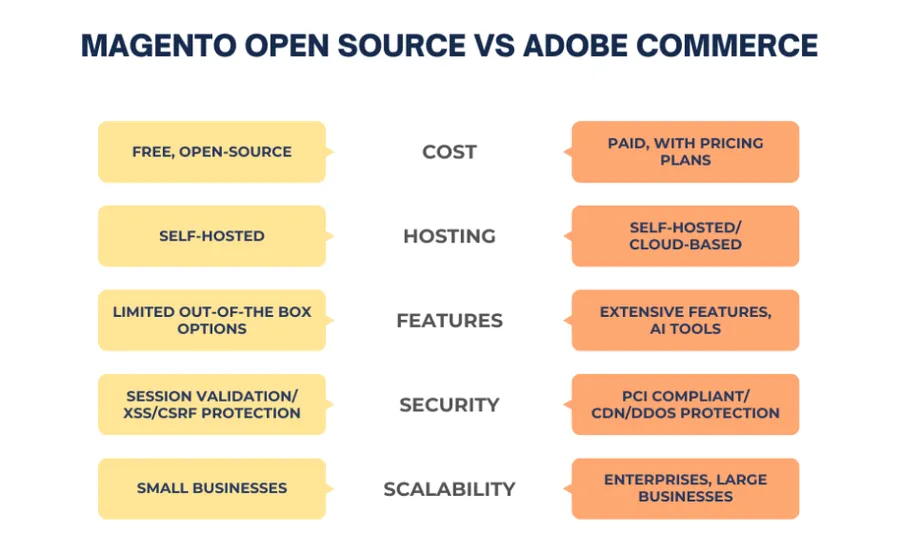
To make the right choice, businesses must evaluate how each platform aligns with their specific operational needs.
Below is a detailed breakdown of the critical factors in the Magento Commerce vs. Adobe Commerce debate.
Pricing and Total Cost of Ownership
Financial investment is often the deciding factor for many merchants.
- Magento Open Source: The software itself is free to download and use. However, “free” does not mean zero cost. Businesses must budget for self-managed hosting, SSL certificates, premium third-party extensions, and the developer hours required to build and maintain the site.
- Adobe Commerce: This is a premium investment. Annual licensing fees generally start around $22,000 for the on-premise version and $40,000 for the cloud edition. Pricing is dynamically tiered based on your store’s Gross Merchandise Value (GMV). While the upfront cost is significant in any Magento Commerce vs. Adobe Commerce comparison, the built-in features often eliminate the need to purchase dozens of separate extensions, effectively balancing the total cost of ownership for high-revenue enterprises.
Hosting Options and Infrastructure
Your hosting environment dictates your store’s speed, reliability, and security.
- Magento Open Source: You must procure your own hosting environment. Whether you choose shared hosting, a Virtual Private Server (VPS), or a dedicated server, your internal team or a contracted agency is responsible for server maintenance and optimization.
- Adobe Commerce: While you can choose to self-host the on-premise version, the cloud edition offers a fully managed AWS environment. A major advantage of Adobe Commerce Cloud vs Magento Open Source is that Adobe handles server-side monitoring, performance optimization, and infrastructure scaling, freeing your IT team to focus on front-end development.
Scalability and Performance
As your business grows, your platform must handle increased traffic and larger product catalogs without slowing down.
- Magento Open Source: This edition utilizes a single database structure. While suitable for smaller catalogs, high-traffic events or massive product databases can cause bottlenecks, requiring complex architectural workarounds to maintain page speed.
- Adobe Commerce: Built specifically for rapid growth, it utilizes a split-database architecture. It provides three separate databases to manage checkout, orders, and product data independently. This makes Adobe Commerce vs Magento Open Source a clear winner for high-volume merchants, as it prevents backend administrative tasks from slowing down the frontend customer experience.
Advanced Features and Built-in Tools
Out-of-the-box functionality dictates how quickly you can deploy advanced marketing and sales strategies.
- Magento Open Source: Provides excellent core features, including mobile optimization, integrated site search, and multi-language support. However, advanced functionalities require the integration of third-party plugins. Therefore, analyzing Magento Open Source vs Adobe Commerce means weighing the cost of buying extensions against paying a flat licensing fee.
- Adobe Commerce: Comes fully loaded with enterprise tools. It features a comprehensive B2B suite (company accounts, shared catalogs, quoting), advanced marketing tools, and customer segmentation. Furthermore, Adobe Sensei, an AI tool, integrates directly to offer advanced product recommendations and personalized live search.
Security and Compliance Standards
Protecting customer data is non-negotiable in e-commerce.
- Magento Open Source: This platform relies on community patches and developer diligence. Crucially, the free version is not Payment Card Industry (PCI) compliant by default. You are entirely responsible for achieving and maintaining compliance, which can be an expensive and time-consuming process.
- Adobe Commerce: Offers a robust suite of security features. The comparison of Adobe Commerce vs Magento Open Source heavily favors the premium edition due to its out-of-the-box PCI compliance. Additionally, it provides built-in Web Application Firewalls (WAF), Distributed Denial of Service (DDoS) protection, Fastly Content Delivery Network (CDN), and 24/7 technical support.
Market Context: Adobe Magento vs Salesforce Commerce Cloud
When organizations reach an enterprise scale, the platform comparison frequently expands beyond Adobe’s ecosystem.
A common analytical point for large organizations is evaluating Adobe Magento vs Salesforce Commerce Cloud.
Salesforce provides a formidable Software-as-a-Service (SaaS) solution with seamless CRM integration, but Adobe Commerce excels in deep customization, open architecture, and native integrations with Adobe’s broader Experience Cloud suite.
Selecting between the two often comes down to whether a company prioritizes a closed-ecosystem SaaS model (Salesforce) or a highly customizable Platform-as-a-Service model (Adobe Commerce).
Adobe Commerce vs Magento: Which One Should You Choose?
Deciding on Adobe Commerce vs Magento Open Source depends entirely on your business model, technical resources, and growth trajectory.
- Choose Magento Open Source if you are a small to medium-sized business with an experienced internal development team or a strong agency partnership. It is ideal for those who need complete control over customization and have the technical acumen to manage hosting and security without a high initial licensing fee.
- Choose Adobe Commerce if you are a fast-growing, high-volume enterprise that requires a scalable infrastructure, built-in B2B functionality, PCI compliance, and 24/7 dedicated support. It is the logical progression for businesses whose technical debt and hosting costs are beginning to outweigh the licensing fees of a premium platform.
FAQs About Magento Commerce vs. Adobe Commerce
What is the primary difference between Magento Open Source vs Adobe Commerce?
The main difference is cost, support, and out-of-the-box features. Magento Open Source is a free, self-hosted platform requiring significant technical expertise to manage. Adobe Commerce is a premium, paid solution offering enterprise-level features, B2B capabilities, dedicated support, and managed cloud hosting options.
Are Magento and Adobe Commerce the same thing?
Yes, they originate from the same core platform. Adobe acquired Magento in 2018. The free version was rebranded as Magento Open Source, while the paid, enterprise versions were rebranded under the Adobe Commerce umbrella.
How does Adobe Commerce Cloud vs Magento on-premise differ?
Adobe Commerce Cloud includes the same enterprise features as the on-premise version but adds a fully managed, AWS-based hosting environment. This means Adobe handles infrastructure security, performance optimization, and scaling, whereas the on-premise version requires you to manage your own servers.
Is Magento Open Source PCI compliant?
No, Magento Open Source is not inherently PCI compliant. While you can build a compliant store using it, you are responsible for securing the servers, implementing data encryption, and passing the required compliance audits. Adobe Commerce, conversely, provides PCI compliance out-of-the-box.
Conclusion
Evaluating Magento Commerce vs. Adobe Commerce is a fundamental step in building a scalable, secure, and profitable online business.
The open-source version provides unmatched flexibility and community support for businesses with the technical capability to manage it.
In contrast, the premium Adobe editions deliver the performance, security, and advanced feature sets required by modern enterprises to dominate their respective markets.
By carefully analyzing your current budget, required features, and future growth goals, you can select the platform that best positions your business for long-term success.
Read more: Shopify vs Magento: Which Ecommerce Platform Fits Your Business Best?
Contact US | ThimPress:
Website: https://thimpress.com/
Fanpage: https://www.facebook.com/ThimPress
YouTube: https://www.youtube.com/c/ThimPressDesign
Twitter (X): https://x.com/thimpress_com