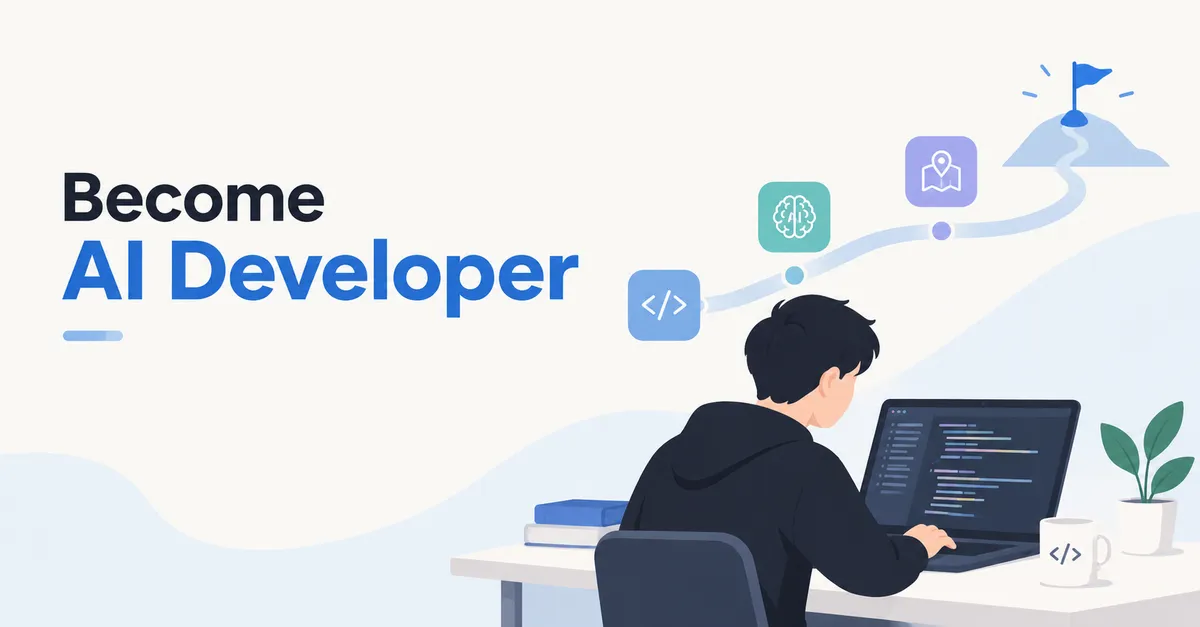
Want to know how to become AI developer and what skills actually matter?
The become AI developer guide is not simply learning how to use ChatGPT or memorizing a list of AI tools. Becoming an AI developer requires a combination of programming, machine learning, data handling, and AI development skills.
For developers who already know how to build applications, the transition can be more practical than expected. The main step is adding machine learning knowledge and learning how to use AI at work more effectively.
Eduma – Education WordPress Theme
We provide an amazing WordPress theme with fast and responsive designs. Let’s find out!
What Does an AI Developer Do?
AI development involves designing, building, integrating, deploying, and maintaining systems that use machine learning or other AI techniques to solve practical problems.
Traditional software generally follows clearly defined rules. AI systems can produce outputs based on patterns learned from data, which means their behavior can require testing, evaluation, monitoring, and repeated improvement.
An AI developer often works between software engineering and machine learning. Data scientists may concentrate on research, experimentation, and model development, while AI-focused developers are often responsible for bringing those capabilities into working software.
A typical project include:
- Defining the problem and success criteria
- Collecting and preparing data
- Selecting and training models
- Testing model performance
- Integrating models with applications and APIs
- Deploying systems to production
- Monitoring behavior and updating models when necessary
This broader scope is a key reason an effective AI developer roadmap should include both AI knowledge and solid software engineering skills.
Become AI Developer Guide: Core Skills to Build
A strong foundation makes the rest of the learning process easier. The best approach is to build skills in stages rather than attempting to master every AI technology at once.
1. Learn Python and Programming Fundamentals
Python is one of the most important languages in AI development and is widely used for data processing, machine learning, and AI applications.
A developer should be comfortable with:
- Variables, functions, loops, and data structures
- Object-oriented programming
- Error handling and debugging
- Writing modular and maintainable code
- Performance analysis and optimization
Libraries such as NumPy, Pandas, and Scikit-learn provide practical building blocks for data manipulation and machine learning.
SQL is also useful because AI systems often depend on structured data stored in databases. Understanding how to query, transform, and organize data is therefore an important part of the machine learning engineer requirements many technical roles expect.
2. Understand Data Before Models
Machine learning depends heavily on data quality. A powerful algorithm cannot compensate for incomplete, inconsistent, or poorly prepared data.
Data preparation may include:
- Collecting relevant data
- Cleaning incorrect or missing values
- Organizing data into usable formats
- Selecting useful features
- Splitting data for training and evaluation
- Creating repeatable data pipelines
This stage can take a substantial amount of project effort because real-world data is rarely perfect.
A useful AI roadmap should therefore place data preparation before advanced model development. Skipping this stage often creates problems that appear later during testing or production.
3. Build Machine Learning Knowledge
The next step is understanding how models are trained, evaluated, and improved.
Core concepts include:
- Supervised and unsupervised learning
- Feature engineering
- Model training
- Validation and testing
- Hyperparameter tuning
- Model performance measurement
- Reproducibility and version control
Developers should also understand that model quality is not always represented by a single accuracy score. Robustness, fairness, reliability, and production performance may also matter.
The machine learning engineer requirements for a role may be more focused on algorithms and mathematical concepts, while an AI developer may spend more time integrating models into applications. There is overlap, but the emphasis can differ.
AI Developer Roadmap: From Developer to AI Specialist
A practical AI developer roadmap does not require learning everything at the same time. A staged process is easier to follow and gives each new skill a clear purpose.
Stage 1: Strengthen Software Engineering
Start with programming fundamentals, Git, testing, APIs, databases, and clean code.
These skills remain valuable even when the underlying technology changes. AI systems still need maintainable code, clear architecture, documentation, and reliable deployment processes.
Stage 2: Add Machine Learning
Learn the basic machine learning workflow:
Data → Preparation → Training → Validation → Deployment → Monitoring
At this stage, focus on understanding why each step exists instead of collecting a large number of disconnected tutorials.
Stage 3: Learn AI Frameworks
Once the fundamentals are clear, move into commonly used frameworks and platforms.
TensorFlow provides tools for developing and deploying machine learning systems, while PyTorch is widely used for experimentation and flexible model development.
Hugging Face provides access to pretrained models and tools for tasks such as text classification, translation, and question answering.
For applications built around large language models, LangChain can help organize common application workflows and model interactions.
The important point is not to memorize every feature in every framework. A better goal is to understand how the tools fit into a complete application.
Stage 4: Learn Deployment and MLOps
A model that only works in a notebook is not enough for many real-world applications.
AI developers should learn how to package and deploy models using technologies such as Docker and Kubernetes. Cloud platforms can also help with scalable machine learning workflows.
Monitoring is equally important. Model performance can change when real-world data changes. This can lead to issues such as data drift and declining performance.
That is why a modern AI engineer roadmap should include:
- Containerization
- Cloud infrastructure
- Automated deployment
- Model monitoring
- Experiment tracking
- Model versioning
- Retraining workflows
AI Engineer Roadmap: What Software Developers Need Next
Software developers often already have several skills needed for AI engineering. The main gap is usually machine learning and data rather than programming itself.
A practical AI engineer roadmap can be divided into five areas.
Programming
Python, SQL, object-oriented programming, debugging, and performance tuning form the technical base.
Machine Learning
The next layer includes data preprocessing, feature engineering, model training, evaluation, and tuning.
Production Engineering
AI systems need testing, version control, CI/CD, documentation, APIs, and scalable architecture.
Infrastructure
Developers should gain working knowledge of containers, cloud services, orchestration, and monitoring.
Communication
AI projects involve more than code. Developers may need to explain technical limitations, discuss requirements, and work with product managers, data scientists, and business teams.
Communication is especially important because business stakeholders may not be familiar with the mathematical or technical details behind AI models.
AI Tools and Frameworks Worth Learning
There is no single perfect tool stack for every project. The right choice depends on the problem, team, infrastructure, and required scale.
| Tool or Platform | Main Use |
| Python | General AI and machine learning development |
| NumPy | Numerical computing |
| Pandas | Data processing and analysis |
| Scikit-learn | Classical machine learning |
| PyTorch | Model development and experimentation |
| TensorFlow | Machine learning development and deployment |
| Hugging Face | Pretrained AI and language models |
| LangChain | LLM application workflows |
| Docker | Application and model containers |
| Kubernetes | Container orchestration |
| MLflow | Experiment and model management |
| Weights & Biases | Experiment tracking and collaboration |
| DVC | Data and model versioning |
Learning tools without understanding the underlying workflow can create shallow knowledge. The AI roadmap should therefore prioritize concepts first and tools second.
The AI Engineering Life Cycle
Step 1: Define the Problem
Every project should begin with a clear problem statement.
Before selecting a model, determine:
- What problem needs to be solved?
- What does success look like?
- What data is available?
- Is AI actually appropriate for the problem?
Not every business problem requires machine learning.
Step 2: Prepare Data
Data must be collected, cleaned, organized, and transformed into a format suitable for training or application use.
Weak data can create unreliable outputs, so data quality should be considered a core engineering concern rather than a separate task.
Step 3: Develop and Test Models
Engineers can compare algorithms, features, and hyperparameters while evaluating their performance.
Testing should include more than a basic metric. Depending on the application, robustness, fairness, reliability, and performance under real-world conditions may also need attention.
Version control is useful at this stage because both code and models may need to be reproduced or rolled back.
Step 4: Deploy
A production deployment should integrate the model with the surrounding software system.
This can involve APIs, databases, user interfaces, cloud infrastructure, containers, and automated deployment pipelines.
Step 5: Monitor and Improve
Deployment is not the final step.
AI systems can change in behavior as data patterns shift. Monitoring can reveal declining performance, unexpected behavior, or the need for retraining.
This continuous cycle is one of the main differences between building a static software feature and operating an AI system.
AI Engineer vs. ML Engineer vs. Software Developer
The job titles can overlap, but their usual focus is different.
| Role | Typical Focus |
| Software Developer | Building predictable software systems |
| ML Engineer | Developing, training, and tuning machine learning models |
| AI Engineer | Building AI systems from development through production |
| Applied AI Developer | Adding AI capabilities to software products |
| MLOps Engineer | Deploying, monitoring, and maintaining AI systems |
Machine learning engineers often spend more time on model development and experimentation. AI engineers generally cover a broader range of software and machine learning responsibilities.
Applied AI developers may focus more on integrating existing models into products, while MLOps engineers concentrate on infrastructure and operations.
Understanding these differences helps make an AI developer roadmap more realistic because the target job determines which skills deserve the most attention.
Career Paths After Learning AI Engineering

There is no single job title that defines the field.
Entry-level professionals may begin by integrating existing models, building AI features, maintaining systems, or supporting model deployment.
With experience, career paths can move toward:
- AI Engineer
- Machine Learning Engineer
- Applied AI Developer
- MLOps Engineer
- LLM-focused engineering roles
Emerging areas such as LLM operations involve challenges around prompt engineering, fine-tuning, cost management, reliability, and production deployment.
Multimodal AI is another area that combines different forms of input such as text, images, audio, and video.
The best path depends on existing experience and the type of systems a developer wants to build.
Best Practices for AI Development
Technical ability alone does not guarantee a reliable AI system. Good engineering practices remain important throughout the process.
Build for Maintainability
Use modular architecture, clear code structure, documentation, and repeatable workflows.
As AI systems become more complex, separating components can make testing and debugging easier.
Use Version Control
Code, data, models, and experiments may change independently. Proper versioning helps teams reproduce results and return to earlier versions when needed.
Automate Testing and Deployment
CI/CD practices can improve consistency and reduce manual errors. Machine learning projects can also use specialized tools to manage data and model changes.
Monitor Production Behavior
A model can perform well during development and behave differently after deployment. Monitoring helps engineers identify these changes early.
These practices are important whether following an AI engineer roadmap toward an engineering role or a more application-focused path.
Frequently Asked Questions
1. How long does it take to become an AI developer?
There is no fixed timeline. The learning period depends on existing programming knowledge, available study time, and the level of role being targeted. Developers with strong software foundations may need to focus mainly on machine learning, data, and AI deployment.
2. What are the most important machine learning engineer requirements?
Common machine learning engineer requirements include programming ability, data preparation, model development, testing, evaluation, and experience with machine learning frameworks. Software engineering and deployment skills are also valuable.
3. Is Python necessary for AI development?
Python is highly useful because of its strong ecosystem for data processing, machine learning, and AI development. However, AI systems can involve other languages depending on the product and infrastructure.
4. What should an AI developer learn first?
Start with programming fundamentals, Python, SQL, data handling, and core machine learning concepts. After that, move into frameworks, deployment, cloud infrastructure, and monitoring.
5. What is the difference between an AI developer roadmap and an AI engineer roadmap?
An AI developer roadmap may focus more on building and integrating AI features into applications, while an AI engineer roadmap usually covers a broader production lifecycle, including model development, infrastructure, deployment, and monitoring. The exact responsibilities vary by company.
Conclusion
Building an AI career is not about learning every new model or framework. The stronger path is to combine software engineering fundamentals with machine learning, data, deployment, and responsible development practices.
For developers asking how to become an AI developer, the most useful starting point is a structured progression: master programming, understand AI for beginners, learn machine learning, build real applications, and then add production skills such as containers, cloud infrastructure, monitoring, and MLOps.
Read more: How to Check URL Redirect: Full Guide
Contact US | ThimPress:
Website: https://thimpress.com/
Fanpage: https://www.facebook.com/ThimPress
YouTube: https://www.youtube.com/c/ThimPressDesign
Twitter (X): https://x.com/thimpress_com