Most sites spend all their energy driving more traffic. Conversion rate optimisation asks a different question: what would it take to get more of the people already on your site to do something useful? That shift in thinking is where CRO starts, and for most teams, it is also where the better returns are.
Eduma – Education WordPress Theme
We provide an amazing WordPress theme with fast and responsive designs. Let’s find out!
What CRO actually means
Conversion rate optimisation is the practice of increasing the percentage of website visitors who complete a target action, whether that is making a purchase, signing up for an account, filling out a contact form, or clicking a specific link. The discipline combines quantitative data:
- Analytics
- Heatmaps
- Funnel reports
With qualitative research (session recordings, user surveys, usability tests) to understand what is stopping visitors from converting, then tests changes to remove those blockers.
Macro and Micro conversions
Not every conversion is a sale. A useful distinction to draw early is between macro conversions and micro conversions.
- Macro conversions are the primary goals that directly drive revenue: completed purchases, demo requests, subscription sign-ups, booked calls.
- Micro conversions are the smaller steps that signal intent along the way: adding a product to a cart, clicking a CTA button, downloading a guide, watching a product video more than halfway through.
Most visitors do not arrive ready to buy. Optimising for micro conversions keeps them engaged and moves them down the funnel toward the point where a macro conversion becomes likely. A SaaS company might define its macro conversion as a paid subscription but run most of its CRO tests on the free trial sign-up rate, because that is the step that determines whether any revenue ever materialises from that visitor.
How to calculate your conversion rate
The formula is straightforward:
(Number of conversions / Total number of visitors) x 100 = Conversion rate (%)
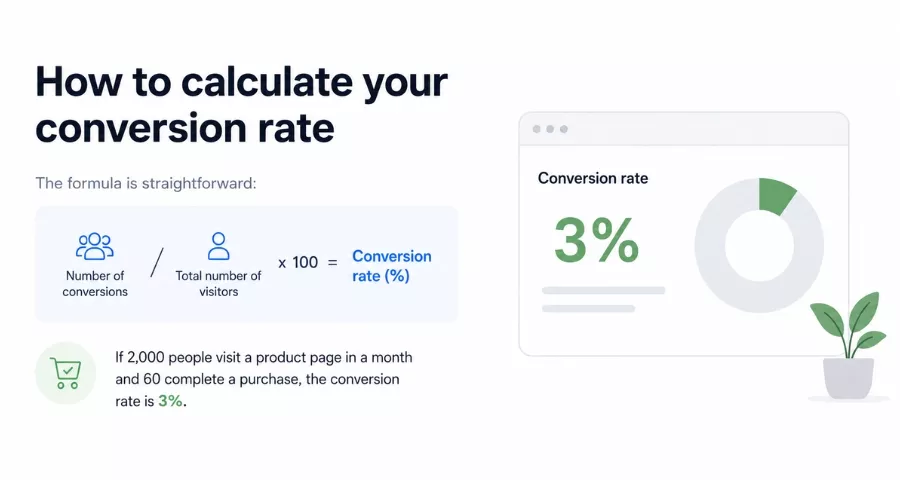
If 2,000 people visit a product page in a month and 60 complete a purchase, the conversion rate is 3%.
One detail to get right from the start: be specific about what you are counting as both the numerator and the denominator. A product page conversion rate (visitors who purchase) is a different number from a checkout completion rate (visitors who reach checkout and finish it). Treating them as the same metric creates a misleading baseline and sends your optimisation efforts in the wrong direction.
Why CRO matters more than more traffic
CRO and traffic generation are not competing strategies, but they address very different leverage points. Understanding the difference shapes how you allocate your time and budget.
The cost of unconverted visitors
On average, only around 1.7% of website visitors across all industries take a desired action, according to Statista. That means roughly 98% of the traffic most sites work to acquire leaves without converting. Every pound or dollar spent on paid ads, SEO, or content marketing is, to some extent, subsidising that unconverted majority.
Increasing the conversion rate from 1.7% to 2.5% on a site receiving 50,000 monthly visitors translates to 400 additional conversions per month, from exactly the same traffic. No extra ad spend. No new content.
CRO is one of the few growth levers where output can increase without input growing proportionally, because the improvement applies to every visitor who arrives afterward.
CRO vs. paid acquisition
Paid acquisition scales in a straight line: more spend equals more traffic, up to a ceiling set by audience size and bidding competition. CRO scales differently. A change to a landing page, a checkout flow, or a CTA can lift conversion rates by single or double-digit percentages, and then continue delivering that lift on every visitor who arrives in the months that follow.
That said, CRO and traffic generation work best together. Running A/B tests on a page that receives 200 visits per month produces statistically unreliable results; you need enough traffic to reach significance. The practical approach for most teams is to build traffic to a workable threshold while running small experiments on the highest-traffic pages, then shifting more resources to optimisation as those pages grow.
The CRO process, step by step
CRO is an iterative cycle, not a one-time project. The five-step process used by most optimisation teams runs as follows.
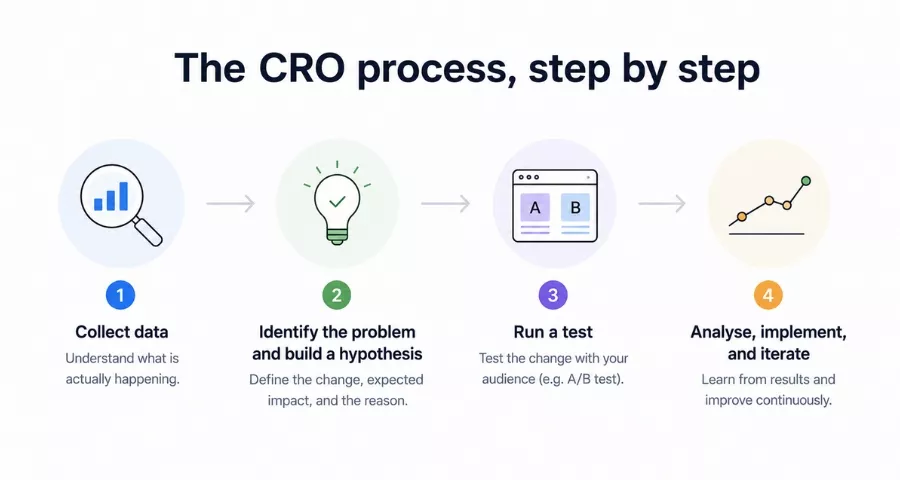
Step 1: Collect data on what is actually happening
Before changing anything, establish a baseline. Quantitative tools tell you where visitors drop off: which pages have high exit rates, where the funnel loses volume, what the checkout abandonment rate is. Qualitative tools show you why, through heatmaps that reveal where users click and scroll, and session recordings that let you watch real user journeys unfold.
On a WooCommerce store we audited last year, product pages showed strong traffic but a 78% drop-off before add-to-cart. Heatmaps showed users scrolling past the product description without engaging. Session recordings revealed that the size guide was buried three clicks deep, and most users who left had hovered over the size selector before exiting. That single finding generated the next six months of test hypotheses.
Step 2: Identify the problem and build a hypothesis
A hypothesis is not “let us change the button colour.” It is a structured prediction: if we make this specific change, this metric should improve, because of this reason.
Example: “If we add a size guide popup directly on the product page, the add-to-cart rate will increase because users currently abandon when they cannot find sizing information quickly.”
A good hypothesis includes the change, the expected impact, and the reasoning. This structure keeps you honest about what you are testing and what a result actually tells you.
Step 3: Run a test
A/B testing is the most common method. You split your audience: half see the original (the control), half see the variation. After a statistically significant sample has been collected, you compare conversion rates between the two groups.
Multivariate testing lets you test multiple page elements simultaneously, though it requires substantially more traffic to reach significance. For most sites, A/B testing is the right starting point.
One discipline worth maintaining: change one variable per test where possible. If you redesign the hero image, rewrite the headline, and move the CTA in a single test, you cannot isolate which change drove the outcome. The next test has no clear direction to build on.
Step 4: Analyse, implement, and iterate
Once a test reaches statistical significance (typically 95% confidence or above), you have a result. If the variation won, implement it and move to the next hypothesis. If it lost, you have still learned something about your audience’s behaviour and what it does not respond to. If the result is inconclusive, run the test longer or increase traffic to that page.
The process then repeats. CRO programmes that compound gains over 12 to 24 months consistently outperform one-off redesigns, because each test builds on the evidence from the last. Only around 12% of experiments produce a statistically winning result on the first run, according to Optimizely’s analysis of 127,000 tests. That is not a reason to stop testing; it is a reason to keep testing.
Core conversion rate optimisation techniques
CRO is not one technique but a toolkit. Different site types and funnel stages respond to different approaches. These four are where most teams start.
A/B testing page elements
A/B testing is the baseline method described above. Common variables to test on an ecommerce or lead generation site include CTA button copy, headline wording, hero image, product description format, pricing display, and form length. Small language changes can move conversion rates more than visual redesigns. On a Shopify store we ran a 30-day test on, changing the primary CTA from “Add to bag” to “Get yours today” lifted the add-to-cart rate by 11% on mobile. The product, the price, and the page design did not change.
Landing page optimisation
Landing pages built around a single conversion goal, with no competing navigation and one clear action, consistently outperform general pages for paid traffic. The key elements to optimise are the headline (does it match what the visitor searched for or clicked on?), the value proposition (is it specific and concrete?), the CTA placement (is it above the fold on mobile?), and the trust signals positioned near the form or checkout button.
One useful test: read your landing page headline aloud and ask whether a first-time visitor would immediately know what they are being asked to do and why. If the answer is not instant, the headline needs work before you run traffic to it.
Reducing friction in the user experience
Friction is anything that adds cognitive load or extra steps between the visitor and the conversion. Common sources include: too many form fields, unclear navigation, slow page load times, checkout flows that require account creation, and mobile layouts where buttons are small or placed below the fold.
Page speed matters more than most teams assume. Research from Portent shows that a one-second delay in load time can reduce conversions by up to 7%. Mobile users are significantly less tolerant of slow loads than desktop users. Running PageSpeed Insights on your highest-traffic pages and acting on the mobile score is one of the fastest friction-reduction moves available.
Trust signals and social proof
Visitors convert when they trust the site. Trust signals include customer reviews, star ratings placed near add-to-cart buttons, security badges at checkout, clear return and refund policies, live chat availability, and specific testimonials with named customers and concrete outcomes.
Social proof works differently at different funnel stages. High-volume ratings (“4.8 stars from 3,200 customers”) work well on product pages where visitors are making quick decisions. Specific case studies (“reduced fulfilment time by 40%”) convert better on B2B landing pages where visitors are evaluating a significant commitment and need evidence that the outcome is achievable for someone in their situation.
Conversion rate benchmarks by industry
What counts as a good conversion rate depends entirely on your industry, traffic source, and device mix. Using a single global average as a target is not useful.
According to multiple 2025 and 2026 studies, the global average ecommerce conversion rate sits between 2.5% and 3%. Contentsquare reported 2.5% for Q3 2025, up 0.4 percentage points year on year. Individual data sources vary: IRP Commerce’s April 2026 live panel reported 1.70%; Dynamic Yield’s enterprise panel, based on 200 million-plus monthly users, reported 2.69%. The spread reflects different sample sizes and methodologies, not a factual disagreement.
By industry, the variation is significant:
| Industry | Average conversion rate |
|---|---|
| Food and beverage | 4.5% to 6.0% |
| Beauty and cosmetics | 3.0% to 4.3% |
| Health and wellness | 2.5% to 3.5% |
| Apparel and fashion | 2.0% to 3.1% |
| Electronics | 1.2% to 2.5% |
| Luxury goods and jewellery | 0.8% to 1.2% |
Traffic source also shapes the number significantly. Email converts at 4% to 5.3% on average; organic search at 2.7% to 3.0%; paid social at below 1.2%, according to aggregated data from Dynamic Yield and Shopify’s 2026 CRO guide. A low overall site conversion rate sometimes reflects a heavy mix of top-of-funnel social traffic rather than a structural problem with the site itself.
The most actionable benchmark is your own historical data. Establish a baseline, segment it by channel and device, and then test toward consistent improvement. Ecommerce stores holding above 3% on session-based reporting are generally in the top 20% for most product categories, according to Littledata’s Shopify benchmark data.
CRO tools worth knowing
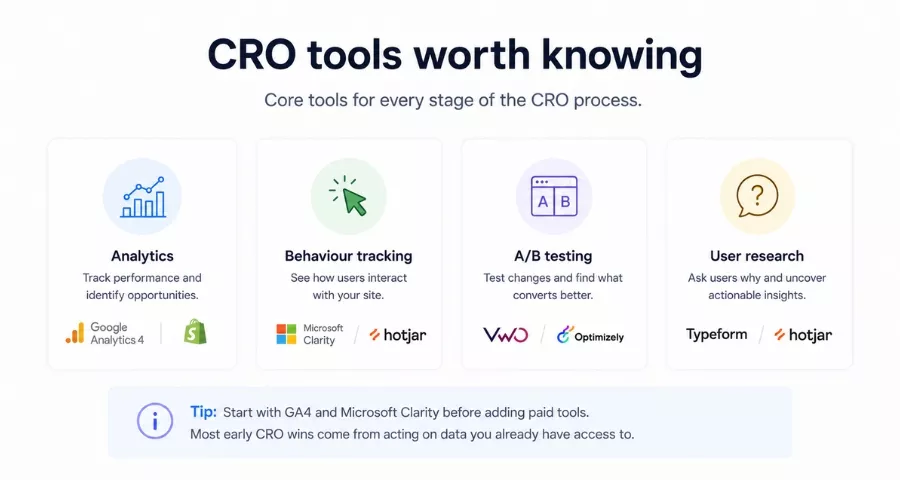
You do not need an expensive stack to run effective website conversion optimization. The tools below cover the core requirements at every stage of the process:
- Analytics: Google Analytics 4 is the starting point for funnel analysis, goal tracking, and identifying high-exit pages. Shopify Analytics and WooCommerce’s built-in reporting add platform-specific funnel visibility. Set up GA4 conversion events for every macro conversion on your site before running any tests.
- Behaviour tracking: Microsoft Clarity (free) provides heatmaps and session recordings without a sampling limit, which makes it practical for sites at any traffic level. Hotjar and FullStory offer more advanced segmentation and user journey analysis at a paid tier.
- A/B testing: VWO and Optimizely are the established options for mid-market and enterprise-level programmes. For Shopify stores, Intelligems and Convert.com are commonly used and integrate well with the platform’s reporting. A/B testing within email platforms (Klaviyo, Mailchimp) covers subject lines and send times without needing a separate tool.
- User research: Typeform and Hotjar surveys let you ask visitors directly why they did not complete a purchase or a form. The responses are often more actionable than heatmap data alone, particularly for understanding objections that visual data cannot surface.
Start with GA4 and Microsoft Clarity before adding paid tools. Most early CRO wins come from acting on data you already have access to, not from switching to a more sophisticated platform.
FAQs About Conversion Rate Optimisation (CRO)
What is the difference between SEO and CRO?
SEO drives traffic to your site through organic search visibility; CRO improves how much of that traffic converts into customers or leads. Both affect the same pages but optimise for different outcomes. SEO focuses on rankings and click-through rates; CRO focuses on what happens after the click. The most efficient marketing programmes run both simultaneously: traffic that does not convert is wasted spend, and conversions require enough traffic to measure and test reliably.
What is a good conversion rate?
A good conversion rate is one that beats your industry average and improves over time. For ecommerce, the global average sits between 2.5% and 3% across most 2025 and 2026 studies, but Food and Beverage stores typically reach 4.5% to 6% while luxury goods sit below 1.2%. The most useful comparison is against your own vertical and traffic source, not a global number. A store above 3% on session-based reporting is generally in the top 20% for most product categories.
How long does CRO take to show results?
Individual A/B tests typically need two to four weeks to reach statistical significance, depending on traffic volume and how large the conversion rate difference is between variants. A structured CRO programme generally shows measurable revenue impact within two to three months. The compounding benefit of continuous optimisation grows significantly over 12 to 24 months, which is why CRO delivers more value as an ongoing practice than as a one-off project.
Is conversion rate optimisation worth the investment?
For most sites, yes. CRO delivers a stronger return than equivalent investment in paid traffic because each improvement applies to every visitor who arrives afterward. The practical qualifier is traffic volume: pages receiving fewer than 1,000 sessions per month are difficult to test reliably, and results take longer to reach statistical significance. At low-traffic stages, a UX and technical audit can surface quick wins without a full testing programme. Once traffic reaches a workable level, a structured CRO cycle typically pays for itself within the first few months.
Conclusion
Conversion rate optimisation is not a one-time fix but a repeatable process of collecting data, forming hypotheses, and testing changes against a clear baseline. The compounding effect of consistent testing is what separates high-performing sites from those that plateau despite steady traffic growth. Start with your highest-traffic pages, pick one metric to improve, and build from there.
Read More: Search Engine Optimization Landing Page: The Complete Guide
Contact US | ThimPress:
Website: https://thimpress.com/
Fanpage: https://www.facebook.com/ThimPress
YouTube: https://www.youtube.com/c/ThimPressDesign
Twitter (X): https://x.com/thimpress_com