Learning how to make artificial intelligence does not mean creating a system as large as ChatGPT or building a machine that thinks exactly like a person. A useful AI project can be much smaller. It may classify emails, predict sales, recommend products, recognize images, summarize text, or automate a repeated decision.
The basic process is simple to understand: define a problem, prepare suitable data, choose a model, train it, test the results, and connect it to a real application. The challenge is making each stage reliable. Good AI depends on useful data, measurable goals, careful evaluation, and regular monitoring after launch. Readers who want to understand the relationship between these technologies before starting can explore the key differences between Machine Learning and AI.
This guide explains how to make artificial intelligence from the ground up in practical steps, including the tools, skills, risks, and project choices beginners need to understand.
Eduma – Education WordPress Theme
We provide an amazing WordPress theme with fast and responsive designs. Let’s find out!
What Does It Mean to Create Artificial Intelligence?

Before learning how to make artificial intelligence, it helps to understand what an AI system actually does. Artificial intelligence is a broad term for computer systems that perform tasks involving learning, prediction, recognition, language processing, or decision support. Most practical AI systems identify patterns in data and use them to produce an output.
That is why the question “how do you create artificial intelligence” needs a clear use case. A house-price model requires different data and methods from a chatbot or image classifier.
Step 1: Define One Clear AI Problem
The first step in how to make artificial intelligence is choosing a specific task. Avoid broad goals such as “build a smart assistant.” Start with something that can be measured.
Beginner-friendly ideas include:
- Classify a review as positive or negative.
- Predict whether a customer may cancel a subscription.
- Detects whether an image contains a cat or dog.
- Forecast sales from past records.
- Recommend similar products.
- Sort support requests into categories.
A good problem statement answers three questions: What information will the system receive? What output should it produce? How will success be measured? An email classifier, for example, may receive message text, return “spam” or “not spam,” and be evaluated with precision, recall, and accuracy. This makes how to create an AI much clearer.
Step 2: Choose the Right AI Approach
There is no single method for making your own AI. The best approach depends on the problem and the available data.
Rule-based systems follow written conditions. They work well when decisions are simple, stable, and easy to explain.
Machine learning is useful when patterns are too complex for fixed rules. Common types include supervised learning, which learns from labeled examples, and unsupervised learning, which finds patterns in unlabeled data.
Deep learning uses multi-layer neural networks. It is often used for images, audio, and language, but it may require more data and computing power than simpler methods.
For many beginners asking how to make an AI, supervised machine learning is a practical starting point because the expected output is clear and performance is easier to measure.
Step 3: Collect and Prepare the Data
Data is one of the most important parts of how to make artificial intelligence. A strong algorithm cannot fully repair information that is incorrect, badly labeled, heavily biased, or unrelated to the problem.
Data may include numbers, text, images, audio, video, user actions, or sensor readings. Before training, correct invalid values, standardize formats, handle missing information, and check labels. For projects involving large or complex datasets, understanding how AI tools for data analysis process and organize information can also provide useful context.
Separate the dataset into training, validation, and test groups so the final model can be judged on examples it has not learned from.
One common mistake when making your own AI is testing it on the same examples used for training. This can make performance look much stronger than it really is. A useful system must generalize to new data.
Step 4: Choose Tools and a Programming Language
Python is a common language for people learning how to make artificial intelligence because it supports many data and machine learning libraries.
Useful tools include:
- NumPy for numerical operations.
- Pandas for structured datasets.
- Matplotlib for basic charts.
- scikit-learn for traditional machine learning.
- PyTorch or TensorFlow for neural networks.
- Jupyter Notebook for experiments.
These tools help prepare data, train models, and evaluate results. People searching for automate automation software may actually need workflow automation rather than custom AI. If clear rules can solve the task, existing AI automation tools or APIs may be simpler. Custom AI is more useful for prediction, classification, generation, or complex pattern recognition.
Step 5: Build a Small First Model

The fastest way to understand how to make artificial intelligence is to create a simple working model before attempting a complex system.
Suppose the goal is predicting whether a customer will leave a service. A basic workflow could be:
- Collect historical customer records.
- Select useful features such as activity and account age.
- Label past customers as “left” or “stayed.”
- Split the data into training and test sets.
- Train a classification model.
- Measure results on unseen data.
- Review important errors.
- Improve the data or model.
Simple algorithms such as logistic regression, decision trees, random forests, or basic clustering can be easier to understand than a large neural network.
The first version does not need to be perfect. The goal is to build your own AI pipeline from input to output and see where problems appear. A useful rule for how to make artificial intelligence is to prefer the simplest model that can solve the task well.
Step 6: Train the Model

Training is where a machine learning model adjusts its internal parameters from examples. This is a central part of how to make artificial intelligence.
During training, the model compares predictions with expected results and adjusts its parameters to reduce error. Poor labels, irrelevant features, imbalanced classes, weak settings, and data leakage can all reduce quality.
Overfitting occurs when a model performs well on training data but poorly on new data. Clean, representative data is often more valuable than simply collecting more noisy data.
Step 7: Test and Evaluate the AI
Anyone learning how to create an AI program should plan evaluation before deployment. A model is not useful simply because it runs without errors.
| Metric | What it measures | Common use |
| Accuracy | Percentage of correct predictions | Balanced classification |
| Precision | Share of predicted positives that are correct | False positives are costly |
| Recall | Share of actual positives found | Missed positives are costly |
| F1 score | Balance of precision and recall | Uneven classes |
| MAE | Average absolute prediction error | Regression |
| RMSE | Error that penalizes large mistakes more | Regression |
There is no universal “good” accuracy. A score acceptable for a low-risk recommendation tool may be unacceptable for medical, financial, safety, or security decisions. Evaluation should also consider different user groups, speed, and failure patterns.
Step 8: Improve the Model Without Adding Unnecessary Complexity
When learning how to make artificial intelligence, beginners often assume a more complex algorithm will automatically produce a better system. That is not always true.
Useful improvements may include:
- Correct weak labels.
- Add more representative examples.
- Remove irrelevant features.
- Compare several algorithms.
- Tune model settings.
- Balance underrepresented classes.
- Test different decision thresholds.
- Review important errors manually.
Change one major factor at a time and record the result. This makes it easier to identify what actually improved the model.
If the goal is how to make an AI that will be maintained over time, also record the dataset version, model version, settings, and evaluation results.
Step 9: Deploy the AI
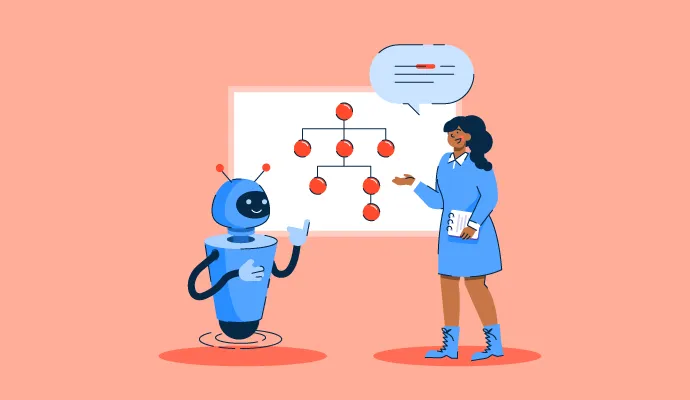
A trained model becomes useful when it is connected to a real product or process. Deployment can mean saving the model, creating an API, connecting it to a website or app, processing user input, returning predictions, and logging errors.
This is where how to create an AI becomes more than a machine learning task. Production systems also need software engineering, security, version control, monitoring, and reliable infrastructure.
For a beginner project, deployment can remain simple. A small model may run locally, inside a basic web app, or as part of an internal tool.
Step 10: Monitor the System After Launch
Learning how to make artificial intelligence includes maintenance. Deployment is not the end.
Real-world data can change. Customer behavior, language patterns, market conditions, and fraud techniques may shift over time. As a result, a model trained on older data can become less accurate.
Monitor important signals such as:
- Prediction quality.
- Changes in input data.
- Error rates.
- Response time.
- Computing or API cost.
- Unusual outputs.
- Fairness concerns.
- Security issues.
Retraining may be needed when data or performance changes significantly.
Build From Scratch or Use an Existing Model?
Training from scratch offers more control, but it can require more data, computing resources, time, and expertise. Existing pre-trained models can reduce development work for tasks such as language processing, image recognition, and text embeddings.
For language-based projects, understanding Large Language Model can help explain why many modern AI applications start with an existing model instead of training one entirely from the beginning.
For many people who want to build their own AI, “your own” does not need to mean training every parameter from zero. A practical system can combine a pre-trained model with custom data, business rules, retrieval, an interface, and safety controls.
Making your own AI should focus on solving the target problem well, not rebuilding technology that already exists. Beginners who want to explore ready-made systems before developing a custom project can also compare different types of generative AI tools and how they are used for text, code, images, and other tasks.
Common Mistakes to Avoid
Several problems can weaken an AI project even when the code works:
- Starting with technology instead of a clear problem.
- Using inaccurate or poorly labeled data.
- Testing on training data.
- Using only one metric.
- Choosing unnecessary complexity.
- Ignoring privacy, security, or bias.
- Forgetting post-launch monitoring.
Reliable AI should be tested for accuracy, safety, privacy, transparency, and fairness, especially when it affects important decisions.
How Long Does It Take to Make an AI?
There is no fixed timeline. A simple model with clean data may be created quickly, while a production system can require much more work. Time depends on data availability, complexity, performance targets, integration, security, and testing. This is why “how to create an AI” is also a project-planning question.
Conclusion
Learning how to make artificial intelligence becomes easier when the process is broken into clear stages. Start with one measurable problem, prepare relevant data, choose the simplest suitable method, train the model, test it on unseen examples, and improve it based on real errors.
The key lesson is that AI is not only an algorithm. Reliable systems depend on data quality, evaluation, software design, monitoring, and responsible use.
Anyone exploring how to make an ai, how to create an ai, or how to create an ai program should begin with a small project that can be completed from start to finish. That experience provides a stronger foundation than trying to build a large system immediately.
FAQs
1. How to make artificial intelligence as a beginner?
Start with Python, basic data analysis, and one simple machine learning project. Choose a clear problem, prepare a small dataset, train a basic model, test it on new data, and improve the largest errors. This gives practical experience with the complete AI workflow.
2. How do you create artificial intelligence without advanced coding skills?
Low-code tools and pre-trained models can reduce the amount of programming required. Basic knowledge of data, testing, and model limitations is still important because a system needs a clear purpose and reliable evaluation even when little code is written.
3. Is making your own AI expensive?
Not always. Small learning projects can use free open-source tools and run on a normal computer. Costs rise when a project needs large datasets, powerful hardware, paid APIs, heavy traffic, or continuous cloud processing.
4. Can one person build your own AI system?
One person can build a small AI project or prototype. Larger systems often require skills in data engineering, machine learning, software development, security, product design, and monitoring. The scope should match the available time and resources.
5. What is the easiest way to learn how to make artificial intelligence?
The easiest route is learning by building. Start with a small supervised learning project, use a clean dataset, train a simple model, measure its errors, and connect it to a basic application. Repeating this process with different problems builds practical AI skills.
Read more: 15 Practical Ways to Use AI at Work More Effectively
Contact US | ThimPress:
Website: https://thimpress.com/
Fanpage: https://www.facebook.com/ThimPress
YouTube: https://www.youtube.com/c/ThimPressDesign
Twitter (X): https://x.com/thimpress_com