Professionals want to know exactly how to validate their technical skills in a market flooded with technological advancements. Earning a reputable AI and ML certification provides a definitive signal to employers that a candidate possesses practical, hands-on capabilities to design, deploy, and scale machine learning models.
Employers no longer settle for theoretical knowledge; they demand proof of execution and an understanding of modern cloud infrastructure.
This comprehensive guide breaks down the industry’s most respected credentials, comparing prerequisites, exam formats, and career outcomes.
If you are still wondering about the core differences between these two domains, you should read our guide on machine learning vs AI before deciding on your certification path.
Eduma – Education WordPress Theme
We provide an amazing WordPress theme with fast and responsive designs. Let’s find out!
Top AI and ML Certification at a Glance
| Certification Name | Target Audience | Prerequisites | Exam Duration | Cost | Focus Area |
| Google Cloud Certified – Professional ML Engineer | Professionals building ML models on Google Cloud | 3 years industry experience; 1+ years with Google Cloud | 120 minutes | $200 | Google Cloud integration, scalable ML pipelines |
| Microsoft Certified: Azure Data Scientist Associate | Professionals applying data science on Azure | Experience in Azure Machine Learning and MLflow | 100 minutes | $165 | Azure ML workspaces, experiment tracking |
| Databricks Certified Machine Learning Professional | Advanced ML practitioners using Databricks | Hands-on experience with Databricks ML | 120 minutes | $200 | Big data environments, ML lifecycle management |
| eCornell Machine Learning Certificate | Programmers, analysts, data scientists, engineers | Python, math, probability, and linear algebra | ~3.5 months | $3,750 | Theoretical foundation, academic ML concepts |
| AWS Certified Machine Learning – Specialty | Experienced ML practitioners and cloud architects | 2+ years hands-on AWS ML/deep learning experience | 180 minutes | $300 | Advanced modeling, infrastructure optimization |
| AWS Certified Machine Learning Engineer – Associate | MLOps engineers, data engineers, and developers | 1+ year hands-on experience with Amazon SageMaker | 130 minutes | $150 | AWS ML services, model deployment, MLOps |
What is an AI and ML Certification?

An AI and ML certification is a formal, standardized credential that validates an individual’s technical expertise in machine learning concepts, algorithms, data processing techniques, and practical applications.
Offered by major technology corporations, respected educational institutions, and professional tech organizations, an AI and ML certification demonstrates that the holder has the required competency to design, implement, and manage complex machine learning projects in real-world production environments.
The core aspects evaluated during an AI and ML certification include:
- Skill Validation: Certifications rigorously test a candidate’s proficiency in tackling end-to-end machine learning tasks. This includes data preprocessing, feature engineering, model selection, hyperparameter tuning, deployment, and ongoing optimization.
- Industry Recognition: Holding a credential from a major cloud provider signals undisputed expertise to employers and peers, thereby enhancing professional credibility and job market appeal.
- Structured Learning: Preparing for an exam provides a highly structured learning pathway, ensuring comprehensive knowledge of fundamental and advanced machine learning topics rather than fragmented understanding.
- Career Growth: A recognized AI and ML certification opens doors to new employment opportunities, higher salary brackets, and influential leadership roles within the data science sector.
- Continuous Development: Because technology evolves rapidly, maintaining an AI and ML certification encourages ongoing continuous learning to stay updated with the latest advancements in artificial intelligence methodologies.
In summary, securing a recognized AI and ML certification acts as direct, verifiable proof to hiring managers that a candidate can construct and maintain robust intelligent systems, rather than merely discussing their theoretical mechanics.
Why Pursue an AI and ML Certification?
The global demand for artificial intelligence and machine learning specialists continues to accelerate at an unprecedented rate. Economic forecasts predict a massive increase in the need for dedicated AI professionals across finance, healthcare, logistics, and software development sectors over the next decade.
Consequently, pursuing the best AI certification is no longer just an educational milestone; it is a strategic career necessity.
The Top AI and ML Certification Programs For 2026
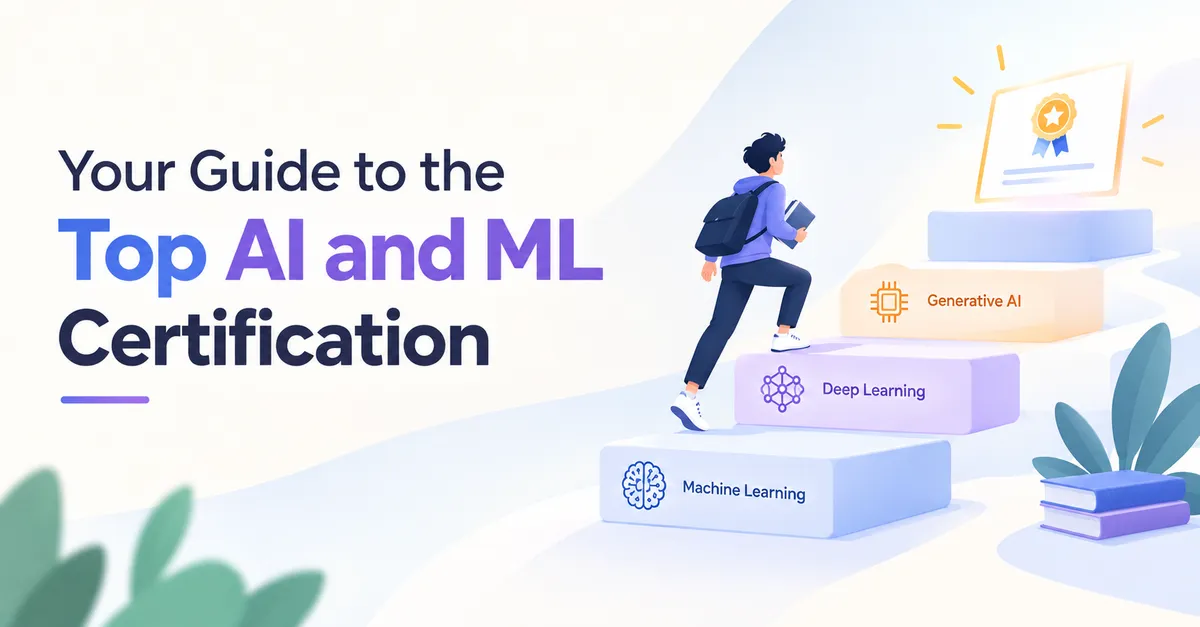
These programs are offered by the foundational pillars of cloud computing and academic excellence, ensuring that graduates possess highly relevant, highly employable skills.
1. Google Cloud Certified – Machine Learning Engineer
This rigorous credential is purposefully designed for IT professionals who build, scale, and maintain machine learning models exclusively within the Google Cloud ecosystem.
It emphasizes the integration of sophisticated models into commercial applications and the continuous management of model performance over time.
This AI and ML certification is optimal for engineers intimately familiar with Google Cloud products, BigQuery, and TensorFlow.
For beginners looking to build a strong foundation before taking the exam, you can explore some of the best online free Google certification courses available.
- Target Audience: Software engineers and data professionals who architect and maintain machine learning solutions on Google Cloud.
- Prerequisites: While there are no strict official prerequisites, Google strongly recommends three years of general industry experience, complemented by at least one year of designing and managing solutions specifically using Google Cloud architecture.
- Exam Structure: A two-hour intensive examination comprising 50 to 60 multiple-choice and multiple-select questions based on complex technical case studies.
- Investment: $200.
2. Microsoft Certified: Azure Data Scientist Associate
Microsoft’s Azure Data Scientist Associate credential targets professionals who apply Azure’s native machine learning and artificial intelligence services within their daily enterprise workflows.
It tests critical skills in data science methodology, emphasizing the seamless integration of Azure’s proprietary ML services.
- Target Audience: IT professionals specializing in applying statistical data science and machine learning on Azure. This includes designing secure environments for data science workloads, training models at scale, and deploying these solutions for enterprise consumption.
- Prerequisites: Proven practical experience utilizing Azure Machine Learning and MLflow, with a strong focus on practical application in data engineering and statistical modeling.
- Exam Structure: A timed, proctored examination covering data transformation, model training, and deployment strategies (typically around 100 to 120 minutes).
- Investment: $165.
3. Databricks Certified Machine Learning Professional
Databricks offers a highly specialized AI and ML certification that focuses entirely on applied machine learning skills, particularly within massive big data environments.
It meticulously assesses a candidate’s ability to build, fine-tune, and deploy predictive models utilizing the Databricks platform and Apache Spark.
This credential holds immense value for data engineers dealing with petabytes of data who must implement highly scalable, distributed solutions.
- Target Audience: Advanced individuals capable of performing complex machine learning tasks using Databricks Machine Learning. Core competencies tested include experiment tracking, comprehensive model lifecycle management, containerized deployment, and continuous monitoring for data drift.
- Prerequisites: No mandatory prerequisites are stated; however, extensive related training and extensive hands-on experience with large-scale ML tasks are deemed highly critical for success.
- Exam Structure: A 120-minute comprehensive exam.
- Investment: $200.
4. eCornell Machine Learning Certificate
For individuals seeking a rigorous academic foundation rather than cloud-specific vendor training, the eCornell program represents one of the premier artificial intelligence certificate programs available.
It provides an exceptionally strong theoretical foundation combined with practical programming skills.
This program is heavily favored by those who prefer a structured, university-backed educational approach to mastering algorithms.
- Target Audience: Programmers, traditional software developers, data analysts, statisticians, data scientists, and systems engineers seeking deep theoretical knowledge.
- Prerequisites: Candidates should possess prior academic experience in advanced mathematics. Familiarity with Python programming, probability theory, statistical analysis, multivariate calculus, and linear algebra is highly recommended before enrollment.
- Program Duration: The curriculum spans approximately 3.5 months, requiring an estimated commitment of 6 to 9 hours per week.
- Investment: $3,750.
5. AWS Certified Machine Learning Engineer – Associate
The AWS Certified Machine Learning Engineer – Associate serves as the primary Amazon Web Services credential for practitioners focused on building, training, and operationalizing machine learning workloads in production environments.
It focuses heavily on Amazon SageMaker, modern MLOps workflows, and the processes required to deploy models at a massive scale.
- Target Audience: Backend developers, data engineers, MLOps engineers, and data scientists actively working with AWS infrastructure.
- Prerequisites: Candidates should possess at least one year of hands-on, practical experience utilizing Amazon SageMaker and related AWS data storage and computing services.
- Exam Structure: The exam lasts 130 minutes and consists of 65 scenario-based questions.
- Investment: $150.
- Advanced Option: Practitioners possessing more than two years of deep AWS experience may prefer the AWS Certified Machine Learning – Specialty ($300, 180 minutes). The Specialty credential covers advanced data engineering, complex modeling, and intricate architectural implementations across the full AWS stack.
How to Get Certified in Artificial Intelligence

Step 1: Master the Foundational Prerequisites
Before attempting to secure an AI and ML certification, candidates must build a solid foundation in mathematics and programming.
Machine learning algorithms rely heavily on linear algebra, calculus, and probability. Additionally, Python remains the undisputed programming language of choice for the industry.
Candidates must become fluent in core libraries such as NumPy, Pandas, Scikit-learn, TensorFlow, and PyTorch.
Step 2: Define the Career Objective and Choose a Platform
Deciding how to get certified in artificial intelligence requires aligning the credential with a specific career trajectory.
If a company relies entirely on Amazon Web Services, pursuing an AWS credential makes strategic sense.
Alternatively, if a candidate wishes to understand the pure mathematics behind the algorithms without vendor lock-in, pursuing academic artificial intelligence certificate programs from institutions like eCornell or Stanford is the logical choice.
Step 3: Utilize High-Quality Study Resources
To prepare effectively, candidates should leverage the best artificial intelligence programs available on the market. These resources offer structured curricula, video lectures, and hands-on laboratory environments.
Exploring various artificial intelligence programs online allows learners to interact with cloud consoles safely without incurring massive infrastructure costs.
The best artificial intelligence programs provide sandbox environments where students can practice deploying models, configuring endpoints, and managing virtual private clouds.
Step 4: Execute Practical Projects
Theoretical knowledge alone will not suffice to pass a rigorous AI and ML certification exam. Candidates must build a portfolio of practical projects. This involves sourcing raw datasets, performing extensive data cleaning, selecting appropriate algorithms, tuning hyperparameter configurations, and deploying the final model.
For instance, a candidate might build a predictive pricing model and integrate it into a standard web application or a WordPress site via a custom REST API.
Furthermore, you can seamlessly integrate these predictive models into the best AI WordPress themes to create an automated and intelligent user experience. This hands-on execution is exactly what certification exams test.
Step 5: Schedule and Pass the Examination
After completing thorough preparation through artificial intelligence programs online and executing practical projects, candidates must schedule the proctored exam.
These exams are often administered under strict conditions, requiring candidates to solve complex, scenario-based architectural problems within a rigid time limit.
What Jobs Can You Get with an AI and ML Certification?

Earning a respected AI and ML certification opens pathways to a wide array of highly lucrative and intellectually stimulating career opportunities across the technology sector. It validates expertise in a field currently experiencing massive talent shortages.
1. Machine Learning Engineer
- Role Responsibilities: Machine Learning Engineers are responsible for designing, building, and deploying machine learning models to solve complex business problems. They optimize algorithms for maximum computational performance and massive scalability in production environments.
- Required Skills: Exceptional proficiency in Python or R, deep knowledge of deep learning frameworks (TensorFlow, PyTorch), and extensive experience with cloud computing architectures and MLOps tools.
2. Data Scientist
- Role Responsibilities: Data Scientists analyze and interpret massive volumes of complex data to assist organizational leadership in making informed, strategic business decisions. They actively apply advanced machine learning techniques to predict future market trends, customer behaviors, and operational bottlenecks.
- Required Skills: Exceptional statistical analysis capabilities, experience with big data processing software, and the ability to translate complex mathematical findings into easily digestible business intelligence reports.
3. NLP (Natural Language Processing) Engineer
- Role Responsibilities: NLP Engineers build sophisticated systems that enable computers to comprehend, interpret, and generate human language dynamically. Core applications include intelligent customer service chatbots, real-time translation services, large language model fine-tuning, and automated sentiment analysis pipelines. Additionally, NLP engineers frequently research and analyze the best ChatGPT alternative tools to develop specialized virtual assistants for unique business needs.
- Required Skills: A deep understanding of computational linguistics, extensive experience with modern NLP libraries (Hugging Face, SpaCy), and rigorous software engineering principles.
4. Data Analyst
- Role Responsibilities: Data Analysts extract and analyze corporate data to identify actionable trends, historical patterns, and performance insights. Modern analysts increasingly utilize foundational machine learning techniques (like clustering and regression) to vastly enhance traditional data analysis workflows. Understanding the true nature of automation vs AI provides a massive advantage for analysts looking to streamline their reporting pipelines.
- Required Skills: A strong background in applied statistics, extreme proficiency in modern data visualization platforms (Tableau, PowerBI), and advanced knowledge of SQL database querying.
5. Business Intelligence Developer
- Role Responsibilities: BI Developers design, deploy, and maintain robust business intelligence interfaces. They build complex query tools, real-time data visualization dashboards, and comprehensive data modeling systems that natively incorporate machine learning endpoints for predictive corporate analytics.
- Required Skills: Extensive experience with enterprise BI tools, deep knowledge of relational database management systems, and a solid understanding of how predictive machine learning models integrate into financial forecasting.
Machine Learning Certification vs. Machine Learning Certificate
When researching educational pathways, candidates frequently encounter two distinct terms that are often mistakenly used interchangeably. Understanding the subtle but critical difference between these two professional credentials is vital for mapping an accurate career trajectory.
| Feature | AI and ML Certification | Certificate for Artificial Intelligence |
| Definition & Issuer | A formal, standardized endorsement issued by highly reputable industry organizations or technology vendors (e.g., Amazon, Microsoft, Google). | An academic document awarded purely upon the successful completion of a specific educational course or university program. |
| Assessment Method | Requires candidates to pass extremely rigorous, proctored, and standardized high-stakes examinations. | Typically involves watching lectures, completing homework assignments, and submitting a final capstone project. |
| Core Value | Demonstrates undisputed mastery of specific tools, architectures, and guarantees a strict baseline of technical competency. | Focuses heavily on targeted skill development, continuous learning, and theoretical knowledge acquisition. |
| Industry Recognition | Highly valued by technical recruiters for advanced engineering roles; showcases comprehensive, production-ready engineering proficiency. | Demonstrates professional commitment but generally carries slightly less weight in validating hands-on production expertise. |
| Best Suited For | Professionals aiming to prove hands-on execution and secure specialized engineering or cloud architect positions. | Ideal for initial, targeted theoretical skill development and foundational learning. |
Both educational pathways significantly enhance a professional resume. However, vendor certifications are strictly preferred for showcasing comprehensive, production-ready engineering proficiency, while academic certificates remain ideal for initial, targeted theoretical skill development.
Choosing the Right Path For Your Career
With a vast variety of credentials available, selecting the best machine learning certification that perfectly aligns with specific career aspirations and current technical skill levels is a critical decision.
Assess Current Skill Levels and Professional Goals
Candidates must objectively evaluate their existing expertise in software engineering and data science. Beginners looking to gain foundational knowledge should lean toward broad, academic programs.
If a professional intends to architect enterprise cloud solutions, pursuing the best machine learning certification from AWS, Google Cloud, or Microsoft Azure is absolutely mandatory.
Analyze the Focus and Curriculum
Every credential maintains a highly unique focus. For instance, AWS and Azure examinations focus almost exclusively on navigating their proprietary cloud services, infrastructure provisioning, and billing optimization related to model deployment.
In contrast, academic artificial intelligence certificate programs provide a broader, mathematics-heavy approach that applies universally across all platforms. Candidates must meticulously review the stated curriculum of each credential to ensure it directly matches the specific skills they wish to acquire.
Understand the Prerequisites and Time Commitment
Professionals must carefully consider the mandatory prerequisites associated with each credential. Advanced exams require years of documented prior experience and deep familiarity with specific programming languages.
Additionally, candidates must assess the extensive time and financial commitment required. Balancing months of rigorous evening study with demanding personal and professional commitments requires careful scheduling and dedication.
Evaluate Industry Recognition and Employer Demand
Finally, professionals should research exactly how different credentials are fundamentally perceived within their specific local job market.
Searching job boards for mentions of specific credentials provides immediate insight into current employer demand, ensuring the chosen AI and ML certification yields a high return on educational investment.
Final Thoughts
The decision to pursue an AI and ML certification represents a significant investment in a professional’s future. The optimal credential depends entirely on a candidate’s current career stage and targeted industry sector.
- For software engineers currently operating within AWS, Google Cloud, or Azure environments, securing a cloud provider credential clearly signals platform-specific competency directly to hiring managers operating within those complex ecosystems.
- For professionals building their analytical skills from the ground up, starting with academic artificial intelligence certificate programs or comprehensive artificial intelligence programs online provides the necessary mathematical and programming foundation.
Ultimately, combining a prestigious AI and ML certification with a robust portfolio of deployed projects remains the most effective strategy for securing a lucrative role in the rapidly expanding artificial intelligence sector.
FAQs
1. Who should consider getting an AI and ML certification?
Any professional looking to definitively validate their technical skills in machine learning, rapidly advance their career within the data science sector, or successfully transition into a lucrative role requiring AI expertise should consider certification. This broad group directly includes existing data scientists, traditional software engineers, database administrators, and IT architects seeking to modernize their skill sets.
2. How to get certified in artificial intelligence if I have no coding background?
Individuals without a coding background must first acquire foundational programming skills, specifically in Python, before attempting a certification. The initial step involves enrolling in introductory artificial intelligence programs online that teach fundamental programming, basic statistics, and data manipulation alongside core machine learning concepts, thereby building the necessary prerequisites over time.
3. What is the difference between a certification and a certificate for artificial intelligence?
A certification (like those from AWS or Google) is a standardized industry credential awarded after passing a rigorous, proctored examination that validates production-ready technical skills. A certificate for artificial intelligence is an academic document awarded upon the completion of a specific educational training program or university course, focusing more on theoretical learning and project completion.
4. What is the best machine learning certification for cloud engineers?
The best machine learning certification for cloud engineers depends entirely on the specific infrastructure utilized by their employer. The AWS Certified Machine Learning – Associate, Google Cloud Professional ML Engineer, and Microsoft Certified: Azure Data Scientist Associate are considered the industry standards, each validating profound expertise within their respective proprietary cloud ecosystems.
5. Are artificial intelligence certificate programs worth the financial investment?
Yes, highly respected artificial intelligence certificate programs are generally worth the investment for professionals seeking structured, foundational knowledge. They provide rigorous academic frameworks, direct access to experienced instructors, and comprehensive peer networking opportunities, serving as an excellent stepping stone before attempting more difficult, vendor-specific cloud engineering certifications.
Read more: Discover 10 Best AI Powered LMS Platforms
Contact US | ThimPress:
Website: https://thimpress.com/
Fanpage: https://www.facebook.com/ThimPress
YouTube: https://www.youtube.com/c/ThimPressDesign
Twitter (X): https://x.com/thimpress_com