Where to Start When Everything Feels Overwhelming
Typing “how to learn ML” into Google or any top search engine usually returns a flood of course links, YouTube playlists, and conflicting opinions about where to begin. Some voices insist on months of calculus before touching a single line of code.
Others argue for skipping theory entirely and jumping straight into a Kaggle competition. Both camps are partly right and that disagreement is exactly why so many beginners quit before finishing a single course.
This article cuts through that noise. It lays out a practical, tested sequence — math, programming, libraries, theory, and real projects — based on what has actually worked for people who moved from zero experience to a working, job-relevant understanding of machine learning.
Anyone looking for a straightforward answer to how to learn ML, without losing the first three months to the wrong material, will find a clear path below.
Eduma – Education WordPress Theme
We provide an amazing WordPress theme with fast and responsive designs. Let’s find out!
Key Takeaways
- Math, Python, and core libraries form the foundation of any solid machine learning for beginners plan — aim for “just enough,” not mastery, before moving forward
- Kaggle competitions and from-scratch implementations turn passive knowledge into applied skill
- A blog, a GitHub portfolio, or a re-implemented research paper demonstrates real capability to employers
- Realistic timelines run from several hundred hours for basic competence to a few thousand hours for independent, job-ready skill
- Long-term, how to master machine learning comes down to repeated exposure to varied, real projects rather than more courses alone
- Consistency over months beats short, intense bursts that lead to burnout
Why a Machine Learning Guide Actually Matters
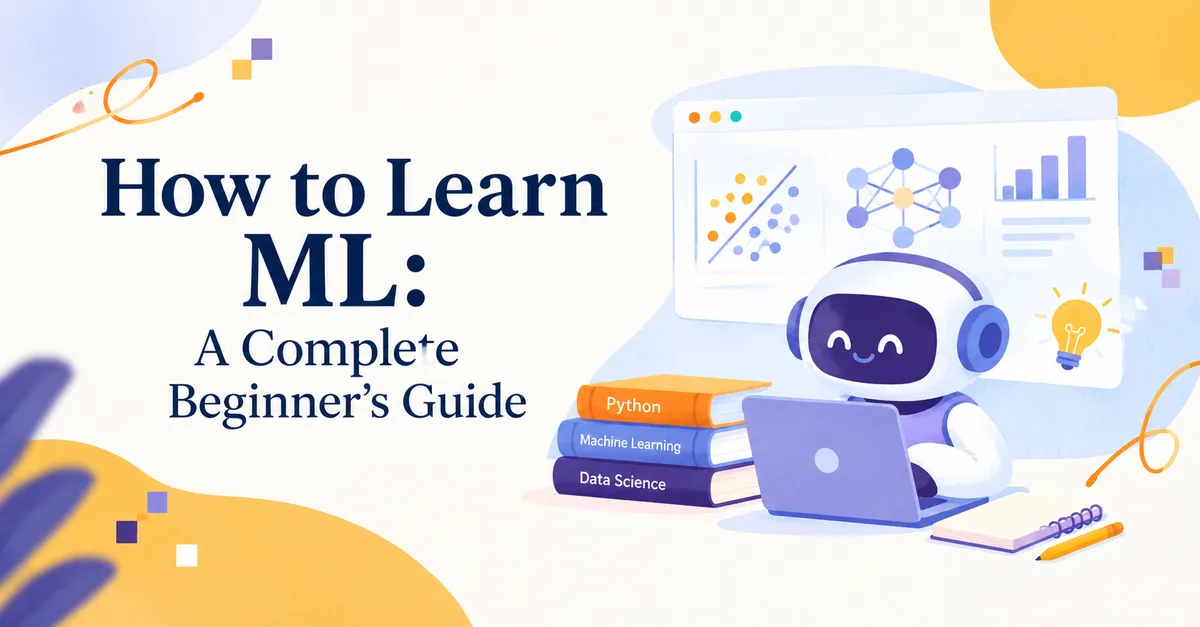
Machine learning is not a single skill, which is exactly why so many searches for how to learn ML turn up conflicting advice. It combines mathematics, programming, statistics, and domain knowledge into one field.
Understanding this broader landscape, including the critical distinctions between machine learning vs AI, is exactly what makes a structured machine learning guide so valuable. Without one, beginners often bounce between random videos, half-finished courses, and Kaggle notebooks they do not fully understand.
People who have gone through this process and now work as data scientists or ML engineers tend to agree on one point: the sequence matters more than the speed. A well-organized path — math first, then programming, then theory, then practice — prevents the common trap of collecting isolated facts that never connect into a working system.
How to Learn ML?
The table below breaks down how to learn ML across six manageable stages, from foundational math to a portfolio that actually gets noticed.
| Stage | Focus Area | Approximate Time | Core Resources |
| 1 | Math foundations | 4–6 weeks | Khan Academy, MIT OpenCourseWare, freeCodeCamp |
| 2 | Python programming | 2–3 weeks | W3Schools, freeCodeCamp, TutorialsPoint |
| 3 | Core ML libraries | 2–3 weeks | NumPy, Pandas, Matplotlib, Anaconda |
| 4 | ML & deep learning theory | 2–4 months | |
| 5 | Hands-on practice | Kaggle, GitHub, from-scratch projects | |
| 6 | Portfolio building | Blog posts, research paper reviews |
Step 1: Build a Solid Math Foundation
Machine learning algorithms are, at their core, mathematical operations repeated at scale, and for anyone working out how to learn ML in a durable way, this stage is the first real test of patience.
Skipping the math is possible in the short term, since most libraries hide the formulas behind a single function call, but anyone aiming to go beyond copying and pasting code eventually needs to understand what is happening underneath it.
Four areas make up most of the math required at this stage:
- Linear algebra – vectors, matrices, and matrix operations, since most models represent data as matrices
- Calculus – derivatives and gradients, which power the optimization process behind training a model
- Probability and statistics – distributions, confidence intervals, and estimation methods such as maximum likelihood
- Eigen-concepts – eigenvectors and eigenvalues, used in techniques like dimensionality reduction
Full mastery of every topic is not required to get moving. Being able to explain what a derivative represents, multiply two matrices, or describe maximum likelihood estimation in plain language is usually enough to keep progressing.
| Topic | Why It Matters | Suggested Free Resource |
| Linear Algebra | Represents data and model parameters as matrices | MIT OpenCourseWare, Khan Academy |
| Calculus | Explains how models are optimized during training | freeCodeCamp, Khan Academy |
| Probability & Statistics | Supports model evaluation and uncertainty estimates | Brilliant, MIT OpenCourseWare |
| Eigen-concepts | Used in dimensionality reduction methods like PCA | Khan Academy |
One commonly used roadmap breaks these four areas into roughly 107 hours of coursework: about 29 hours each for single- and multi-variable calculus, 28 hours for linear algebra, and 21 hours for statistics and probability.
Free platforms such as Khan Academy, Brilliant, MIT OpenCourseWare, and freeCodeCamp all cover this material at no cost.
The goal here is not perfection — finishing one course tends to work far better than jumping between five different ones.
Step 2: Learn Python Programming
Python remains the standard language for machine learning work, largely because of its readable syntax and the enormous ecosystem of libraries built around it.
For someone starting from zero, almost any solid introductory course covers the same core material, so which course gets chosen matters less than actually finishing it.
The essentials to focus on include:
- Native data structures: lists, dictionaries, sets, and tuples
- For and while loops
- If-else conditional logic
- Functions and classes
- Basic mathematical operations in code
This stage doubles as a practical introduction to ML tooling, since many beginner Python exercises already resemble small data tasks.
Free options such as W3Schools, TutorialsPoint, and freeCodeCamp all teach these fundamentals clearly. One widely used introductory course runs close to 135 hours, though learners with prior programming experience — in Java or JavaScript, for example — often move through it much faster, since the underlying logic transfers even when the syntax does not.
The most important habit at this stage is coding along with every lesson instead of just watching.
Concepts like loops and conditionals only become intuitive after being typed out and debugged a few times, not after being read passively.
If you want to dive into practice without configuring local software right away, you can start writing your first scripts using various online code editor tools.
Step 3: Get Comfortable with Core ML Libraries
Once basic Python is in place, the next layer is the set of libraries that make data science and machine learning practical. Three of them come up constantly:
- NumPy – built for numerical computing, with fast matrix operations that matter when working with large datasets
- Pandas – the standard tool for loading, cleaning, and manipulating tabular data
- Matplotlib – the main charting library for visualizing data and model results
Treat this stage as a hands-on intro to machine learning tooling rather than a deep dive into every parameter each library offers. Installing Anaconda alongside these tools is worth the extra step.
It bundles Python, Jupyter Notebooks, an environment manager, and most common data science packages into a single distribution, which removes a lot of the setup friction that trips up beginners.
| Library | Main Use | Learning Curve |
| NumPy | Numerical computing, matrix math | Low |
| Pandas | Data loading, cleaning, manipulation | Low–Medium |
| Matplotlib | Data visualization | Low |
| Anaconda | Environment and package management | Low |
freeCodeCamp offers crash courses on each of these tools, and they are enough to get functional quickly.
As with the earlier stages, the advice stays consistent: learn the basics, resist the urge to master every feature immediately, and move on to applying the tools on real data. Grasping these fundamentals is crucial before you transition to using automated AI tools for data analysis.
Step 4: Study Machine Learning Theory and Algorithms
This is where the earlier groundwork starts paying off.
Unlike the first three stages, which can usually be finished within a month, the theory stage takes longer because each new concept tends to build on the one before it. Rushing through this part often means circling back later to fill in gaps.
To further expand your knowledge and strengthen your resume, you can also seek out free Google certification courses. Additionally, testing out a ChatGPT alternative can be an excellent way to observe how different AI architectures process information in real-world scenarios.
Step 5: Practice with Real Projects
Theory alone rarely produces someone who can apply machine learning to a real problem. Hands-on practice is where the concepts actually stick, and it tends to be the step beginners underestimate the most.
Kaggle competitions
Entering a Kaggle competition is less about winning prize money and more about experiencing how machine learning gets applied to messy, real-world data, which rarely looks like the clean datasets used in course exercises.
Trying a mix of competition types — time series forecasting, computer vision, natural language tasks — also helps narrow down which subfield feels most interesting for later specialization.
No machine learning tutorial can fully substitute for the experience of debugging a model against messy, real-world data.
Building algorithms from scratch
Implementing an algorithm using only base Python and NumPy, without relying on Scikit-Learn or similar libraries, forces a much deeper understanding than calling a pre-built function ever will. A reasonable order to follow:
- Linear regression and gradient descent
- Logistic regression
- Decision trees
- A basic neural network
Applying skills to real datasets
Beyond structured competitions, picking a dataset tied to a personal interest — sports statistics, a hobby, work-related data — and trying to answer a genuine question with it tends to produce faster learning than another tutorial. Publishing the resulting notebook on GitHub also starts building a portfolio at the same time.
Step 6: Build a Portfolio That Stands Out
Finishing courses puts someone on par with thousands of other self-taught learners. Publicly documenting the work along the way is what actually separates a strong candidate from the rest, and it takes far less effort than most people assume.
Start a blog
Writing about machine learning concepts — how a neural network makes predictions, what a Markov chain is, why gradient descent converges — reinforces understanding while creating something a future employer or collaborator can read.
A useful approach is picking one topic and writing a short series about it rather than scattered, unrelated posts.
Writing a short machine learning tutorial of one’s own, even a beginner-level one, is one of the fastest ways to confirm real understanding.
If you need assistance structuring your explanations, utilizing AI article writer tools can help streamline your initial drafts.
Re-implement a research paper
This is a harder but higher-payoff option for later stages.
Reproducing the results from a published paper is genuinely difficult, but it teaches lessons no course replicates. A practical process looks like this:
- Read the paper carefully and identify the goal, model, and reported results
- Track down the same dataset used by the authors, where possible
- Study the model architecture and the reasoning behind its design choices
- Build the implementation step by step, checking results along the way
Following a weekly roundup of new machine learning research helps with finding papers worth attempting and keeps exposure to the field’s direction over time.
Documenting any of this on GitHub, LinkedIn, or a personal blog turns months of private study into something visible and verifiable — which is exactly what anyone looking for how to master machine learning eventually needs to show.
How Long Does It Actually Take?
Timelines vary enormously depending on background, but a few data points help set realistic expectations. Any honest machine learning guide should be upfront about this time commitment rather than promising shortcuts that rarely hold up.
One structured roadmap estimates roughly 107 hours for the math foundation, 135 hours for an introductory programming course, and over 200 hours for the combined Machine Learning and Deep Learning Specializations — a total of just over 440 hours to complete the structured coursework alone, before any project work begins.
Learners who track their hours over a longer period report a wider range.
One account from someone studying part-time alongside a demanding job describes putting in 500 to 1,000 hours over the first year, with an estimate of around 2,500 hours and three to five years of consistent effort before reaching a level considered genuinely competent — defined as being able to build, evaluate, deploy, and monitor different types of models independently.
| Commitment Level | Approx. Study Time | Realistic Outcome |
| 2–4 hrs/day, part-time | 500–1,000 hrs (Year 1) | Solid foundation, entry-level readiness |
| Consistent effort, 3–5 years | ~2,500 hrs total | Independent model development and deployment |
| Full-time, intensive | 400–450 hrs | Completion of core coursework only |
The takeaway is not that machine learning takes forever — it is that expecting mastery within a few weeks sets an unrealistic bar.
Starting slowly, building consistency, and increasing intensity only after confirming genuine interest tends to produce better long-term results than an aggressive sprint that ends in burnout.
Common Mistakes to Avoid
A few patterns show up repeatedly among people trying to figure out how to learn ML on their own, and most of them stall the journey partway through:
- Getting stuck in tutorial hell. Watching course after course without ever building something independently creates a false sense of progress.
- Treating math as something to finish completely before starting ML. Learning just enough to move forward, then returning to fill gaps later, tends to work better than trying to master every topic upfront.
- Skipping hands-on projects. Passive learning rarely transfers into the ability to solve a new, unfamiliar problem.
- Ignoring adjacent skills. SQL, basic cloud platforms, and data visualization principles are not strictly machine learning, but they show up constantly in real jobs.
- Comparing progress to others. Backgrounds vary too much for a fair comparison — someone with a math degree and someone starting from a non-technical background will naturally move at different speeds.
Avoiding these patterns matters more than finding the “perfect” course, since almost any well-reviewed resource teaches similar material.
A Sample Weekly Study Routine
A study split that has worked well for people balancing this with a full-time job looks roughly like this, and it works as a starting rhythm for machine learning for beginners more broadly:
- Days off: around 6 hours total, split between reading, math practice, and coursework
- Work days: 2–4 hours, focused on one area rather than switching between several
- Weekly structure: roughly 2 hours reading, 2 hours on math, and 2 hours on ML coursework, adjusted based on which stage of the roadmap is active
Trying to sustain 8-hour daily study sessions alongside other responsibilities tends to backfire, leading to guilt on lighter days and eventual burnout.
Starting with a lighter, sustainable pace for the first few months, then increasing intensity once the habit is established, produces steadier long-term results than an aggressive start.
Top-Down or Bottom-Up: Choosing a Learning Style
Two broad approaches show up across successful learners, and neither is objectively correct.
The bottom-up approach starts with math and fundamentals, then layers programming, libraries, and theory on top before attempting real projects. It suits people who want a deep, structured understanding before applying anything.
The top-down approach flips the order: pick a topic of interest, try to train a working model right away, and fill in theoretical gaps as they come up. Supporters of this method argue it keeps motivation higher, since progress feels tangible from the first week, which lowers the risk of giving up somewhere in the middle of a long list of prerequisites.
In practice, a blend of both tends to work best: enough foundational math and programming to avoid feeling completely lost, paired with early and frequent attempts at real projects rather than waiting until every course is finished.

Conclusion
Machine learning is less about finding one perfect course and more about following a sequence that builds on itself: enough math to understand what is happening, enough Python to build things, enough theory to know which tool fits which problem, and — most importantly — enough real projects to prove all of it sticks.
The exact resources matter far less than most beginners assume, since any well-reviewed course covers similar ground. What separates people who reach genuine competence from those who stall out in tutorial hell is consistency, realistic pacing, and a willingness to build in public along the way.
Anyone still wondering how to learn ML now has a complete, tested starting map — the only step left is beginning.
Frequently Asked Questions
1. How long does it take to learn machine learning from scratch?
Completing the core math, programming, and theory coursework typically takes around 440 hours, spread over three to six months of part-time study. Reaching a point where independent projects, model deployment, and evaluation feel comfortable usually takes one to three years of continued practice, depending on prior background and the time available each week.
2. Is a computer science degree required before starting an intro to machine learning?
No. A structured intro to machine learning built on free resources — Python fundamentals, core math, and Andrew Ng’s Coursera specializations — covers most of the technical material a computer science degree would, minus the unrelated coursework. A degree can help with certain hiring processes, but it is not a requirement to start learning or building real projects.
3. What is the best machine learning tutorial for someone with no programming background?
Starting with a beginner-friendly Python course, such as those on W3Schools or freeCodeCamp, before attempting any machine learning tutorial tends to save time later. Trying to learn Python syntax and ML concepts at the same time usually slows progress, since debugging code and understanding an algorithm both demand full attention on their own.
4. How to master machine learning after finishing the basic courses?
Mastery comes from repetition across varied problems, not from stacking on more courses alone. Entering multiple Kaggle competitions across different domains, re-implementing published research papers, and contributing to open-source ML projects are the activities that separate someone who finished a course from someone who has genuinely mastered the material.
5. Can machine learning for beginners really lead to a job?
Yes, though timelines vary by market and background. Entry-level and junior roles are realistic after finishing the core coursework plus a handful of documented projects, usually somewhere between six months and two years of consistent study.
Read more: How Does AI Learning Work: A Simple Guide for Beginners
Contact US | ThimPress:
Website: https://thimpress.com/
Fanpage: https://www.facebook.com/ThimPress
YouTube: https://www.youtube.com/c/ThimPressDesign
Twitter (X): https://x.com/thimpress_com