Understanding how is AI created starts with three foundational elements: massive datasets, mathematical algorithms, and high-performance computing power.
Developers do not build intelligent software by writing endless lines of manual rules for every possible scenario. Instead, engineers feed millions of structured and unstructured data examples into neural networks, allowing the system to identify hidden patterns, learn from mistakes, and make independent predictions—the exact technology powering the best personal AI assistants available today.
From smartphone facial recognition and email spam filters to autonomous vehicles and smart navigation apps, intelligent systems operate quietly behind everyday tools.
This guide breaks down the exact engineering stages behind smart machines, core subfields, system classifications, and how modern platforms apply these models in real-world scenarios.
Eduma – Education WordPress Theme
We provide an amazing WordPress theme with fast and responsive designs. Let’s find out!
Quick Artificial Intelligence Summary
Before exploring the technical development pipeline, the table below provides a quick artificial intelligence summary covering the core concepts, operational methods, and daily impact of the technology.
| Core Aspect | Simple Explanation | Real-World Examples |
| Core Definition | A branch of computer science focused on building machines capable of learning, reasoning, and solving complex problems. | Optical character recognition (OCR), smart search engines, voice assistants. |
| Creation Process | Engineers train mathematical models on vast datasets using high-speed processors rather than coding manual step-by-step instructions. | Training a vision model with millions of labeled photos to recognize traffic signs. |
| Key Subfields | Machine Learning (ML), Deep Learning (DL), Natural Language Processing (NLP), and Computer Vision. | Language translation tools, automated medical image analysis, predictive text. |
| Primary Benefits | Automates repetitive workflows, minimizes human calculation errors, operates 24/7, and accelerates scientific research. | 24/7 network cybersecurity monitoring, automated factory quality inspections. |
| Modern Frontier | Generative models, Large Language Models (LLMs), and autonomous AI agents capable of multi-step execution. | Content generation, code refactoring, and integrated e-learning operating loops. |
Explain AI in Simple Terms: What Does It Actually Mean?

To explain AI in simple terms, think of traditional software as a strict recipe book and artificial intelligence as an adaptable student. Standard computer programs only follow exact instructions written by a programmer.
If an unexpected situation occurs, a traditional program stops working or produces an error. An intelligent system, however, learns from experience. Rather than receiving a million strict rules on how to identify a bird, the computer examines thousands of bird photographs and figures out the visual patterns—such as feathers, beaks, and wings—on its own.
At a broader level, this technology represents a collection of advanced computing methods that allow machines to simulate human cognitive tasks.
These tasks include understanding spoken or written language, analyzing complex statistical trends, recognizing visual objects, and offering actionable recommendations.
Building these capabilities requires collaboration across multiple academic and technical disciplines:
- Computer Science & Software Engineering: Provides the coding frameworks and system architecture.
- Data Analytics & Statistics: Supplies the probability models used to weigh predictions and measure accuracy, which also power specialized AI tools for data analysis.
- Hardware Engineering: Delivers specialized graphics processing units (GPUs) and tensor processing units (TPUs) capable of running trillions of calculations per second.
- Linguistics & Neuroscience: Inspires how machines structure human grammar and how artificial neural networks mimic the interconnected neurons of the human brain.
- Philosophy & Psychology: Guides ethical frameworks, decision-making logic, and human-computer interaction standards.
A practical example of these disciplines working together is Optical Character Recognition (OCR).
When a scanner processes a physical invoice or an old book, OCR software uses computer vision and linguistic patterns to extract raw text from the image. It transforms unstructured visual content into structured, searchable business data in seconds, uncovering insights that would take human workers weeks to transcribe manually.
How Is AI Created? The Step-by-Step Engineering Process
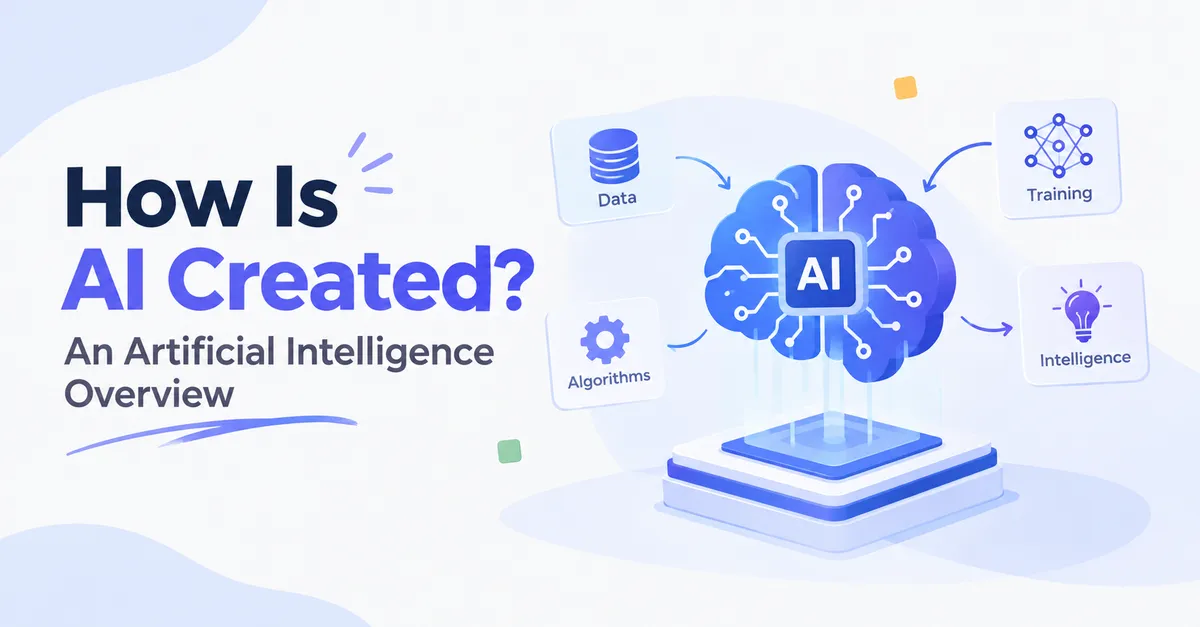
For readers searching for accurate information about AI development, the creation process follows a rigorous engineering lifecycle. Software teams do not simply flip a switch to generate machine intelligence; they move through five distinct phases to turn raw data into a reliable model.
1. Problem Definition and Goal Setting
Every project begins with a clear objective. Engineers must define what the machine needs to accomplish—whether predicting supply chain delays, translating spoken audio, or grading student quizzes.
Defining the exact scope determines what kind of data and mathematical structure the team will need.
2. Data Collection and Preparation
Data serves as the textbook for any smart system. The quality and volume of this training material directly dictate how well the final product performs. Developers gather massive datasets containing text, audio, video, or numerical records. Once collected, the data undergoes strict cleaning:
- Removing duplicate, corrupted, or irrelevant files.
- Formatting entries into a consistent structure.
- Labeling data (for supervised learning) so the machine knows what correct answers look like during early training.
- Auditing datasets to minimize human bias and ensure fair representation.
3. Selecting the Right Algorithms and Architecture
Once the data is clean, data scientists choose the mathematical models that will process the information.
Simple prediction tasks might only require basic linear regression or decision trees. Complex tasks—like generating human-like text or driving a car—require deep artificial neural networks layered together to process multiple variables simultaneously.
4. Model Training and Computational Processing
Training is the core phase where the system actually learns. Engineers feed the prepared data through the selected algorithms using powerful cloud servers or local GPU clusters.
- Initial Guesses: Early in training, the model makes random predictions based on the input data.
- Error Calculation: A mathematical loss function measures how far the model’s guess was from the correct answer.
- Optimization: The system adjusts its internal mathematical weights (parameters) to reduce that error rate on the next attempt.
- Iteration: This cycle repeats millions of times across vast datasets until the system consistently produces accurate results.
5. Testing, Fine-Tuning, and Deployment
Before releasing the model to users, engineers evaluate it using fresh validation data that the system has never seen before.
This step verifies that the machine actually learned underlying patterns rather than just memorizing the training material. Developers fine-tune the parameters, put safety guardrails in place, and connect the finished model to user applications through Application Programming Interfaces (APIs).
An Artificial Intelligence Overview of Core Subfields
A complete artificial intelligence overview requires looking at the specialized branches that make up the broader ecosystem. While all techniques rely on data, algorithms, and computing power, different subfields solve different types of problems.
- Machine Learning (ML): The foundational engine of modern smart software. Machine learning enables computers to identify statistical patterns within historical data and make decisions without explicit programming for every rule. Email providers use ML to analyze millions of messages and automatically separate spam from important correspondence. Exploring a detailed breakdown of machine learning vs. AI helps clarify how this specific subfield fits into the wider computing landscape.
- Deep Learning (DL): A specialized subset of machine learning built around artificial neural networks. Inspired by the biological structure of the human brain, these networks arrange algorithms into dozens or hundreds of processing layers (which is why the method is called “deep”). Each layer extracts a more specific feature from the data, making deep learning ideal for high-complexity tasks like real-time speech recognition and medical imaging.
- Natural Language Processing (NLP): The branch dedicated to helping machines read, interpret, and generate human languages. NLP bridges the gap between human communication and computer code, powering translation softwares, sentiment analysis tools, and conversational voice assistants.
- Computer Vision: This discipline enables machines to capture and interpret visual data from the physical world. By breaking images and video streams down into pixels and mathematical values, computer vision systems can verify identities at airport security gates, spot manufacturing defects on fast-moving assembly lines, and help autonomous vehicles detect pedestrians.
Types of Artificial Intelligence: Capability vs. Functionality
When reviewing artificial intelligence info, researchers and engineers classify systems in two primary ways: by their overall intellectual capability and by how they function in specific environments.
Classification by Capability
This framework categorizes models based on their problem-solving depth and how closely they compare to human cognition.
- Artificial Narrow Intelligence (ANI): Also known as Weak AI, ANI is the only form of artificial intelligence that exists today. Every modern tool—from chess-playing computers and facial recognition cameras to advanced Large Language Models—operates as narrow intelligence.
- Artificial General Intelligence (AGI): An AGI system would be able to learn, reason, adapt, and apply knowledge across completely unrelated fields autonomously without needing to be retrained from scratch. While frequently depicted in science fiction movies, AGI does not currently exist, and experts continue to debate the technical and ethical requirements needed to build it safely.
- Artificial Superintelligence (ASI): The most advanced theoretical category. ASI describes a hypothetical entity that surpasses the brightest human minds across every domain, including scientific creativity, strategic reasoning, and social understanding.
Classification by Functionality
This framework organizes systems based on how they handle memory, process stimuli, and interact with their surroundings.
| Functional Type | Current Status | Memory Capacity | How It Operates & Examples |
| Reactive Machines | Exists Today | No Memory | Responds strictly to immediate stimuli using preprogrammed rules. Cannot store past experiences to improve future actions. Example: IBM’s Deep Blue chess computer (1997). |
| Limited Memory | Exists Today (Standard) | Short-Term / Contextual | Uses historical training data and temporary session observations to make immediate decisions. Memory typically resets or stays confined to a specific window. Examples: Self-driving cars tracking nearby traffic, modern conversational chatbots. |
| Theory of Mind | Theoretical (In Research) | Emotional & Social Memory | A proposed future class of machines capable of understanding human emotions, beliefs, and intentions, allowing them to navigate complex social interactions naturally. |
Clearing Up Common Misconceptions: Myth vs. Reality
Public discussions often mix science fiction with actual computer science. Examining the reality behind common myths provides a clearer overview of AI and its realistic boundaries.
- Myth 1: Intelligent machines are conscious and experience real feelings.
- Reality: Software models can simulate empathy, write polite responses, and recognize emotional tone in text or voice, but they have zero consciousness. They do not feel happiness, frustration, or self-awareness. Under the hood, they are advanced mathematical pattern-matching systems calculating which words or actions are statistically appropriate.
- Myth 2: Machine decisions are always 100% objective and neutral.
- Reality: An algorithm is only as objective as the data used to create it. Because humans generate and select the training datasets, historical inequalities or cultural biases present in the records will be learned and repeated by the model unless engineers actively audit and correct the data.
- Myth 3: Automation will completely replace all human workers.
- Reality: While smart technologies automate repetitive data entry and routine calculations, their primary workplace value lies in augmentation. By handling tedious background tasks, these tools free human professionals to focus on high-level strategy, creative problem-solving, interpersonal leadership, and quality verification.
Real-World Applications: Where the Technology Operates Today
Understanding how is AI created becomes much clearer when looking at how different sectors deploy these trained models in daily operations:
- Daily Consumer Tools: Smartphone face unlock features, personalized video queues on streaming platforms, predictive text on keyboards, and real-time traffic routing on navigation apps all rely on background machine learning models.
- Healthcare and Medicine: Radiologists use computer vision to detect early indicators of tumors in X-rays and MRIs with higher precision. Hospital networks also use predictive analytics to customize patient recovery plans and manage bed capacity.
- Transportation and Logistics: Autonomous vehicles combine LiDAR sensors, cameras, and limited-memory models to detect lane markings, predict pedestrian movement, and make split-second braking decisions. Logistics platforms also use algorithms to optimize delivery routes and reduce fuel consumption.
- Business and Finance: Banks run real-time fraud detection algorithms that flag unusual credit card purchases instantly. E-commerce brands use recommendation engines to personalize product suggestions and balance inventory across warehouses, while customer support teams deploy AI chatbot software to resolve buyer inquiries instantly.
- Media and Entertainment: Video game developers use pathfinding algorithms to create responsive, challenging non-player characters (NPCs), while creative studios use generative tools to assist with storyboarding, audio cleanup, and visual effects.
A Brief History: From Early Concepts to the Modern Boom
While conversational bots and image generators feel brand new, the scientific journey explaining how is AI created spans more than eight decades of computer science milestones.
| Era | Milestone Phase | Key Breakthroughs & Developments |
| 1940s–1950s | The Seeds of Machine Intelligence | The invention of programmable electronic computers sparked foundational theories. In 1950, British mathematician Alan Turing published his famous paper proposing the “Turing Test” to evaluate whether a machine could exhibit behavior indistinguishable from a human. |
| 1956 | The Birth of an Academic Field | Computer scientist John McCarthy and colleagues organized the Dartmouth Summer Research Project. This workshop officially coined the term “artificial intelligence” and established the discipline as a dedicated field of research. |
| 1960s–1970s | Early Programs and “AI Winters” | Engineers built early milestones like ELIZA (an early conversational program) and Shakey the Robot (the first mobile robot able to reason about its physical surroundings). However, limited computing power and high costs led to periods of reduced government funding known as “AI Winters.” |
| 1980s–2000s | Expert Systems and Machine Learning | The field revived through rule-based “expert systems” designed for corporate use and a shift toward data-driven machine learning. In 1997, IBM’s Deep Blue defeated reigning world chess champion Garry Kasparov, proving machines could master complex strategic games. |
| 2010s–Present | The Deep Learning & Generative Boom | The combination of cloud computing, massive internet datasets, and advanced neural network architectures triggered an industry explosion. Breakthroughs in deep learning led directly to modern multimodal models and autonomous software agents. |
The Cutting Edge: Generative Models, LLMs, and Agentic Workflows
Over the past few years, the technology landscape has shifted from analytical software (which simply classifies existing data) to generative and autonomous systems.
Generative AI
Unlike traditional models that only analyze numbers or categorize images, generative systems create brand-new content.
By learning the underlying structures of massive text, image, audio, and code repositories, generative tools can produce original essays, realistic illustrations, musical compositions, and functional software scripts from simple text prompts.
Creative and technical teams frequently evaluate the best generative AI tools to streamline content production and prototyping.
Large Language Models (LLMs)
LLMs serve as the foundational engines behind modern text and reasoning applications.
Trained on billions of pages of text and software documentation, these massive models excel at summarizing complex reports, translating languages, answering technical questions, and writing computer code.
Modern LLMs are increasingly multimodal, meaning a single model can process and connect text, images, audio, and video simultaneously—though human developers still play a vital role in reviewing and validating machine-generated outputs.
Readers interested in the underlying architecture can explore a dedicated guide on what is a large language model and how transformer networks process text.
AI Agents and Agentic Workflows
The newest frontier moves beyond passive chat interfaces toward agentic systems. While a standard chatbot waits for a human prompt and replies with text, an autonomous agent is built to achieve multi-step goals by interacting directly with digital environments. An agentic system can:
- Plan: Break a broad objective down into smaller, logical steps.
- Reason: Evaluate current system data to choose the best action at each stage.
- Act: Connect to external software tools, databases, and APIs to execute read and write commands.
- Adapt: Review the outcome of its actions and adjust its workflow to ensure accuracy.
Practical Implementation: How LearnPress AI Applies Agentic Workflows in E-Learning
A prime example of this practical engineering in the education sector is LearnPress AI, developed for the LearnPress WordPress LMS ecosystem to demonstrate how to use AI in eLearning effectively.

Most educational software tools fail because they treat online learning as a single, isolated prompt. In reality, running an online academy involves three constant bottlenecks: instructors struggle with the friction of structuring courses from scratch, students drop out when they get stuck inside difficult lessons, and site administrators lack real-time agentic control over their platform data.
LearnPress AI solves this by connecting generative models and the Model Context Protocol (MCP) into an interconnected Operating Loop.
Conclusion
Knowing how is AI created removes the mystery behind modern smart technology and shows that intelligent systems are the product of structured engineering rather than magic.
While current models operate within the boundaries of Artificial Narrow Intelligence, ongoing breakthroughs in generative software and autonomous agents continue to expand what machines can accomplish.
Whether applied to medical diagnostics, supply chain logistics, or an interconnected WordPress e-learning ecosystem like LearnPress AI, the true value of machine intelligence lies in practical execution. When human expertise guides data preparation, model training, and agentic control, intelligent technology becomes a dependable partner for solving real-world challenges at scale.
Frequently Asked Questions (FAQs)
1. How is AI created from scratch?
Creating an artificial intelligence system from scratch involves five primary steps: defining a specific problem to solve, gathering and cleaning large datasets, choosing a mathematical algorithm or neural network architecture, training the model on high-powered processors so it learns patterns from the data, and fine-tuning the system before deploying it into a software application.
2. How do you explain AI in simple terms to a beginner?
To explain AI in simple terms, compare it to how humans learn from experience. Instead of a programmer writing strict step-by-step rules for every situation, engineers show a computer thousands of examples—such as photos, text, or numbers. The computer analyzes those examples, spots recurring patterns, and uses that knowledge to make smart predictions or decisions on its own.
3. What is the difference between Machine Learning and Deep Learning?
Machine learning is a broad subset of artificial intelligence where computers learn from structured data to make predictions. Deep learning is a specialized, more advanced type of machine learning that uses multi-layered artificial neural networks inspired by the human brain. Deep learning can process massive amounts of unstructured data—like raw video, audio, and natural language—without needing humans to manually label every feature first.
4. Does Artificial General Intelligence (AGI) exist today?
No, Artificial General Intelligence (AGI) does not exist yet. Every intelligent system operating today—including advanced conversational bots, image generators, and self-driving cars—is classified as Artificial Narrow Intelligence (ANI). These systems are highly capable within specific, bounded tasks, whereas AGI remains a theoretical future technology that would possess autonomous, human-level reasoning across any subject.
5. What is the difference between Generative AI and Agentic AI?
Generative AI focuses on creating new content—such as writing text, designing images, or drafting code—in response to a user prompt. Agentic AI takes this a step further by combining language models with external tools and protocols (like the Model Context Protocol in LearnPress AI) so the system can plan multi-step workflows, read system signals, and execute real actions like updating databases or managing online courses autonomously.
Read more: How to Choose the Best AI Course in 2026
Contact US | ThimPress:
Website: https://thimpress.com/
Fanpage: https://www.facebook.com/ThimPress
YouTube: https://www.youtube.com/c/ThimPressDesign
Twitter (X): https://x.com/thimpress_com