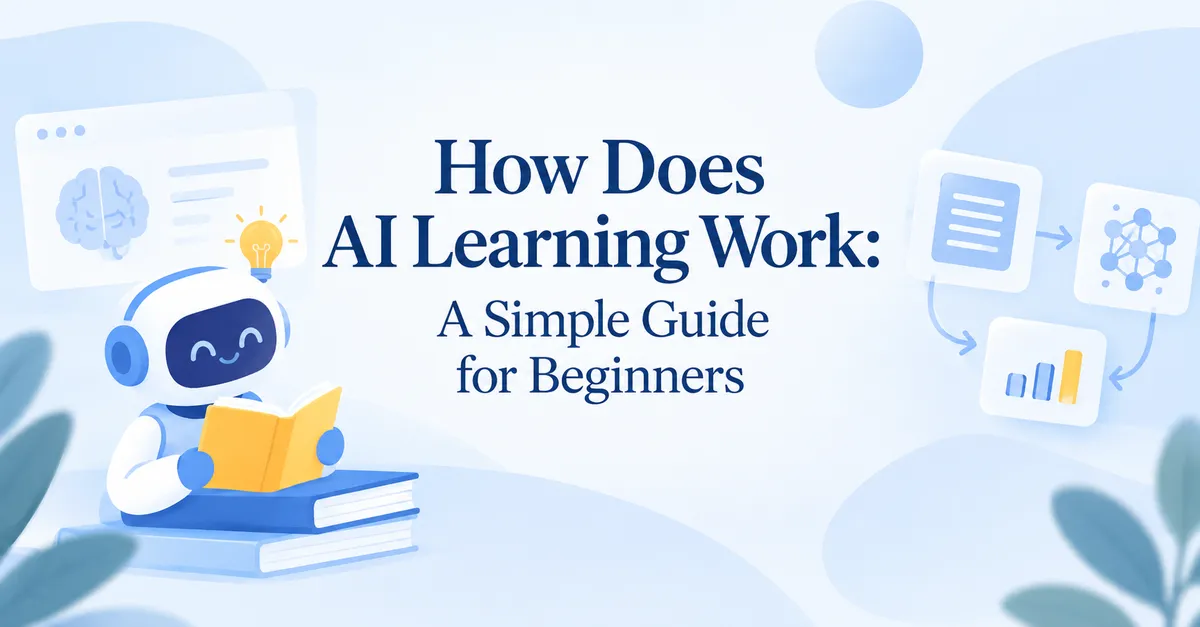
How does AI learning work? This question sits at the heart of modern technology.
Artificial intelligence powers recommendation systems, medical diagnostics, and autonomous vehicles. What makes these systems valuable is their ability to learn from data and improve over time.
Understanding how does AI learning work helps businesses and individuals use these tools more effectively. This article breaks down the learning process, explores different methods, and explains why training data matters so much.
For a clearer comparison of core concepts, this guide on machine learning vs AI offers useful context.
Eduma – Education WordPress Theme
We provide an amazing WordPress theme with fast and responsive designs. Let’s find out!
TL;DR
How artificial intelligence works involves data, algorithms, and continuous improvement. The process includes data collection, model selection, training, validation, and deployment. Challenges exist, especially around data quality and security. But the potential is immense.
Understanding how does AI learn helps users trust and apply these systems. From healthcare to retail, AI is transforming industries. The future promises even more advances.
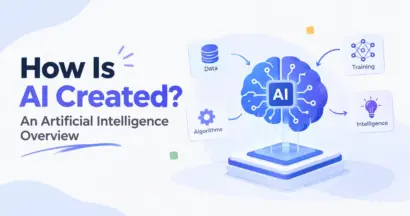
Where Did Artificial Intelligence Come From?
The story of artificial intelligence begins in the mid-20th century. Researchers wanted to build machines that could mimic human reasoning. The term “artificial intelligence” was coined in 1956 at the Dartmouth Conference. Early efforts focused on symbolic reasoning and expert systems.
Over decades, AI evolved through several phases. Early enthusiasm gave way to periods of reduced funding, often called “AI winters.” Each time, new breakthroughs revived interest. The rise of big data and powerful computers accelerated progress. Today, AI is embedded in everyday tools, from search engines to voice assistants.
Understanding where did artificial intelligence come from helps explain why AI was made. The goal was always practical: create systems that can solve problems, make decisions, and learn from experience.

How Does AI Actually Work?
At its core, how does AI actually work involves processing large amounts of data to find patterns. Traditional programs follow fixed rules. AI systems, by contrast, learn from examples. They adjust their internal parameters to improve accuracy.
Here is a simple way to think about it:
- Input: Data enters the system (images, text, numbers)
- Processing: Algorithms analyze the data and identify relationships
- Output: The system produces a prediction, classification, or decision
- Feedback: Results are compared to expected outcomes, and the model adjusts
This cycle repeats many times. Each round improves performance. That is how AI works in practice.
How Does Artificial Intelligence Learn?
Learning is what separates AI from conventional software. How does artificial intelligence learn? It learns by analyzing data, identifying patterns, and adjusting its behavior to reduce errors.
The analogy to human learning is useful but not perfect. Humans learn from experience, experimentation, and instruction. AI learns from data and feedback. Neural networks, inspired by the brain, are a key part of this process. They consist of layers of connected nodes that process information at different levels of abstraction.
All AI models share one requirement: they must adapt based on data. If a system cannot learn, it is not truly artificial intelligence.
1. The Process of AI Learning: Step by Step
How does AI learning work in practice? The process follows a structured path. Each stage matters for the final result.
Step 1: Data Collection and Preparation
Data is the foundation. Relevant data must be gathered, cleaned, and formatted. This step often takes significant time and resources. Poor data leads to poor results. Many teams rely on dedicated AI tools for data analysis to handle this stage efficiently.
Step 2: Model and Algorithm Selection
The next step is choosing the right model and algorithm. The choice depends on the problem type, available data, and desired performance. Different tasks require different approaches.
Step 3: Model Training
Training involves feeding data into the model and adjusting its parameters. The goal is to minimize prediction error. This process is iterative and often requires large datasets.
Step 4: Validation and Testing
After training, the model is tested on separate data. This checks whether it works on unseen examples. It also helps detect overfitting (too much focus on training data) or underfitting (poor learning).
Step 5: Implementation and Monitoring
The final model is deployed in a real environment. It makes predictions or supports decisions. Continuous monitoring is essential. Data changes over time, so models need regular updates.
2. Types of Machine Learning Algorithms
Artificial intelligence uses several machine learning approaches. Each has strengths and suitable use cases.
Machine Learning (ML)
Machine learning allows systems to learn from data without explicit programming. Algorithms analyze input, find patterns, and make predictions. Examples include image classification, sentiment analysis, and demand forecasting.
Neural Networks
Neural networks are mathematical models inspired by the brain. Deep neural networks use multiple layers to process data at different levels of abstraction. They excel in image and sound processing.
Deep Learning (DL)
Deep learning is a subset of machine learning. It uses multi-layered neural networks to handle large amounts of unstructured data. Applications include speech recognition, language translation, and medical diagnostics. This technology also underpins modern large language model systems used in text generation.
Robotics
Robotics involves designing and operating robots. In AI, robotics often uses machine learning for navigation, object manipulation, and interaction with dynamic environments. The line between automation vs AI is worth understanding here, since robots can combine both.
3. Machine Learning Methods: Supervised, Unsupervised, and Reinforcement

How AI works depends on the learning method. There are three main types.
| Method | How It Works | Common Uses |
| Supervised Learning | Trained on labeled data (input + correct output) | Classification, regression |
| Unsupervised Learning | Finds patterns in unlabeled data | Clustering, association |
| Reinforcement Learning | Learns through rewards and penalties | Games, robotics |
Supervised Learning
The model learns from labeled examples. Each example includes input features and the correct output. The goal is to predict labels for new data. Common tasks include classification (assigning categories) and regression (predicting continuous values).
Unsupervised Learning
The model receives only input data without labels. It discovers structure or patterns. Clustering groups similar data. Association finds rules between items, like market basket analysis.
Reinforcement Learning
An agent learns by interacting with an environment. It receives rewards for good actions and penalties for bad ones. Through trial and error, it optimizes behavior. This method powers game-playing algorithms and robotic control.
4. Challenges of AI Learning
Data drives machine learning, but data brings challenges. Quality, accuracy, and completeness are critical. Models struggle to distinguish malicious input from valid data. They also have trouble identifying incorrect information. The rise of AI-generated content adds another layer of complexity to data quality checks.
Training data often comes from public databases. These can be targets for cyberattacks. Over time, malicious data can be treated as correct if its format looks normal.
The consequences of errors can be severe. In medicine, a wrong decision can be tragic. In business, it can cause reputational damage, financial loss, and legal issues. Another challenge is explainability. When AI makes a decision, it is often hard to provide evidence supporting it. This limits trust and creates barriers in courts and public opinion.
Understanding Training Data
Whether supervised or unsupervised, training data is essential. The quality and availability of data—and its ongoing expansion—determine how well AI systems perform.
Advanced models can add their own results to training data, but this usually requires human oversight. A system must know when something is successful or not. The original training data sets the benchmark. Over time, new results influence behavior to optimize success rates.
Here is why more data matters:
- Remove human bias: More data reduces the impact of individual biases. Statistics support this: more data points lead to better correlations.
- Cater to outliers: Outliers occur. Large datasets help handle these unusual cases.
- Give AI freedom: In unsupervised learning, AI needs room to make decisions. Quality data and clear goals support this.
Data Security Methods
Securing data and models protects confidentiality and ensures accurate decision-making. Several methods help.
- Data Encryption: Encrypt stored and in-transit data. Even if intercepted, it remains unreadable without keys.
- Identity and Access Management (IAM): Control who accesses data and models. Users should only access what they need.
- Regular Audits and Monitoring: Conduct security audits and monitor systems in real time. This detects suspicious activity early.
- Protection Against Attacks: Prepare for external and internal threats. Use firewalls, intrusion detection, and antivirus tools.
- Secure Storage of AI Models: Store valuable models in controlled environments. Use secure servers or isolated systems.
- Employee Training: Train staff on data security regularly. Knowledge reduces risk.
- Incident Management: Have a response plan. Identify, assess, counter, and report incidents quickly.
- Secure Data Sharing: Use secure portals, tokenization, or temporary access keys when sharing data externally.
Real-World Integration
Understanding the theory is only half the picture; seeing how does AI work in practical environments highlights its utility.
- Healthcare: Algorithms analyze X-rays and MRI scans faster than human radiologists, identifying microscopic anomalies that indicate early-stage diseases.
- Finance: High-frequency trading platforms use machine learning to analyze market sentiment and historical data to execute trades in milliseconds.
- Customer Service: Chatbots utilize natural language processing to understand user intent, extract relevant information from company databases, and generate helpful, context-aware responses.
Every time a streaming service recommends a movie, or a navigation app recalculates a route to avoid traffic, these learning models are executing their trained functions in real time.
The Continuous Evolution of the Technology
The landscape of machine learning is not static. As hardware becomes more powerful and datasets grow larger, the capabilities of these systems will expand. Developers are constantly refining algorithms to require less training data and consume less computational energy. While the fundamental answer to how does AI learning work remains rooted in statistics and pattern recognition, the scale and efficiency of these processes are improving daily.
This continuous refinement ensures that systems become more accurate, less biased, and increasingly integrated into vital infrastructure, forever changing the way digital tools interact with the physical world.
Conclusion
How does AI learning work? It combines data, algorithms, and feedback. The process mirrors human learning but relies on computation. From origins in the 1950s to modern deep learning, AI has come far. Challenges remain, especially around data quality and security. Yet the potential is vast.
Understanding how AI works empowers better use and informed decisions. As technology advances, AI will continue to shape industries and daily life.
For those in education, using AI in eLearning is already showing how these systems can personalize and improve learning outcomes.
FAQs
1. Does machine intelligence understand the text it writes?
No, the system does not possess conscious understanding or biological comprehension. It utilizes complex statistical models to predict the most probable next word or sequence of words based on the massive datasets it analyzed during its training phase.
2. Can algorithms learn on their own without human intervention?
While some frameworks like unsupervised learning and reinforcement learning require less direct human labeling, humans still set the initial parameters, define the reward structures, and select the training data. Truly autonomous learning without any human-defined framework does not currently exist.
3. What is the difference between standard software and intelligent algorithms?
Standard software follows strict, hard-coded rules written by programmers (e.g., “If X happens, do Y”). Intelligent algorithms figure out the rules themselves by analyzing data. They adapt and improve their performance over time rather than just executing rigid, predefined instructions.
4. Why do these systems sometimes produce incorrect or fabricated information?
Because the technology operates on statistical probability rather than definitive factual databases, it can occasionally generate an output that is statistically likely but factually wrong. This phenomenon, often referred to as a “hallucination,” occurs when the training data is incomplete or the prompt falls outside the algorithm’s core parameters.
5. How much data is actually required to train these systems effectively?
The requirement varies depending on the complexity of the task. A simple algorithmic model for predicting housing prices might only need thousands of data points. Conversely, advanced natural language models require billions of parameters, encompassing vast portions of the public internet, to function smoothly.
Read more: Become AI Developer Guide: Skills, Roadmap and Tips
Contact US | ThimPress:
Website: https://thimpress.com/
Fanpage: https://www.facebook.com/ThimPress
YouTube: https://www.youtube.com/c/ThimPressDesign
Twitter (X): https://x.com/thimpress_com