Choosing an AI course can feel like picking a trail in a forest with no map. Hundreds of programs promise to make you job-ready, yet many are either too shallow or too technical for where you are today.
This guide explains what a good AI course teaches, how to compare your options, and which programs deserve your time in 2026.
Eduma – Education WordPress Theme
We provide an amazing WordPress theme with fast and responsive designs. Let’s find out!
What an AI course teaches
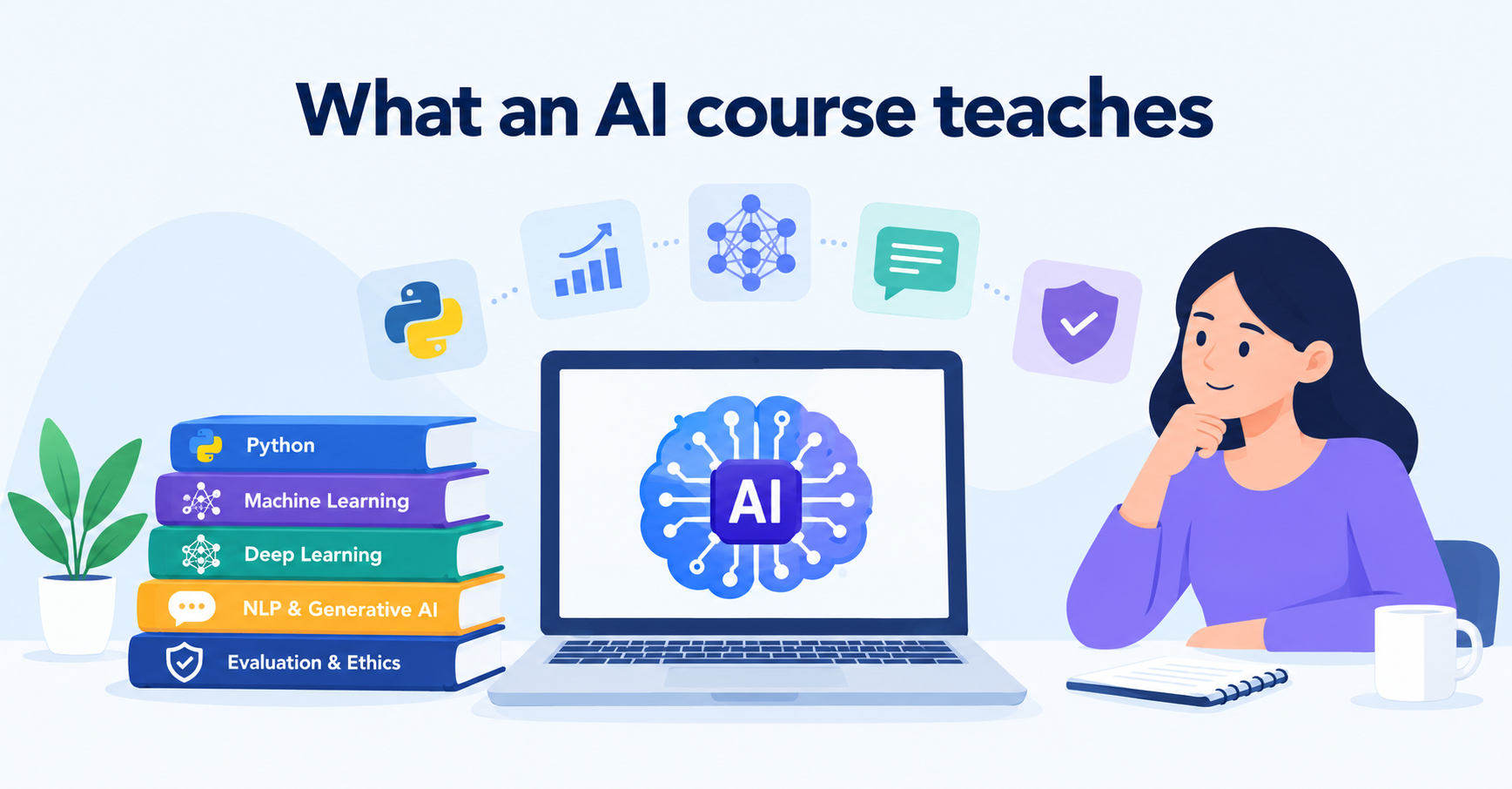
An AI course teaches you how computers learn from data and how to use that ability to solve real problems. The depth depends on the level: some courses explain concepts in plain language, while others have you train models in code.
Core topics you should expect
Artificial intelligence is the field of computer science that builds systems able to perform tasks that normally need human judgment, such as recognizing images, understanding language, and making predictions. A solid course covers these topics:
- Python basics and data handling
- Supervised and unsupervised machine learning
- Neural networks and deep learning
- Natural language processing and generative AI
- Model evaluation, bias, and responsible use
If a syllabus skips evaluation and ethics, treat that as a warning sign. Those topics separate a serious program from a short promotional video.
Why understanding artificial intelligence matters even if you do not code
Understanding artificial intelligence helps managers, teachers, marketers, and designers ask better questions about the tools they use every day. You do not need to build a model to judge whether an AI tool is accurate, fair, or safe for your work. Non-technical courses exist for exactly this reason, and they usually take a few hours rather than a few months.
Types of AI training courses
AI training courses come in several formats, and each fits a different goal:
- Short courses: two to ten hours, good for a first look.
- Specializations: several linked courses with projects, good for career changers.
- Bootcamps: fast and intensive, usually with mentor support.
- University programs: deeper theory, longer and more expensive.
- Vendor certificates: focused on a cloud platform such as Azure, AWS, or Google Cloud.
How can I learn artificial intelligence from scratch?
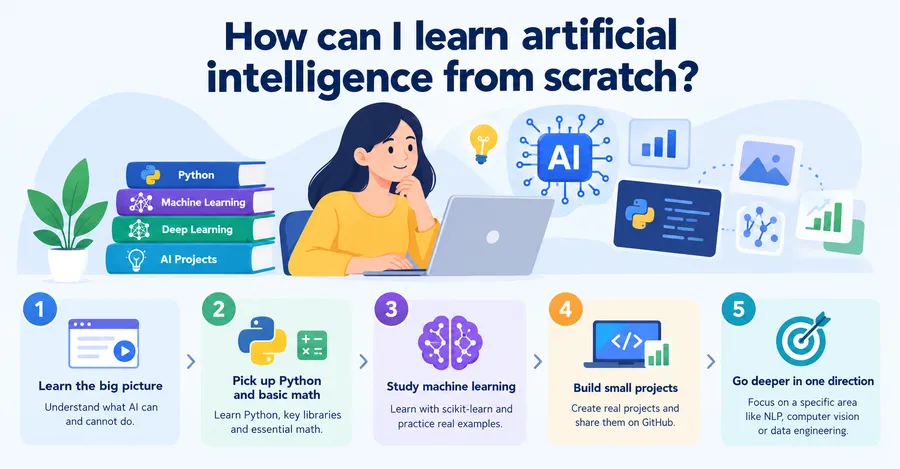
If you are asking how can I learn artificial intelligence with no background, the answer is to move in small, ordered steps. Jumping straight into deep learning is the most common reason beginners quit.
Step 1: Learn the big picture
Start with a non-technical course that explains what AI can and cannot do. You should finish it able to describe machine learning, training data, and a model in your own words. This takes a weekend for most people.
Step 2: Pick up Python and basic math
Python is the standard language for AI work. Learn variables, loops, functions, and libraries such as NumPy and pandas. For math, a refresher on averages, probability, and basic algebra is enough to begin. You can add linear algebra later, when a course needs it.
Step 3: Study machine learning
Next, take a course that teaches classic machine learning with scikit-learn: regression, classification, and clustering. Run every example yourself instead of only watching. Changing a dataset or a setting and seeing the result change teaches more than any lecture.
Step 4: Build small projects
Projects turn knowledge into proof. Good first ideas include a spam filter, a house price predictor, or a simple image classifier. Publish your notebooks on GitHub with a short README that explains the problem, the data, and the result. Hiring managers read these.
Step 5: Go deeper in one direction
After the basics, choose one area, such as language models, computer vision, or data engineering, and study it for a few months. Depth in one area beats shallow knowledge of everything.
6+ Best AI course for beginners: comparison table
The best AI course for beginners is one that matches your starting point, not the one with the biggest brand. The table below compares well-known options so you can see the differences at a glance.
| Course | Provider | Level | Best for | Cost model |
|---|---|---|---|---|
| AI for Everyone | DeepLearning.AI on Coursera | Beginner, no coding | Managers, business teams | Usually free to audit, paid certificate |
| Elements of AI | University of Helsinki | Beginner, no coding | Curious learners, first look | Free |
| Google AI Essentials | Google on Coursera | Beginner | Workplace AI skills | Subscription |
| CS50’s Introduction to AI with Python | Harvard on edX | Intermediate, needs Python | Aspiring developers | Free to audit, optional paid certificate |
| Machine Learning Specialization | DeepLearning.AI and Stanford Online | Beginner to intermediate | Core machine learning skills | Subscription |
| IBM AI Engineering Professional Certificate | IBM on Coursera | Intermediate | Career changers | Subscription |
Cost models change, so check the current price on each page.
How to read this table
If you have never written code, begin with AI for Everyone or Elements of AI. Both take only a few hours and give you the vocabulary to follow later courses. If you are comfortable with Python, jump to the Machine Learning Specialization, which is widely used as a first technical course.
Best AI courses for different goals
The best AI courses depend on what you want from them:
- Workplace productivity: Google AI Essentials.
- Strong theory with code: CS50’s Introduction to AI with Python.
- Job-focused practice: IBM AI Engineering Professional Certificate.
- Low risk, zero cost: Elements of AI.
Best AI courses for becoming an artificial intelligence developer
To work as an artificial intelligence developer, you need a course path that ends with deployed projects, not just certificates. Employers want to see that you can take a model from a notebook to something that runs.
Skills employers look for
Most junior job listings ask for a similar set of skills:
- Python, plus libraries such as scikit-learn, PyTorch, or TensorFlow
- SQL and data cleaning
- Git and basic software testing habits
- Cloud deployment on AWS, Azure, or Google Cloud
- Working with large language model APIs
A simple learning path
A practical order is the Machine Learning Specialization, then a deep learning course, then one cloud certificate. Along the way, build at least three projects. One could use tabular data, one images, and one text. Write a short report for each that states the goal, your approach, and what went wrong. Honest notes about failures show real experience and help you stand out.
5+ Best and most demanding AI certificate options
When people search for the best and most demanding AI certificate, they usually mean two things: certificates employers ask for, and certificates that are hard to pass. Cloud vendor exams often fit both. The table lists common choices.
| Certificate | Provider | Level | Good for |
|---|---|---|---|
| Azure AI Fundamentals (AI-900) | Microsoft | Entry | Proving basic AI knowledge |
| AWS Certified AI Practitioner | Amazon Web Services | Entry | Non-engineers and new learners |
| AWS Certified Machine Learning Engineer, Associate | Amazon Web Services | Intermediate | Building and deploying models |
| Professional Machine Learning Engineer | Google Cloud | Advanced | Experienced practitioners |
| IBM AI Engineering Professional Certificate | IBM | Intermediate | Portfolio and job preparation |
Vendors retire and rename exams from time to time, so confirm that an exam is active before you start studying.
How much a certificate really helps
A certificate shows that you studied a defined syllabus and passed a test. It does not prove you can solve messy, real-world problems. The strongest applications combine a recognized certificate with a public project portfolio. If you must choose one, choose the portfolio.
Which level to aim for
Start with an entry-level exam if you are new. Move to associate level once you have built a few projects on the same cloud platform. Save advanced exams for when you have at least a year of hands-on work, because those tests expect practical judgment.
How to choose the right AI training course
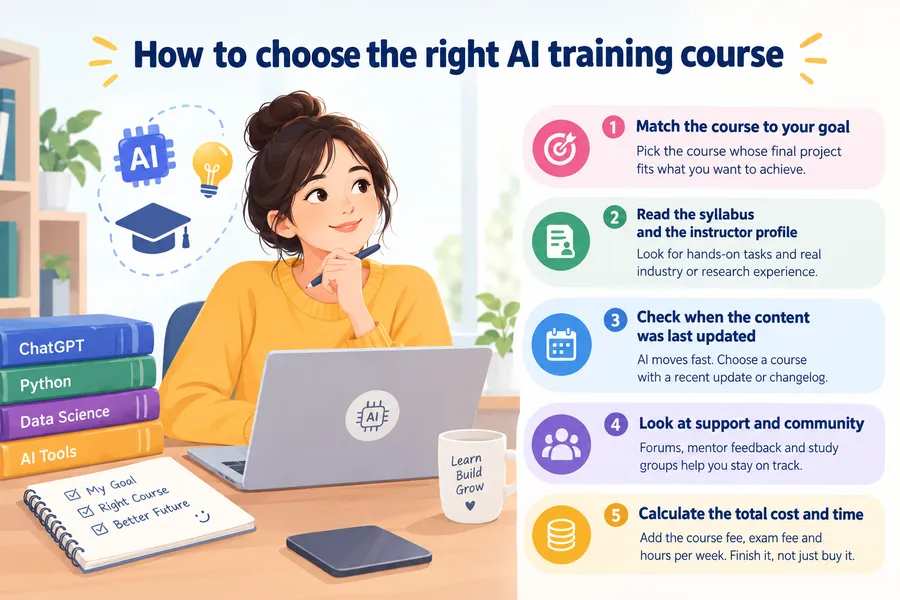
Any AI course should pass a short checklist before you spend money. Use the points below to compare two or three finalists.
Match the course to your goal
Write one sentence about what you want: “I want to use AI tools at work,” or “I want a junior developer job in twelve months.” Then pick the course whose final project looks like that goal.
Read the syllabus and the instructor profile
Open the syllabus and check that each week has a hands-on task. Look up the instructor. Real industry or research experience matters more than a long list of followers.
Check when the content was last updated
AI changes quickly, especially generative AI. Look for a recent update date or a changelog. A course that still treats a 2021 tool as the latest option will leave you behind.
Look at support and community
Forums, mentor feedback, and study groups keep people moving when a concept gets hard. Self-paced courses with no support have the highest dropout rates, so be honest about how much structure you need.
Calculate the total cost and time
Add up the course fee, the exam fee, and the hours per week you can really give. A cheap course you never finish costs more than a fair-priced one you complete.
Common mistakes to avoid
Most beginners lose time in the same few ways:
- Starting with advanced deep learning before learning Python basics.
- Collecting certificates without building any projects.
- Switching courses every two weeks instead of finishing one.
- Trusting a course only because of a famous logo.
- Copying notebook code without changing it to see what happens.
Build and sell your own AI course with Eduma and LearnPress
If you already know AI and want to teach it, WordPress is a practical place to start. Eduma is an education WordPress theme from ThimPress, and LearnPress is a free LMS plugin that adds courses, lessons, and quizzes to a WordPress site. Together they let you run a course site without writing code. Features and add-ons change by version, so check the current documentation first.
A simple setup looks like this:
- Install a WordPress site and activate the Eduma theme.
- Install and activate the LearnPress plugin, then run its setup wizard.
- Create a course, then add sections, lessons, and quizzes.
- Set a price, or keep the course free to build an audience first.
- Add a certificate or payment add-on if your plan needs one.
This route suits instructors, bootcamps, and companies that want to train staff on their own domain instead of renting space on a marketplace.
FAQs about the best AI course
1. How long does it take to finish an AI course?
It depends on the level. A beginner course can take 5 to 10 hours, while a full specialization often takes three to six months at a few hours per week. Choose a pace you can keep for the whole length, because consistency matters more than speed.
2. Do I need a degree to work in AI?
No, a degree is not always required. Many roles accept strong projects, relevant certificates, and proven skills, especially in applied and junior positions. Research roles and some large employers still prefer a master’s or PhD.
3. Are free AI courses good enough?
Some are excellent. University-backed courses such as Elements of AI and CS50’s Introduction to AI with Python teach real content at no cost. The paid part is often a certificate, mentor feedback, or graded projects, so decide whether you need those extras.
4. Can I study AI while working a full-time job?
Yes. Most self-paced courses are built for working adults. Plan three or four short sessions per week, keep a fixed time slot, and use weekends for projects. Small, steady blocks work better than one long weekend marathon.
5. What skills should I learn before taking an AI course?
Basic computer skills are enough for non-technical AI courses. If you want to study machine learning or become an AI developer, learn Python, basic algebra, probability, and data handling first. These foundations will make technical lessons easier to understand.
6. Is an AI certificate enough to get a job?
An AI certificate can demonstrate your knowledge, but it does not guarantee employment. Employers often look for practical skills, problem-solving ability, and real projects. Combine a recognized certificate with a portfolio of AI projects to strengthen your job applications.
Conclusion
The right AI course is the one that fits your starting point, your goal, and your schedule. Beginners should start with a light, non-technical program, then add Python and machine learning step by step. Anyone aiming to become an artificial intelligence developer should pair courses with real projects and, later, a cloud certificate. Compare two or three options with the checklist above, finish one course before starting another, and publish your work as you go. If you want to teach what you learn, Eduma and LearnPress give you an easy way to turn your knowledge into a course of your own.
Read more: 8+ Best Business Analytics Tools: Compared and Ranked
Contact US | ThimPress:
Website: https://thimpress.com/
Fanpage: https://www.facebook.com/ThimPress
YouTube: https://www.youtube.com/c/ThimPressDesign
Twitter (X): https://x.com/thimpress_com