If you have ever looked at a Shopify store and wondered how the company behind it turns a profit, you are not alone.
How does Shopify make money while also letting merchants keep the bulk of their own sales?
The short answer is that Shopify runs on a mix of subscription fees, payment processing, and a growing list of merchant services, and understanding that mix also tells you a lot about whether you can make money using Shopify yourself.
Let’s get started!
COMA – Modern Multipurpose Shopify Theme OS 2.0
We provide an amazing Shopify theme with fast and responsive designs. Let’s find out!
What is Shopify and how the business actually works
Shopify is not a marketplace like Amazon or Etsy. It is software that store owners rent to build, run, and grow their own online stores. That distinction matters, because it shapes every revenue stream Shopify has.
A subscription-first platform with several add-on layers
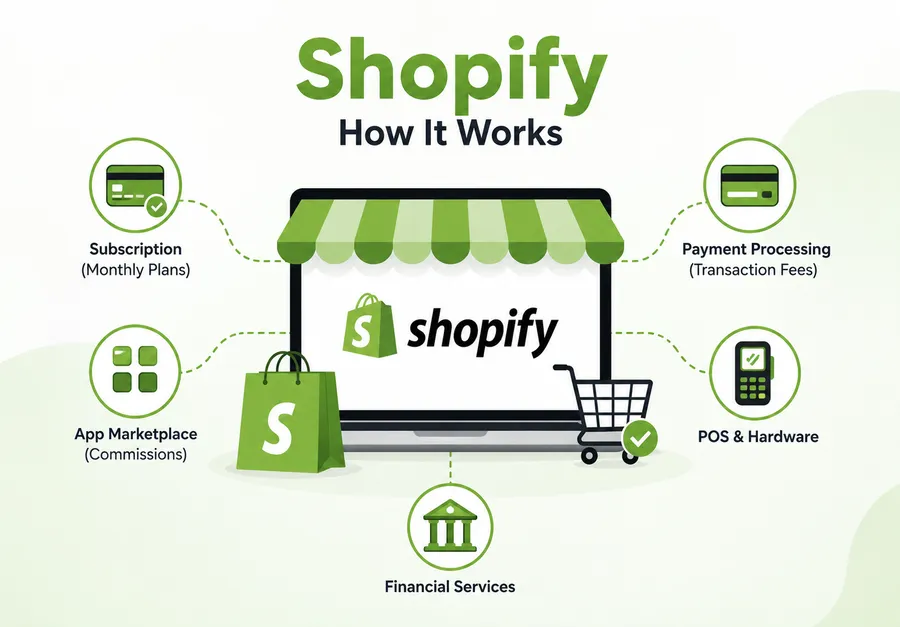
At its core, Shopify charges merchants a monthly fee to use the platform, the same way a landlord charges rent. On top of that base subscription, Shopify layers in payment processing, app marketplace commissions, point-of-sale hardware, financial products, and enterprise services for larger brands. Each layer adds a new way for Shopify to earn revenue without raising the base subscription price, which is part of why the company has grown from a small Ottawa startup into one of the largest eCommerce platforms in the world.
Why the model works for both sides
Shopify’s incentive is tied directly to merchant success. The more a store sells, the more Shopify earns through payment processing, so the company keeps investing in checkout conversion, storefront speed, and AI tools like Sidekick that help merchants sell more. That alignment is worth keeping in mind whenever the question of how does Shopify make money comes up, because it explains why so much of the platform’s roadmap is aimed at merchant growth rather than just adding new fees.
How does Shopify make money: the core revenue streams
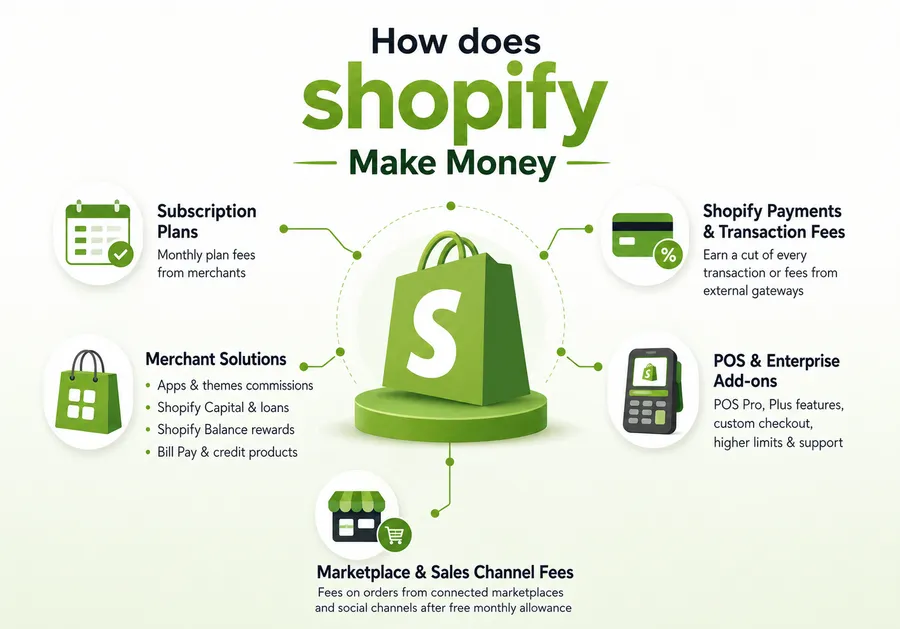
Shopify’s income breaks down into a handful of clear categories. Once you see them laid out, the whole picture of how does Shopify make money becomes much easier to follow.
Subscription plans
The most obvious source is the monthly plan fee every store owner pays. According to Shopify’s current pricing page, the Basic plan starts at $19 a month when billed yearly, Grow runs $49 a month, Advanced is $299 a month, and Shopify Plus, built for large or complex businesses, starts from $2,300 a month. Multiply that across millions of active stores and the subscription tier alone becomes a massive, predictable revenue base.
Each tier unlocks more staff accounts, higher API rate limits, and deeper customization, which nudges growing merchants to upgrade on their own as their store scales. A solo entrepreneur running a Basic store today may need Grow’s five staff seats within a year, and a merchant expanding into wholesale eventually needs Advanced or Plus for unlimited B2B catalogs. That natural upgrade path is baked into the plan structure and is one of the quieter reasons subscription revenue keeps climbing even without new customers signing up.
Shopify Payments and transaction fees
The second major stream comes from payments. When a merchant uses Shopify Payments, the platform’s built-in checkout processor, Shopify earns a cut of every card transaction. Merchants who choose to use an outside payment gateway instead still pay Shopify an additional transaction fee, which is one reason most store owners end up sticking with the native payment option. This is arguably the single biggest answer to how does Shopify make money at scale, since it grows automatically as merchant sales grow.
Merchant Solutions: apps, themes, capital, and more
Shopify groups a wide range of services under what it calls Merchant Solutions. This includes:
- Commissions from paid Shopify apps and themes sold through the Shopify App Store and Theme Store
- Shopify Capital, which offers merchant cash advances and loans, funded in the US through WebBank
- Shopify Balance, a business account that pays merchants a reward rate, currently 2.29% for most plans and 3.31% for Plus stores, according to Shopify’s published terms
- Shopify Bill Pay, run through a partnership with Melio, for scheduling and managing vendor payments
- Shopify Capital and Credit products, including a pay-in-full Visa card with cashback on marketing, fulfillment, or wholesale spend
Point of sale and enterprise add-ons
Physical retailers pay extra for POS Pro, an add-on priced at $89 a month per location on standard plans, while Plus merchants get 20 locations included. Larger brands on Shopify Plus also pay for features like custom checkout extensions, higher API limits, and dedicated support, all of which add incremental revenue on top of the base subscription.
Put together, these layers explain why Shopify’s business model is often described as picks-and-shovels commerce. The company earns money whether a merchant succeeds wildly or just gets by, because the subscription and payment fees keep flowing either way.
Marketplace and sales channel fees
Shopify also earns from orders that come in through connected marketplaces and social channels, not just the main storefront. Merchants get 50 synced marketplace orders included free each month, and after that, Shopify charges 1% of order value up to a $99 monthly cap. That fee structure encourages merchants to sell across Instagram, TikTok, and third-party marketplaces while still routing a small cut back to Shopify, which is another quiet contributor to the answer to how does Shopify make money at scale.
Can you make money from Shopify as a store owner
Understanding Shopify’s own revenue is one thing. The question most people actually care about is simpler: can you make money from Shopify if you are the one running the store, not the platform?
Do Shopify stores make money in practice
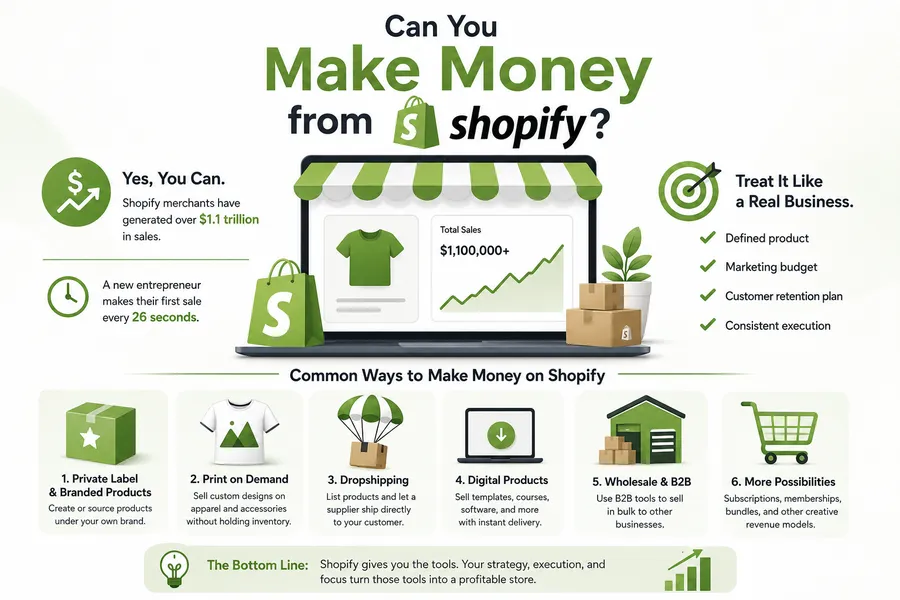
Yes, plenty of them do, but not automatically. Shopify reports that merchants have collectively generated over $1.1 trillion in cumulative sales on the platform, and the company says a new entrepreneur makes their first sale roughly every 26 seconds. Those numbers prove the platform works at scale, but they say nothing about any individual store’s odds. Do Shopify stores make money? The ones that treat it like a real business, with a defined product, a marketing budget, and a plan for customer retention, generally do. The ones set up as a weekend experiment with no traffic strategy usually do not.
How to make money Shopify style: the common paths
There is no single formula, but most profitable Shopify stores fall into a handful of models:
- Private label and branded products, where you manufacture or source a product under your own brand
- Print on demand, selling custom designs on apparel or accessories without holding inventory
- Dropshipping, listing products that a supplier ships directly to the customer
- Digital products, such as templates, courses, or software sold through Shopify’s digital delivery apps
- Wholesale and B2B, using Shopify’s B2B catalog tools to sell in bulk to other businesses
Each path answers the question of how to make money Shopify offers a little differently, but they all rely on the same underlying store, checkout, and payment infrastructure.
How much can you make with Shopify
This is the question with the widest range of honest answers, because store revenue depends entirely on the merchant, not the platform.
Realistic expectations for new stores
New store owners often earn very little in the first few months while they test products and build an audience. It is common for a first store to bring in a few hundred dollars a month in the early stage, simply because traffic and trust take time to build. That is normal, not a sign the platform is broken.
Most of that early period is spent testing, not earning: trying different product angles, adjusting pricing, and figuring out which ad creative or organic channel actually brings buyers instead of just browsers. Store owners who track this testing phase as data collection, rather than expecting immediate profit, tend to make faster progress once they find an angle that converts.
What separates six-figure stores from stalled ones
So how much can you make with Shopify once a store finds traction? Established merchants running a focused product line, consistent paid or organic traffic, and a conversion-optimized store regularly report six and seven figures in annual revenue. The gap between a stalled store and a thriving one usually comes down to a few concrete factors: product-market fit, page speed and checkout experience, and how well the theme presents the product.
Choosing a theme that actually supports sales
A slow or cluttered theme quietly kills conversions before a marketing budget ever gets a chance to work. If you are setting up on WordPress alongside a Shopify build, or comparing Shopify theme options for a client project, a few ThimPress themes are worth a look.

- COMA – Modern Multipurpose Shopify Theme is built for stores that need a clean, flexible layout across fashion, electronics, or general retail catalogs.
- Gearx – Auto Parts, Motorcycle, Vehicles Shopify Theme is tailored specifically for automotive and vehicle parts sellers who need spec-heavy product pages and filtering.
- Classy – Minimal Multipurpose Shopify Theme suits brands that want a stripped-down, fast-loading storefront without sacrificing design polish
- Lusion – Multipurpose eCommerce Shopify Theme offers a broader set of pre-built sections for stores that sell across several product categories at once.
Picking a theme that matches your niche is a small decision that has an outsized effect on how much you can make with Shopify over time.
Making money using Shopify: what actually moves the needle
Once a store is live, a handful of habits separate stores that grow from stores that stall out.
Optimize theme performance and checkout
Page speed and a smooth checkout are not optional extras. Shopify’s own checkout is built to convert better than many alternatives, but a heavy, unoptimized Shopify theme can undo that advantage. Compressing images, limiting third-party scripts, and choosing a lightweight theme all protect conversion rate.
Use Shopify’s built-in marketing and Sidekick
Shopify includes email campaigns, abandoned checkout recovery, discount codes, and Sidekick, its AI assistant for store tasks and content, on every plan. Store owners who actually use these built-in tools, instead of paying for a separate app to do the same job, tend to keep more margin, which directly affects how much you can make with Shopify after expenses.
Track the numbers that matter
Shopify’s analytics dashboard reports over 200 real-time metrics on every plan. Watching conversion rate, average order value, and repeat purchase rate week over week is what turns making money on Shopify from guesswork into a repeatable process.
It also helps to separate revenue from profit early on. A store doing $10,000 a month in sales can still lose money once ad spend, app subscriptions, shipping, and the Shopify plan fee are subtracted. Reviewing that full cost breakdown monthly, not just the top-line sales number, is what keeps a growing store actually profitable instead of just busy.
Shopify plan comparison table
| Plan | Price (billed yearly) | Best for | Staff accounts | Cashback on sales |
| Basic | $19/mo | Solo entrepreneurs starting out | Not included | Up to $3,500 |
| Grow | $49/mo | Small teams scaling up | Up to 5 | Up to $5,000 |
| Advanced | $299/mo | Stores selling globally | Up to 15 | Up to $7,000 |
| Plus | From $2,300/mo | Complex, high-volume businesses | Unlimited | Up to $10,000 |
FAQs
Does Shopify take a percentage of every sale?
Shopify does not take a flat percentage cut the way a marketplace does, but it does charge a transaction fee when merchants use an outside payment gateway instead of Shopify Payments. Merchants who use Shopify Payments avoid that extra fee and only pay standard card processing rates.
Is Shopify itself a profitable company?
Shopify’s revenue comes from a diversified mix of subscriptions, payment processing, and merchant services rather than a single income source, which is part of why it has scaled into a major public company. Its financial reports are publicly available, so exact profit figures should be checked against the company’s most recent quarterly filing.
Can a complete beginner make money on Shopify?
Yes, but it takes more than opening a store. Beginners who succeed usually pick one specific product niche, invest time in a theme and product pages that load fast, and commit to consistent marketing rather than expecting sales to appear on their own.
How long does it typically take to become profitable on Shopify?
Most new stores need at least three to six months of consistent traffic and testing before profitability becomes stable, though this varies widely by niche, ad spend, and product margin. Stores with an existing audience or email list from another channel often see faster results.
Conclusion
Shopify’s business model is built to succeed whether a merchant scales into a seven-figure brand or stays a small side project, because subscription and payment revenue accrue either way. That said, the platform’s growth and the millions of active stores on it show that making money using Shopify is entirely possible for merchants who treat it like a real business: a focused product, a fast and well-designed theme, and consistent attention to the numbers. Whether you are asking how does Shopify make money out of curiosity or sizing up whether to start a store yourself, the answer comes down to the same idea: value flows to whoever builds something people actually want to buy.
Read more: TOP 10+ Shopify eCommerce Agencies to Hire
Contact US | ThimPress:
Website: https://thimpress.com/
Fanpage: https://www.facebook.com/ThimPress
YouTube: https://www.youtube.com/c/ThimPressDesign
Twitter (X): https://x.com/thimpress_com