Understanding the foundational Shopify definition is essential for modern entrepreneurs navigating the digital marketplace, as commerce relies heavily on accessible, robust infrastructure.
At its core, Shopify operates as an all-inclusive, cloud-based commerce platform designed to help merchants sell products online, across social media channels, and in physical retail locations. If you are comparing leading digital commerce solutions for your store, exploring the top ecommerce platforms can give you a solid head start before launching your commercial ventures.
Furthermore, the shift toward omnichannel retail has made centralized management a necessity rather than a luxury. Modern consumers interact with brands across multiple touchpoints—scrolling through social media feeds, searching on web browsers, visiting brick-and-mortar locations, and browsing digital marketplaces.
Having a platform that seamlessly bridges these disparate environments into a single administrative dashboard enables founders to scale operations smoothly without technical debt.
Eduma – Education WordPress Theme
We provide an amazing WordPress theme with fast and responsive designs. Let’s find out!
Content Overview
| Feature / Aspect | Overview Details |
| Platform Type | Cloud-based, hosted ecommerce platform for digital and physical commerce |
| Core Functionality | Online store builder, payment processing, inventory management, and POS |
| Target Audience | Entrepreneurs, small business owners, retail brands, and global enterprises |
| Primary Advantages | Industry-leading checkout speed, secure hosting, extensive integrations, and scalability |
| Pricing Tiers | Basic, Grow, Advanced, and Plus plans tailored to varying business scales |
What Is the Full Shopify Definition for Ecommerce?
The precise Shopify definition extends far beyond a simple website builder; it represents a unified ecosystem bridging software and hardware for retail operations.
Operating as a Software-as-a-Service (SaaS) solution, the platform handles web hosting, SSL security certificates, core software updates, and payment gateways automatically.
This hands-off technical approach ensures store owners can focus strictly on brand development, product curation, customer service, and growth marketing rather than managing server uptime or applying manual technical patches.
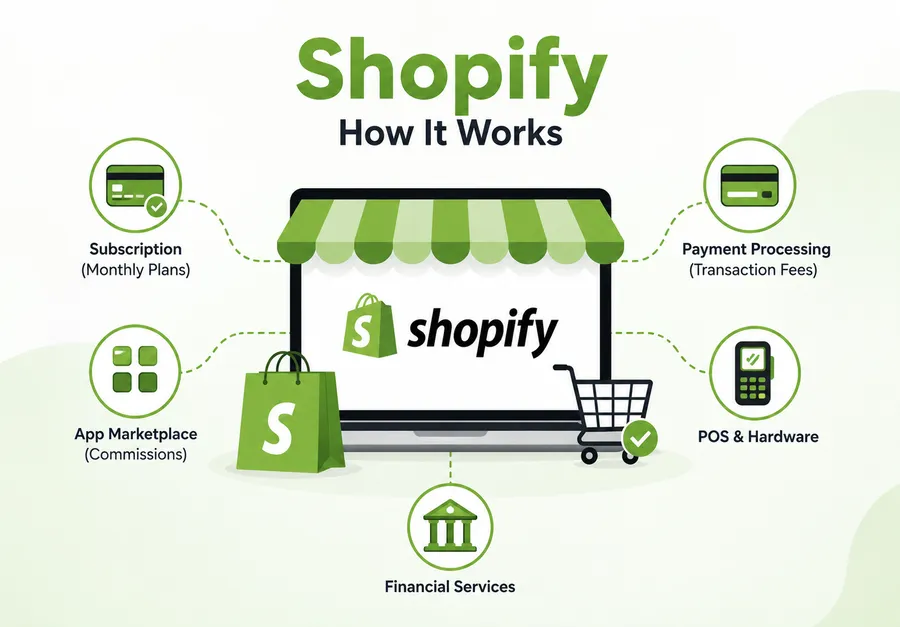
The Shopify Ecosystem Structure
| Sales Channels | Centralized Management Features |
| Online Selling Custom Web Storefront Marketplaces (Amazon, eBay) Social Channels (TikTok, Instagram) | Core System Operations Integrated Checkout & SSL Security Order & Shipping Automation AI-Powered Store Creation Analytics & Financial Tools |
| In-Person Selling Shopify POS Hardware Mobile Card Readers Real-Time Inventory Synchronization |
Every day, millions of merchants across more than 175 countries rely on this ecosystem to power their operations, ranging from side-hustle startups to multinational enterprises operating under a modern what is an ecommerce business model.
The primary benefit of this structured architecture lies in its centralized database system: when an item sells in a physical retail store via a handheld POS device, online inventory levels update instantaneously across connected social media storefronts and web channels, preventing costly stockouts and overselling scenarios.
How Does Shopify Work for Beginners Step by Step?
When embarking on a new digital enterprise, newcomers often ask how does Shopify work for beginners without past technical backgrounds. The platform is engineered specifically to eliminate technical friction, allowing users to launch a functional store through a straightforward process divided into core operational phases.
1. Building and Designing Your Online Storefront
Building a visually appealing storefront does not require writing line after line of code. Merchants can utilize the drag-and-drop online store editor or leverage generative artificial intelligence to design custom themes simply by describing their brand aesthetic.
- Pre-Built Themes: Choose from over 900 mobile-responsive industry themes featuring dynamic scrolling and hover effects, or explore high-performing 20 best free Shopify themes to jumpstart your store design.
- AI Assistance: Utilize built-in tools like Sidekick to generate compelling product descriptions, draft original blog content, and assist in setting up store configurations effortlessly.
- Custom Layouts: Adjust color schemes, typography, navigation menus, and page structures without modifying underlying HTML or CSS stylesheets.
2. Sourcing and Uploading Products
Managing inventory is seamless whether producers create their own handcrafted items or source existing merchandise from suppliers.
- Handmade Goods: Upload high-resolution photographs, set product variants (such as sizes, materials, and colors), configure SKU numbers, and organize items into intuitive collections.
- Dropshipping & Print-on-Demand: Connect directly with verified suppliers or dropshipping apps to automatically import inventory into catalogs without keeping physical stock on hand.
- Wholesale Sourcing: Access wholesale marketplaces like Faire or partner through Shopify Collective to sell products from established brands and ship orders directly from suppliers.
3. Processing Payments and Managing Checkouts
Converting store visitors into paying buyers depends heavily on smooth payment processing and user security.
- Instant Payment Setup: Accept major credit cards, debit cards, local payment gateways, and digital wallet payment methods as soon as stores go live.
- High Conversion Checkout: Utilize Shop Pay—recognized as one of the fastest converting one-tap checkout solutions on the web—to reduce cart abandonment and increase overall conversion rates.
4. Shipping, Delivery, and Fulfillment Automation
Once an order arrives, fulfillment tools streamline the entire packing, dispatch, and tracking routine.
- Shipping Discounts: Print shipping labels directly from dashboards while receiving carrier discounts of up to 88% on shipping rates.
- International Taxes & Tracking: Collect accurate import duties automatically, print customs documentation, and send accurate tracking updates directly to buyers.
- Fulfillment Networks: As volume grows, partner with trusted third-party logistics providers through the Shopify Fulfillment Network for offsite warehousing, inventory distribution, and streamlined customer returns.
Is Shopify Easy to Use for Beginners?
Evaluating usability is crucial before committing time and budget to a platform, leading many new store owners to ask is Shopify easy to use for beginners without past web development experience.
The short answer is affirmative. The user interface is crafted with simplicity in mind, presenting complex backend technical processes through intuitive visual dashboards.
Key Factors Making It Beginner-Friendly
- Zero Coding Required: Users never need to write code to launch a store, change page structures, add navigation links, or update banner images.
- Automated Maintenance: Cloud hosting, regular server backups, platform software updates, and SSL security certificates are completely managed in the background.
- App Store Integrations: Expand store functionality in seconds by picking from over 8,000 third-party apps created for marketing automation, customer support, and inventory tracking.
- Comprehensive Help Resources: Access continuous 24/7 technical assistance, step-by-step documentation, community forums, and certified developer networks.
Because all administrative functions are centralized in one dashboard, managing product lines, customer relationships, email campaigns, and store settings requires minimal effort. Merchants can also streamline store operations using specialized best AI project management tools for ecommerce.
Is Shopify Good for Scaling Your Business Long-Term?
As order volumes increase, online merchants often wonder is Shopify good for supporting long-term growth, high-traffic promotional events, and flash sales.
The platform is explicitly designed to support businesses through every stage of development, moving seamlessly from a merchant’s first sale to enterprise-level global operations. Every 26 seconds, a brand makes its first sale on Shopify, while global powerhouses generate billions through the same underlying network.
Benchmark Performance and Scale
| Metric Category | Platform Scale and Performance |
| Market Presence | Powers ~12% of US Ecommerce |
| Total Platform Sales | Exceeds $1.4 Trillion USD |
| Annual Shoppers Served | Over 875 Million Consumers |
| Global Footprint | Supported in 175+ Countries |
Advanced Features Supporting Business Expansion
- Omnichannel Expansion: Expand sales channels beyond websites to social platforms like TikTok, Instagram, Facebook, and YouTube, or list products on popular marketplaces like Amazon, eBay, Walmart, and Etsy.
- Integrated Point of Sale (POS): Unify online and offline retail operations with dedicated hardware—you can learn how to set up the Shopify Point of Sale (POS) to keep physical store sales synchronized with digital stock in real time.
- Financial Management & Growth Capital: Monitor business expenses, handle regional tax obligations, and access funding options through Shopify Capital or earn cash back on eligible expenses using Shopify Credit.
- Enterprise Infrastructure: High-growth retail brands can upgrade to Plus or Enterprise plans for specialized B2B wholesale portals, headless commerce architectures, and multi-market localization.
Should I Use Shopify for My Online Store?
When choosing an ecommerce foundation, business leaders inevitably weigh alternatives and ask themselves should I use Shopify for their specific retail model.
To determine if it is the right match for an enterprise, review the comparative breakdown below outlining core platform capabilities against traditional open-source alternatives.
Comparative Platform Breakdown
| Evaluation Factor | Shopify Platform | Open-Source Alternatives |
| Setup Time | Ready in hours with guided setups | Days or weeks requiring developer assistance |
| Web Hosting & Security | Built-in secure hosting & SSL certificates | Must purchase separate hosting & security |
| Technical Maintenance | Automatic platform & security updates | Manual plugin updates & server management |
| Checkout Conversion | Industry-leading speed & one-tap Shop Pay | Varies based on plugin configurations |
| Monthly Cost Structure | Predictable monthly plan pricing | Variable server, maintenance, & developer fees |
Shopify Plans and Subscription Costs Explained
Shopify offers tailored subscription plans designed to meet merchants wherever they are in their business journey.
| Subscription Tier | Target Audience and Focus |
| Basic Plan | Ideal for solo entrepreneurs and startups |
| Grow Plan | Designed for expanding small teams |
| Advanced Plan | Built for scaling businesses requiring advanced reporting |
| Plus / Enterprise | Engineered for high-volume enterprise brands |
Merchants can explore features using a free trial before choosing an ongoing plan suited to their operational budget.
Conclusion
Mastering the foundational Shopify definition boils down to recognizing it as a complete commerce operating system. By unifying store design, product sourcing, global shipping discounts, omnichannel marketing, and ultra-fast checkout systems into one cloud-hosted platform, it equips businesses of all sizes to thrive.
Whether launching a side project or expanding a global enterprise, utilizing these integrated commercial tools provides the scalability and reliability required for modern retail success.
Frequently Asked Questions (FAQs): What Is Shopify
Is Shopify good for beginners starting an online store?
Yes, the platform is structured specifically to accommodate beginners through an intuitive visual ecosystem. New store owners can choose pre-designed drag-and-drop themes, customize storefront aesthetics without writing lines of code, and utilize generative artificial intelligence tools like Sidekick to write high-converting product descriptions.
Furthermore, automated cloud hosting, built-in SSL security certificates, and instant payment gateway configurations eliminate the technical barriers typically associated with launching an online business. This allows first-time entrepreneurs to launch fully functional commercial storefronts within a single afternoon while focusing entirely on product selection and customer marketing.
Is Shopify free or does it require a paid subscription?
Shopify is a premium Software-as-a-Service platform, meaning it requires an ongoing paid subscription to maintain active storefront operations. However, new users can begin with a flexible free trial period to build layouts, upload product catalogs, configure tax settings, and explore administrative tools risk-free. Following the initial trial, merchants frequently gain access to limited-time promotional pricing—such as operating their store for $1 per month during the first three months—allowing early-stage businesses to generate initial revenue and validate commercial demand before committing to full-price subscription tiers.
What does Shopify cost on a monthly basis?
Monthly subscription costs scale dynamically based on the specific feature set and operational capacity required by your enterprise. The Basic plan starts at $29 per month when billed annually, providing everything necessary for solo entrepreneurs to manage web channels, print shipping labels, and process card payments. The standard Grow plan expands these capabilities for small teams requiring professional performance analytics, while the Advanced plan serves high-volume stores needing custom report builders and carrier-calculated shipping rates. High-growth enterprise brands can leverage Shopify Plus for bespoke wholesale channels, automated workflows, and reduced payment processing fees.
What items and services can I sell on Shopify?
The platform accommodates an extraordinarily diverse range of commercial offerings, supporting physical products, digital downloads, automated recurring subscriptions, ticketed event registrations, online courses, and professional consulting services. Merchants can create handcrafted inventory, utilize print-on-demand services, establish dropshipping connections with global suppliers, or curate third-party merchandise through wholesale portals like Faire. Provided products adhere to regional legal regulations and the platform’s acceptable use policies, merchants can structure virtually any commercial catalog within their dashboard.
Where can I sell products using Shopify?
Shopify functions as a comprehensive multi-channel commerce hub, empowering merchants to sell anywhere modern consumers shop. Beyond your custom web storefront, you can synchronize product catalogs with social media platforms like TikTok, Instagram, Facebook, and YouTube to drive social commerce sales. Additionally, you can list merchandise directly on global online marketplaces like Amazon, eBay, Walmart, and Etsy while centralizing inventory management in one place. For physical retail, pop-up events, or boutique storefronts, Shopify POS hardware unifies in-person transactions with digital stock levels in real time across 175+ countries.
Read more: Magento Extension Guide: 6 Options for Your eCommerce Store
Contact US | ThimPress:
Website: https://thimpress.com/
Fanpage: https://www.facebook.com/ThimPress
YouTube: https://www.youtube.com/c/ThimPressDesign
Twitter (X): https://x.com/thimpress_com