Shopify has grown from an ecommerce platform for small online stores into one of the world’s largest commerce technology companies. That growth has also made Shopify market cap a closely watched number among investors, ecommerce professionals, marketers, and businesses evaluating the platform.
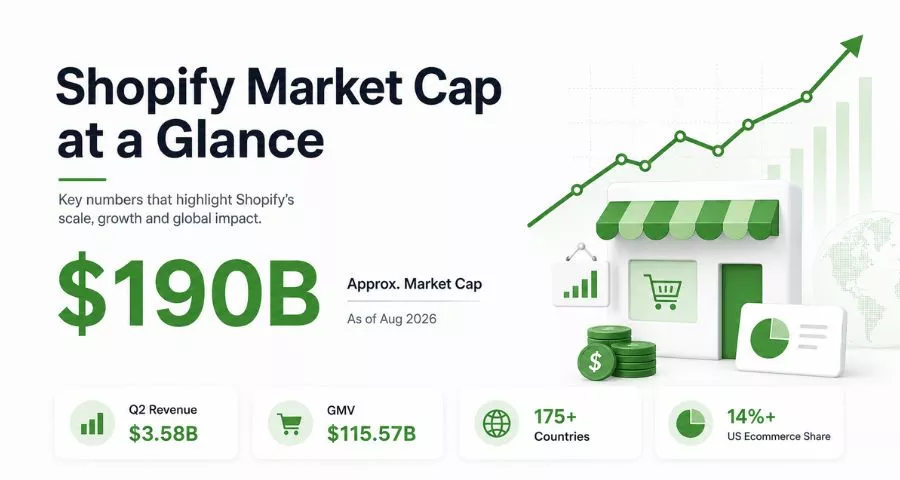
As of August 2026, Shopify’s market capitalization is roughly $190 billion, although the exact figure changes every trading day with Shopify’s share price. The company entered August after market-cap estimates of roughly $165–$170 billion in late July, before Shopify shares jumped more than 18% following stronger-than-expected Q2 2026 results and an optimistic third-quarter outlook.
That valuation puts Shopify firmly among the world’s largest publicly traded software and ecommerce companies.
Eduma – Education WordPress Theme
We provide an amazing WordPress theme with fast and responsive designs. Let’s find out!
Shopify Market Cap: Quick Overview
| Metric | Approximate figure |
|---|---|
| Shopify market cap | ~$190 billion* |
| Stock ticker | SHOP |
| Primary US exchange | NASDAQ |
| Shares outstanding | ~1.30 billion |
| Q2 2026 revenue | $3.58 billion |
| Q2 2026 GMV | $115.57 billion |
| Q2 2026 revenue growth | 34% YoY |
| Q2 2026 GMV growth | 32% YoY |
| Countries served | 175+ |
| US ecommerce market share | More than 14% based on 2025 data |
Shopify reports that millions of merchants across more than 175 countries use its commerce platform. The company also says Shopify merchants accounted for more than 14% of the US ecommerce market in 2025.
What Is Shopify’s Market Cap?
Market capitalization represents the total market value of a publicly traded company’s outstanding shares.
The basic calculation is:
Market Capitalization = Share Price × Shares Outstanding
For example, if Shopify has approximately 1.30 billion shares outstanding and SHOP trades at $145 per share, its implied market capitalization would be about $188.5 billion.
This is why the market capitalization of Shopify can change by billions of dollars in a single trading session even when nothing changes about the number of merchants, employees, or products the company has.
A 5% increase in SHOP shares can translate into several billion dollars of additional market value.
Market cap should therefore be viewed as a real-time market assessment rather than a fixed estimate of what Shopify is permanently worth.
Shopify Market Capitalization in 2026
Shopify entered 2026 as one of the most valuable commerce technology companies globally.
At the end of July 2026, major financial-data providers placed Shopify’s market cap around $165–$170 billion. StockAnalysis reported approximately $169.5 billion, while CompaniesMarketCap showed approximately $164.6 billion around the same period. Small differences between financial sites can result from timing, market prices, share-count methodology, and data refresh schedules.
The picture changed again on August 5.
Shopify reported Q2 2026 revenue of $3.58 billion, up 34% year over year, while gross merchandise volume reached $115.57 billion, up 32%. The company also issued third-quarter revenue guidance above market expectations.
Investors responded by sending Shopify shares more than 18% higher.
This illustrates an important point when looking up Shopify market capitalisation: any figure published in an article is effectively a snapshot.
For an evergreen article, the date attached to the valuation is just as important as the number itself.
Shopify Market Cap History
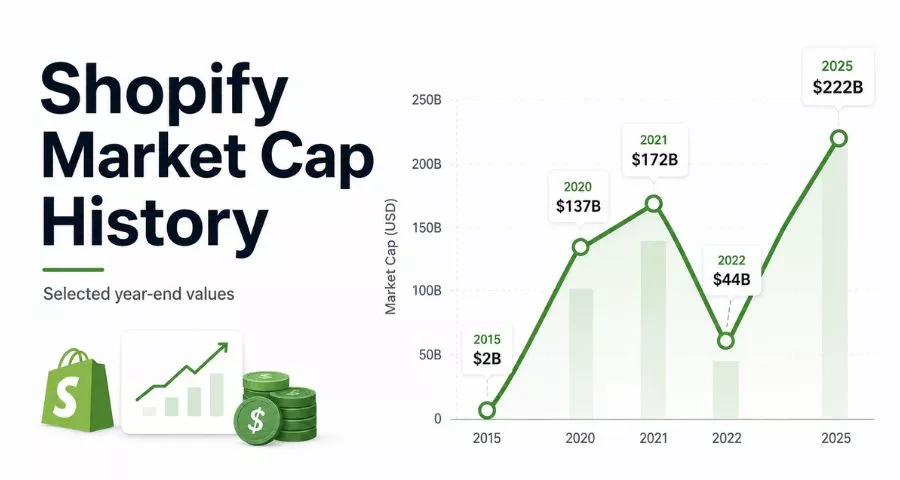
Shopify’s valuation has experienced enormous growth since its public-market debut, but the path has been far from linear.
CompaniesMarketCap reports the following historical figures:
| Year | Shopify Market Cap |
|---|---|
| 2015 | $2.05 billion |
| 2016 | $3.80 billion |
| 2017 | $10.04 billion |
| 2018 | $15.30 billion |
| 2019 | $46.01 billion |
| 2020 | $137.41 billion |
| 2021 | $171.57 billion |
| 2022 | $44.15 billion |
| 2023 | $100.04 billion |
| 2024 | $141.22 billion |
| 2025 | $222.39 billion |
The pattern highlights just how volatile Shopify’s valuation has been.
Shopify’s market cap expanded dramatically during the ecommerce boom of 2020 and 2021. It then fell sharply in 2022 as technology valuations compressed before recovering strongly across 2023–2025.
That history is useful because looking only at today’s Shopify valuation can hide how strongly investor expectations have shifted over time.
Why Is Shopify Valued So Highly?
A company’s market capitalization reflects what investors believe its future cash flows and growth potential are worth, not simply how much money the company generated last year.
Several factors help explain the Shopify valuation.
1. Shopify operates at enormous ecommerce scale
Shopify says its platform serves millions of merchants across more than 175 countries.
The company also reports more than $1.6 trillion in cumulative GMV since its inception and more than 14% of the US ecommerce market based on 2025 data.
This gives Shopify exposure not just to software subscriptions but to an enormous volume of commerce activity.
2. Revenue grows with merchant activity
Shopify’s business model extends well beyond monthly subscriptions.
The company generates revenue through merchant solutions such as payment processing and other commerce services in addition to subscription plans. As Shopify merchants sell more, Shopify can participate in that growth.
The scale of this model was visible in Q2 2026, when GMV grew 32% year over year to $115.57 billion and revenue increased 34% to $3.58 billion.
3. Shopify serves businesses of very different sizes
Shopify is no longer simply a website builder for small ecommerce stores.
Its ecosystem stretches from individual entrepreneurs to major international brands. This broad merchant base gives Shopify opportunities across small business, direct-to-consumer commerce, retail, payments, enterprise ecommerce, and international expansion.
4. Investors expect continued growth
Shopify’s valuation remains heavily influenced by expectations.
Following its Q2 2026 results, Shopify projected third-quarter revenue growth in the low-30% range, ahead of the roughly 26% growth analysts had expected.
A company trading at a high valuation must generally continue delivering strong growth to support those expectations.
5. AI could create another commerce channel
Artificial intelligence has become another factor in Shopify’s valuation.
Shopify has been working with companies including OpenAI, Google, and Microsoft to help merchants become discoverable through AI-powered shopping and search experiences.
In Q2 2026, Shopify said AI-driven customer traffic and orders to stores on its platform had both tripled. Daily active usage of Shopify’s Sidekick AI assistant among merchants increased 3.6 times year over year.
For marketers, this development is particularly significant. Ecommerce discovery may increasingly extend beyond traditional Google search, paid media, social platforms, and marketplaces into AI assistants and agent-driven shopping experiences.
Shopify Market Cap vs. Shopify Valuation
The terms Shopify market cap and Shopify valuation are often used interchangeably, but they do not always mean exactly the same thing.
Market cap has a specific public-market definition:
Share price × outstanding shares.
Valuation can refer more broadly to several ways of measuring a company’s value.
Investors may look at:
- Market capitalization
- Enterprise value
- Price-to-earnings ratio
- Forward P/E
- Price-to-sales ratio
- Enterprise value-to-revenue
- Free cash flow
- Expected revenue and earnings growth
For example, StockAnalysis reported roughly 1.30 billion Shopify shares outstanding and an enterprise value of approximately $164.5 billion in late July 2026.
Enterprise value differs from market capitalization because it also accounts for items such as cash and debt.
So when somebody asks, “What is Shopify’s valuation?”, market cap provides the simplest answer, but it is not the only valuation metric professionals use.
What Is Shopify’s Net Worth?
Searches for Shopify net worth usually refer to the value of the company itself.
For a publicly traded company, market capitalization is typically the closest simple answer.
That means Shopify’s corporate “net worth” in common search usage is roughly equivalent to its market cap, or around $190 billion as of August 2026.
However, this should not be confused with accounting net worth.
A company’s book value or shareholders’ equity is calculated from its balance sheet and can be dramatically different from its stock-market valuation.
It also should not be confused with the personal net worth of Shopify founder and CEO Tobias Lütke.
In short:
| Term | What it means |
|---|---|
| Market cap | Market value of outstanding shares |
| Enterprise value | Company value adjusted for cash and debt |
| Book value | Accounting value of net assets |
| “Shopify net worth” | Usually used informally to mean Shopify’s market value |
| Founder net worth | Personal wealth of an individual shareholder |
For people searching how much Shopify as a company is worth, market capitalization is usually the most useful metric.
Who Uses Shopify?

The size and diversity of Shopify’s merchant ecosystem are major reasons its valuation attracts attention.
So, who uses Shopify?
Shopify says its customers range from individual entrepreneurs to internationally known brands. Companies and brands it publicly identifies as Shopify users include:
- SKIMS
- Supreme
- Vuori
- Aldo
- BarkBox
- Carrier
- Meta
Shopify is therefore not limited to one business size or industry.
Its platform is used for fashion, beauty, consumer goods, retail, digital-first brands, business-to-consumer commerce, and enterprise operations.
For marketers and ecommerce teams, that breadth matters. A platform that can support businesses from initial launch through substantial scale has greater opportunities for merchant retention, transaction growth, payments adoption, app revenue, and additional commerce services.
Those dynamics ultimately feed back into the market’s expectations for Shopify’s future revenue, and therefore its valuation.
What Shopify’s Market Cap Tells Marketers
Market capitalization may appear to be primarily an investor metric, but Shopify’s scale has several implications for SEO and digital marketing professionals.
First, Shopify is large enough to influence how ecommerce websites are built and optimized. Changes to Shopify’s storefront technology, structured data, checkout system, performance architecture, international commerce features, and AI integrations can affect a very large number of businesses.
Second, Shopify’s growth reinforces the importance of platform-specific SEO.
Marketers working with Shopify stores must consider technical SEO factors such as site architecture, collection pages, product duplication, internal links, structured data, Core Web Vitals, faceted navigation, and Shopify-specific URL behavior.
Third, Shopify’s AI strategy could affect product discovery.
If commerce increasingly takes place through AI assistants, marketers may need to think beyond conventional rankings and optimize product information so it can be understood and surfaced across search engines, shopping platforms, and AI systems.
Shopify’s valuation therefore reflects more than investor sentiment. It also illustrates how strategically important ecommerce infrastructure has become.
Is Shopify Overvalued?
There is no objective answer that applies to every investor.
Shopify trades at substantially higher earnings multiples than many mature businesses because investors expect faster future growth. That can support a premium valuation when revenue, margins, GMV, and cash flow continue expanding, but it can also make the stock more sensitive when results fail to meet expectations.
This is one reason Shopify’s market capitalization has moved so dramatically over its history.
The company fell from a market cap above $170 billion in 2021 to roughly $44 billion at the end of 2022 before subsequently recovering.
Rather than asking only whether Shopify’s market cap is “too high,” a more useful valuation question is:
Does Shopify’s future growth justify the price investors are currently willing to pay for the business?
That requires looking beyond market capitalization alone.
What Could Increase Shopify’s Market Cap?
Shopify’s market capitalization could increase if investors become more optimistic about factors such as:
- Revenue growth
- GMV growth
- Shopify Payments adoption
- Enterprise merchant growth
- International expansion
- Operating margins
- Free cash flow
- AI commerce adoption
- New products and merchant services
Its August 2026 earnings reaction provides a clear example.
Revenue and profit exceeded expectations, management issued stronger-than-expected guidance, and investors rapidly reassessed Shopify’s growth outlook. Shares rose more than 18% following the results.
What Could Reduce Shopify’s Valuation?
The opposite can also happen.
Potential pressure on Shopify’s valuation could come from slower ecommerce growth, weaker merchant spending, increased competition, margin pressure, expensive AI infrastructure, economic weakness, or investors becoming less willing to pay premium multiples for growth stocks.
Even strong companies can experience significant changes in market capitalization if expectations change.
Shopify’s 2021–2022 market-cap decline demonstrates this clearly.
Shopify Market Cap: FAQ
What is Shopify’s market cap?
As of August 2026, Shopify’s market capitalization is approximately $190 billion, although the exact figure changes with SHOP’s stock price. Before its August 5 earnings rally, major financial databases placed Shopify around $165–$170 billion. Shopify shares then climbed more than 18% following stronger-than-expected Q2 results.
What is the market capitalization of Shopify?
Shopify’s market capitalization is the value of all outstanding Shopify shares. It is calculated by multiplying the current SHOP share price by the company’s approximately 1.30 billion outstanding shares.
What is Shopify’s net worth?
When people search for Shopify’s net worth, they usually mean the company’s market value. For a publicly traded company, market capitalization provides the simplest approximation. Shopify’s market value is roughly $190 billion as of August 2026.
Is Shopify a billion-dollar company?
Yes. Shopify has been a billion-dollar company for many years and is currently valued at well over $100 billion.
What is Shopify’s highest market cap?
Shopify’s market capitalization has exceeded $200 billion during periods of strong stock-market performance. CompaniesMarketCap records a year-end market cap of approximately $222.39 billion for 2025.
Why is Shopify worth so much?
Shopify’s valuation reflects its large merchant ecosystem, recurring software revenue, payments business, exposure to merchant GMV, international reach, revenue growth, and expectations for future opportunities such as enterprise commerce and AI-powered shopping.
Who uses Shopify?
Shopify is used by millions of businesses across more than 175 countries. Shopify publicly lists brands and companies such as SKIMS, Supreme, Vuori, Aldo, BarkBox, Carrier, and Meta among businesses using its platform.
Final Thoughts
The Shopify market cap provides a useful snapshot of how investors value one of the most influential companies in ecommerce. As of August 2026, Shopify is worth roughly $190 billion on the public market, following a strong earnings-driven rally. But that figure will continue to move as Shopify’s share price changes.
More important than the headline number is what sits behind the Shopify valuation: millions of merchants, more than $1.6 trillion in cumulative GMV, a significant share of US ecommerce, rapidly expanding merchant services, and an increasingly important position in AI-powered commerce.
For marketers, ecommerce professionals, and SEO specialists, Shopify’s scale makes the company worth watching even if they never own a share of SHOP. The platform’s product, search, checkout, payments, and AI decisions increasingly shape how a substantial part of online commerce operates.
Read More: 8+ Best SEO Link Building Tools
Contact US | ThimPress:
Website: https://thimpress.com/
Fanpage: https://www.facebook.com/ThimPress
YouTube: https://www.youtube.com/c/ThimPressDesign
Twitter (X): https://x.com/thimpress_com