Backlink building is the process of earning links from other websites to your pages, so that search engines and readers see your content as trustworthy. Most site owners know they need links, but they are not sure where to start, which tactics are safe, or how to tell if the work is paying off.
This guide covers the entire link-building process, from planning and outreach to tracking results. It follows Google’s guidelines and explores common link-building tools and techniques. You’ll also find a comparison of popular link-building tactics, useful resources, and answers to frequently asked questions.
Eduma – Education WordPress Theme
We provide an amazing WordPress theme with fast and responsive designs. Let’s find out!
What backlink building is and why it matters
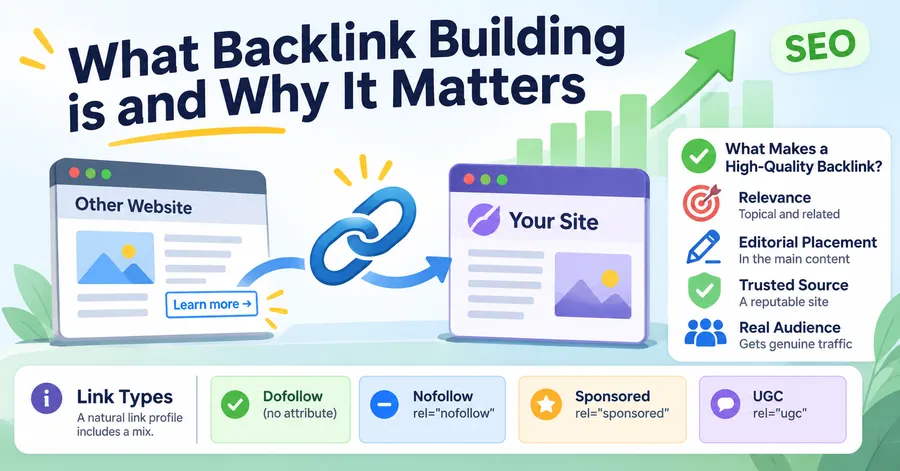
A backlink is a link on another website that points to a page on your site. Before you pick a tactic, it helps to be clear about what makes a link valuable and what makes it a waste of time.
Search engines use links to find new pages and to judge which pages other people trust. A page that earns links from relevant, respected sites usually has a better chance of ranking than a similar page with none. Links also bring referral traffic, which means visitors who click through from the linking page to yours.
What makes a backlink high quality
A high-quality backlink is a link placed by an editor or site owner because your page is useful to their readers. Four traits matter most:
- Relevance: The linking page covers a topic close to yours. A link to a WordPress tutorial from a web design blog is worth more than one from an unrelated recipe site.
- Editorial placement: The link sits inside the main content, not in a footer, a sidebar widget, or a block of links added for ranking purposes.
- Trusted source: The linking site has real readers, a clear owner, and a history of publishing original work.
- Real audience: The page gets visits from actual people. A link from a page nobody reads rarely helps.
Ten links that meet these four traits will usually do more for you than a hundred links from random directories.
Dofollow, nofollow, sponsored and UGC links
Google lets site owners label links with the rel attribute, which tells search engines how the link was created. Google treats these labels as hints, not strict commands. A natural link profile contains a mix of all four types, so you do not need to chase only dofollow links.
| Link type | Rel attribute | Typical use | SEO effect |
|---|---|---|---|
| Dofollow (standard) | None | Editorial links within content | Can pass ranking signals |
| Nofollow | rel=”nofollow” | Links the site owner does not want to vouch for | Treated as a hint; still brings traffic |
| Sponsored | rel=”sponsored” | Paid placements and affiliate links | Not meant to pass ranking signals |
| UGC | rel=”ugc” | Comments and forum posts | Treated as a hint; low impact alone |
You can read Google’s own explanation on the Search Central page about qualifying outbound links.
Build an SEO backlinking strategy first
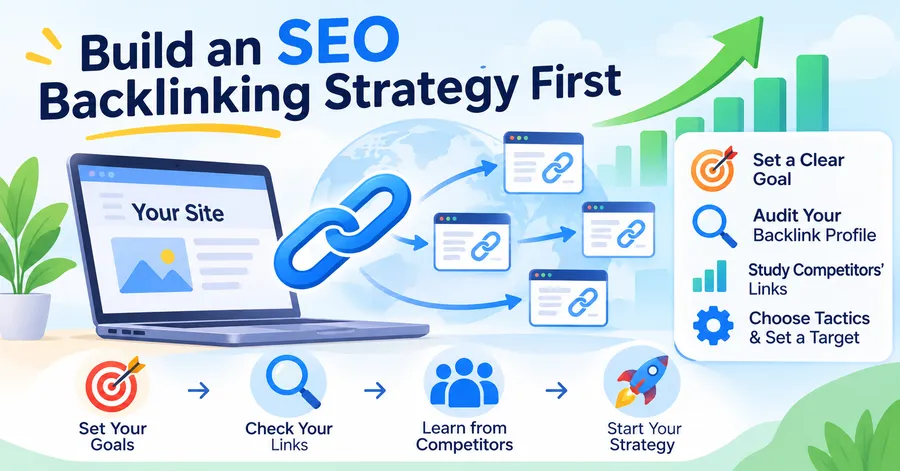
A strong SEO backlinking strategy starts with a plan, not with an email blast. Spend the first week on research, because it tells you which pages need links, which sites are likely to link, and which tactics fit your resources.
Set a clear goal for each page
Decide which pages you want to rank and why. A service page, a course page, and a blog post each need a different approach. Links to a blog post build topical authority and brand awareness. Links to a money page need more careful targeting, because site owners rarely link to a sales page without a good reason.
A simple method is to list your ten most important pages, write the keyword each one targets, and note how many sites link to the pages that currently rank in the top five for that keyword. That number gives you a realistic target.
Audit your current backlink profile
Open the Links report in Google Search Console. It shows your top linked pages, the sites linking to you, and your most common anchor text. For a deeper view, SEO audit tools such as Ahrefs, Semrush, or Moz Link Explorer list referring domains and flag links that were gained or lost.
When you audit, look for three things: which pages already attract links without any effort, which anchor texts appear most often, and whether any links look unnatural. Pages that already attract links are your best candidates for a content update and more promotion.
Study the sites that link to your competitors
Pick three to five competitors that rank for your target keywords. Export their referring domains and look for sites that link to two or more of them but not to you. This is often called a link gap or link intersect analysis.
Sites on that list have already shown interest in your topic. They are warmer prospects than sites chosen at random. Sort the list by relevance first and authority second, then remove anything that looks like a directory, a link farm, or a site with no recent posts.
Pick two or three tactics and set a monthly target
Do not try every tactic at once. Choose two or three that match your skills and budget, and set a modest, steady target, such as 20 personalized outreach emails per week. Review the results every month and keep what works.
Organic link building best practices
Organic link building best practices come down to one idea: earn links by being useful, and make it easy for others to find and cite your work. The habits below keep your profile healthy and protect you from penalties.
Put relevance before authority
A site with moderate authority and a perfect topic match is often a better target than a famous site with a loose connection. Relevant links help search engines understand what your page is about. They also bring visitors who are more likely to read, subscribe, or buy.
Create something worth linking to
People link to pages that save them time or give them something they cannot find elsewhere. Examples include original research, free templates, calculators, clear definitions, step-by-step tutorials with screenshots, and well-organized checklists. Before you publish, ask a simple question: “If I ran a blog on this topic, would I link to this page?” If the answer is no, improve the page first.
Keep anchor text natural
Anchor text is the clickable words in a link. Natural profiles include branded anchors (“ThimPress“), URL anchors, generic anchors (“this guide”), and descriptive anchors (“WordPress LMS plugin”). If most of your links use the exact same keyword phrase, it looks forced. You cannot control how others write anchors, so never ask for exact match text in every outreach email.
Grow at a steady pace
Links that appear slowly over months look normal. A sudden spike of hundreds of links from unknown sites does not. Aim for steady progress, and expect a new site to take several months before link efforts show up in rankings.
Stay away from paid links and link schemes
Google’s spam policies list buying or selling links that pass ranking signals, large-scale link exchanges, and automated link creation as link spam. You can review the details in Google’s spam policies for web search. Sites caught using these methods can lose rankings. If you pay for a placement, such as a sponsored post, make sure the link carries a rel=”sponsored” attribute.
Link building tactics that work in 2026
Many backlink building tactics can earn links, but they differ in effort, risk, and speed. The six below are the ones most teams can run without paying for links or breaking search guidelines.
Publish original data and research
Original data is one of the easiest assets to cite. Run a short survey of your customers or students, analyze your own site data, or pull public numbers into one clear summary. Publish the results on a dedicated page with a clear title, a chart or two, and a short methodology note.
Then tell journalists and bloggers who cover your topic. A page with a unique number that others can quote will keep attracting links for months.
Guest posting done right
Guest posting means writing an article for another site in your field and including a link to a relevant page of yours. It works when you offer real value to the host site’s audience, and it fails when you write thin posts only to get a link. Google has warned against large-scale guest posting campaigns done mainly for links, so keep it small and selective.
Choose sites your target readers already visit. Pitch a specific headline, explain why it fits their audience, and link only where it helps the reader. One link to a relevant resource in the body is enough.
Broken link building
Broken link building means finding dead links on other websites and suggesting your page as a replacement. It is helpful to the site owner because you fix a problem for them.
To do it, search for resource pages in your niche, then run a broken link checker such as the Check My Links browser extension or Ahrefs. When you find a dead link that matches a page you have, email the owner with the exact URL and your suggested replacement. This only works when your page covers the same topic as the dead one.
Resource page outreach
Many sites keep a page called “useful resources,” “tools,” or “further reading.” These pages exist to link out. Search for phrases such as “your topic + resources” or “your topic + useful links,” review the list, and suggest your page only if it adds something the list does not already cover.
Digital PR and expert quotes
Journalists regularly look for expert comments on current topics. Services such as Connectively (formerly HARO) and Qwoted connect sources with reporters. Reply quickly, answer the question directly, and include one useful fact or example. If the reporter uses your quote, a link to your site often follows.
Reclaim unlinked brand mentions
Sometimes a site mentions your brand but does not link to you. Set up alerts for your brand and product names, then email the author and ask them to add a link. Because they already know your brand, the response rate is usually better than cold outreach.
Link building tactics compared
The table below compares the tactics above so you can match them to your time and resources. Ratings are general guidance, and results vary by niche and by how well you carry out each tactic.
| Tactic | Effort | Risk level | Time to first links | Best for |
|---|---|---|---|---|
| Original data and research | High | Low | 1 to 3 months | Sites with data or a strong audience |
| Guest posting | Medium | Medium if done in bulk | 2 to 6 weeks | Writers and subject experts |
| Broken link building | Medium | Low | 2 to 6 weeks | Sites with many evergreen guides |
| Resource page outreach | Low to medium | Low | 2 to 6 weeks | Tools, templates, and guides |
| Digital PR and expert quotes | Medium | Low | Days to weeks | Founders and recognized experts |
| Unlinked mention reclamation | Low | Low | Days to weeks | Established brands |
| Buying links | Low | High | Fast, but short-lived | Not recommended |
If you are new, start with resource page outreach and unlinked mentions, because they take the least effort. Add original research once you have a steady content routine.
How to write outreach emails that get replies
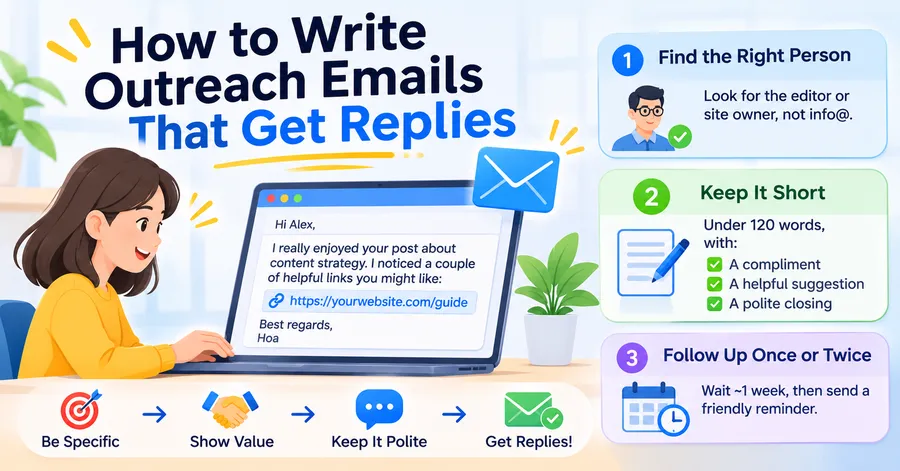
Good backlink building outreach is short, specific, and polite. Site owners receive many link requests every week, and most are ignored because they are generic.
Find the right person
Check the site’s About page, author bios, and LinkedIn profile to find the editor, content manager, or site owner. Avoid sending to a general “info@” address when you can find a named person. Use the person’s first name and mention something specific about their site.
Keep the message short
Aim for under 120 words. State who you are, why you are writing, and what you suggest. A simple structure works well:
- A one-line compliment that proves you read their page.
- The specific problem or gap you noticed, such as a broken link or a missing topic.
- Your suggestion, with the exact URL.
- A polite closing that makes it easy to say no.
Do not offer money, and do not write “I will pay for a link.” Do not mention rankings or SEO in the first email either. Focus on how the link helps their readers.
Follow up once or twice
Many replies arrive after the second message. Wait about a week, then send a short reminder that adds something new, such as a related statistic. If you hear nothing after the second follow-up, move on.
Link building resources and tools worth using
The right link building resources save hours of manual work. You do not need every tool, but a small set covers research, outreach, and tracking.
Tools for research, outreach, and tracking
Choosing the right tools can make link building more efficient by helping you find link opportunities, manage outreach, identify issues, and track your progress. Here are some useful tools to support each stage of the process:
- Google Search Console: Free. The Links report shows who links to you and which pages get the most links.
- Ahrefs, Semrush, or Moz Link Explorer: Paid. Use them for competitor link gap analysis, broken link checks, and monitoring new and lost links.
- Hunter or similar email finders: Help you find a publicly listed business email address for a named contact.
- Screaming Frog SEO Spider: Crawls your own site to find broken links and orphan pages that should receive more internal links.
- Google Alerts or Brand24: Track brand mentions so you can reclaim unlinked ones.
- A simple spreadsheet or CRM: Record each prospect, date contacted, reply, and result. Without this, follow-ups get missed.
Link building articles and guides worth reading
Good link building articles teach the thinking behind a tactic, not only the steps. Start with Google Search Central, which explains how Google treats links and what counts as spam. Then read the learning hubs from Moz, Ahrefs, and Search Engine Journal for tactic walkthroughs and case studies.
When you read link building articles from agencies, check whether the author explains how results were measured. Be careful with posts that promise a fixed number of links per month or guaranteed rankings, because no one can guarantee either.
Backlink building for WordPress course websites
Backlink building works the same way on an online course site, but the best linkable assets look different. If you run a WordPress site built on an education theme, you already have content that other sites can cite.
LearnPress is a WordPress LMS plugin from ThimPress that lets you build and sell online courses, lessons, and quizzes. Eduma is an education theme from the same team that is designed to work with LearnPress. Together they give you a structure where each course, lesson, and instructor profile has its own URL, which means each one can earn links.
Turn course content into linkable assets
These pieces from a course site tend to attract links when they are well made:
- A free course preview or open lesson that other bloggers can recommend.
- A glossary of key terms in your subject, written clearly and kept up to date.
- Downloadable study guides, checklists, or templates.
- A page of student results or survey data, with permission from participants.
- Instructor profile pages with credentials, which help with expertise and trust signals.
Prepare your site before you start outreach
Links are less useful if the page that receives them loads slowly or confuses visitors. Before outreach, check your Core Web Vitals in PageSpeed Insights, make sure course pages have clear titles and headings, and add FAQ or Article schema with an SEO plugin such as Rank Math or Yoast. Also link from your high-traffic posts to your course pages, so the authority from new links flows where you need it.
How to measure your link building results
Measure backlink building by looking at links, traffic, and rankings together. No single number tells the whole story.
Track these metrics each month:
- New referring domains: The number of different sites linking to you. This matters more than the total link count.
- Link quality: Relevance and traffic of the new linking sites.
- Referral traffic: Visits from linking pages, visible in Google Analytics.
- Keyword rankings: Movement for the pages you targeted, tracked in Search Console or a rank tracker.
- Branded search: Growth in searches for your name, which often follows increased visibility.
Give each campaign at least three to six months before you judge it. Rankings depend on many factors, including content quality and competition, so links are rarely the only cause of a change. Compare pages that received links with similar pages that did not.
Common backlink building mistakes
Most failed backlink building campaigns share the same handful of mistakes. Avoid these and you are already ahead of many site owners.
- Chasing quantity: Collecting links from low-quality directories adds risk and little value.
- Sending templates without edits: Site owners can tell when an email was copied and pasted.
- Targeting only your homepage: Deep pages with useful content are easier to earn links to.
- Ignoring existing assets: Updating a page that already has links is faster than starting from zero.
- Skipping content quality: No outreach can fix a weak page for long.
- Giving up too soon: Link building is slow work. Most results appear after several months of steady effort.
FAQs
How many backlinks do I need to rank on page one?
There is no fixed number. The right amount depends on how many links the pages already ranking for your keyword have, and on how strong your content is. Check the top five results in a tool such as Ahrefs or Semrush, and use their referring domain counts as a rough benchmark.
What is a toxic backlink, and should I disavow it?
A toxic backlink is a link from a spammy or manipulative site that you did not earn. Google says most sites do not need the disavow tool, because it ignores most spammy links automatically. Consider it only if you have a manual action or a large pattern of paid or spam links that you cannot remove.
Is it okay to exchange links with other sites?
A small number of natural, relevant mentions between partners is fine. Large-scale reciprocal linking, where sites trade links only to improve rankings, is listed as link spam in Google’s guidelines. If you cooperate with another site, link only when the link helps readers.
Does domain authority affect Google rankings?
No. Domain authority is a score created by Moz, and similar scores exist in other tools, such as Domain Rating in Ahrefs. Google does not use these scores. They are useful for comparing sites when you build a prospect list, but they should not be treated as a ranking factor.
Conclusion
Backlink building is slow, steady work, but it pays off when you focus on relevance and value. Start with a clear plan: audit your current links, study competitors, and pick two or three tactics. Follow organic link building best practices by creating pages worth citing, writing personal outreach, and avoiding paid schemes.
Use good link building resources to speed up research and tracking, and read link building articles from trusted sources to keep improving your approach. A well-built SEO backlinking strategy also works best when your site is fast, clear, and trustworthy. If you run an online course site, tools such as LearnPress and Eduma give you a solid foundation to publish the kind of content that earns links over time. Pick one tactic from this guide this week, send your first ten emails, and measure the results next month.
Read more: Magazine Cover Template: Free Options & Design Ideas
Contact US | ThimPress:
Website: https://thimpress.com/
Fanpage: https://www.facebook.com/ThimPress
YouTube: https://www.youtube.com/c/ThimPressDesign
Twitter (X): https://x.com/thimpress_com