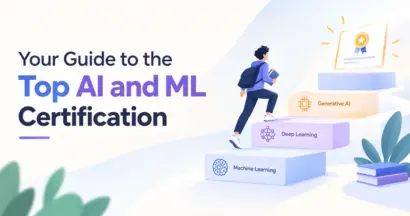
Artificial intelligence, machine learning, deep learning are closely related, but they are not interchangeable. Artificial intelligence (AI) is the broad field of building systems that perform tasks associated with human intelligence. Machine learning (ML) is one approach within AI that learns patterns from data. Deep learning (DL) is a specialized branch of machine learning built around multilayer neural networks.
The shortest accurate relationship is: deep learning is a subset of machine learning, and machine learning is a subset of artificial intelligence. Generative AI overlaps heavily with deep learning because modern generative systems usually use deep neural networks, but “generative” describes what a system produces, while “deep learning” describes a family of methods used to build it.
People searching for artificial intelligence machine learning deep learning, AI ML and deep learning, or AI machine learning deep learning are usually asking the same core question: where does each concept sit? The hierarchy above is the answer. Comparisons framed as artificial intelligence vs deep learning, AI vs deep learning, or generative AI vs machine learning examine different levels or dimensions of that hierarchy, as the sections below explain.
This guide explains the hierarchy, training methods, data needs, examples, strengths, limitations, and business uses of AI, ML, deep learning, and generative AI. If you are completely new to the subject, ThimPress’s practical guide to AI for beginners provides a useful companion introduction.
Eduma – Education WordPress Theme
We provide an amazing WordPress theme with fast and responsive designs. Let’s find out!
Artificial Intelligence vs. Machine Learning vs. Deep Learning at a Glance
| Concept | Simple definition | Typical methods | Common outputs | Example |
|---|---|---|---|---|
| Artificial intelligence | The broad field of creating systems that perform intelligent tasks | Rules, search, optimization, knowledge systems, ML, robotics | Decisions, plans, recommendations, actions, content | A route-planning system |
| Machine learning | A subset of AI that learns patterns from data | Regression, decision trees, support vector machines, clustering, neural networks | Predictions, classifications, rankings, clusters | A fraud-risk score |
| Deep learning | A subset of ML using neural networks with multiple layers | CNNs, RNNs, transformers, deep reinforcement learning | Complex predictions and representations from text, images, audio, or video | Speech recognition |
| Generative AI | AI designed to create new content or data | Transformers, diffusion models, GANs, other generative models | Text, images, audio, video, code, synthetic data | A chatbot drafting an email |
These categories describe different dimensions. AI describes the broad goal and field. ML and DL describe technical approaches. Generative AI describes a capability and class of systems. That distinction resolves much of the confusion around AI, ML, and deep learning.
What Is Artificial Intelligence?
Artificial intelligence is the broad discipline of designing computer systems that can perform tasks commonly associated with human intelligence. Depending on the system, those tasks may include perceiving an environment, understanding language, reasoning, solving problems, planning, making decisions, learning, or creating content.

AI is defined by the capability of the overall system, not by a requirement that it learn from data. A rule-based expert system can qualify as AI even if its knowledge was explicitly encoded by people. Search algorithms, planning systems, optimization methods, robotics, computer vision, natural language processing, machine learning, and knowledge representation all belong within the broader AI field.
Most AI in daily use is narrow AI: it is designed for particular tasks such as recommending a product, recognizing speech, detecting fraud, answering questions, or optimizing a route. It does not possess general human intelligence merely because it performs one task extremely well. This boundary matters when evaluating the claims made by the growing market of AI automation tools.
Examples of Artificial Intelligence
- A rule-based system that checks whether a loan application meets predefined policies
- A navigation system that searches possible routes and optimizes travel time
- A voice assistant that combines speech recognition, language processing, search, and action tools
- A recommendation engine that ranks products or lessons for each user
- A robot that perceives its surroundings and selects actions
- A generative assistant that creates text, images, audio, or software code
What Is Machine Learning?

Machine learning is a subset of AI focused on algorithms that improve at a task by identifying patterns in data. Instead of writing every decision rule by hand, developers define a model, a learning process, an objective, and evaluation criteria. Training adjusts the model so it can make useful predictions or decisions when presented with new data.
For example, a conventional spam filter may be trained on emails labeled “spam” or “not spam.” It learns statistical relationships between input features and the label. When a new email arrives, the trained model estimates which category is more likely. This differs from manually listing every phrase that could appear in spam.
Machine learning still requires substantial human decisions: defining the problem, collecting and preparing data, selecting features and algorithms, evaluating errors, monitoring drift, and deciding how predictions affect real people. For a direct two-way comparison, see machine learning vs. AI.
Main Types of Machine Learning
- Supervised learning: The model learns from labeled examples, such as transactions marked fraudulent or legitimate. Common tasks include classification and regression.
- Unsupervised learning: The model analyzes unlabeled data to find structures such as clusters, associations, or unusual observations.
- Semi-supervised learning: Training combines a relatively small labeled dataset with a larger unlabeled dataset.
- Self-supervised learning: The system creates learning signals from the data itself, such as predicting masked words or the next element in a sequence.
- Reinforcement learning: An agent learns actions through rewards and penalties while interacting with an environment.
Examples of Machine Learning
- Predicting customer churn from account activity
- Estimating home prices from property characteristics
- Ranking search results or product recommendations
- Detecting unusual payment activity
- Forecasting demand and inventory requirements
- Grouping customers by behavioral similarity
These systems are valuable because they turn historical patterns into repeatable predictions. ThimPress’s review of AI tools for data analysis shows how related capabilities are applied to practical analytics workflows.
What Is Deep Learning?

Deep learning is a specialized type of machine learning that uses artificial neural networks with multiple processing layers. Each layer transforms its input into a representation that later layers can use. During training, the network adjusts large numbers of parameters to reduce error on a defined objective.
The word “deep” refers to the number of layers in the network, not to human-like depth of thought. The inspiration for neural networks came loosely from biological neurons, but modern artificial networks are mathematical computing systems, not replicas of the brain.
Traditional ML often depends on human-designed features. To classify a tabular business record, specialists might choose variables such as account age, transaction frequency, and average value. Deep learning can learn useful representations more automatically, especially from unstructured data such as images, audio, video, and natural language. This advantage usually comes with higher requirements for data, computing power, training time, and specialized expertise.
Common Deep Learning Architectures
- Convolutional neural networks (CNNs): Commonly associated with image and spatial-data tasks.
- Recurrent neural networks (RNNs): Designed for sequential information, though transformers have replaced them in many language applications.
- Transformers: Use attention mechanisms to model relationships across a sequence and underpin many modern language and multimodal systems.
- Autoencoders: Learn compressed representations and can support reconstruction, anomaly detection, and generation.
- Generative adversarial networks (GANs): Train competing networks to generate data that resembles a target distribution.
- Diffusion models: Learn to reverse a noise-adding process and are widely used in modern image generation.
Examples of Deep Learning
- Recognizing objects and people in images
- Transcribing and synthesizing speech
- Translating natural language
- Interpreting medical images
- Detecting objects for driver-assistance systems
- Generating text, images, video, music, and code
The Relationship Between AI and Machine Learning
The relationship between AI and machine learning is best understood as goal versus method. AI is the larger goal of creating systems with intelligent capabilities. Machine learning is one set of methods used to achieve some of those capabilities by learning from data.
Therefore, all machine learning falls within AI, but not all AI depends on machine learning. A chess program could search a game tree using explicitly programmed evaluation rules. It may display intelligent behavior without learning those rules from a training dataset. A modern chess system might combine search with neural networks learned from games. Both are AI systems, but only the second necessarily uses ML.
The hierarchy continues: deep learning is one family of ML methods. A random forest used for credit-risk prediction is machine learning but not deep learning. A transformer trained for language understanding is both deep learning and machine learning, and the resulting application is AI.
Machine Learning vs. Deep Learning
| Factor | Traditional machine learning | Deep learning |
|---|---|---|
| Data volume | Can perform well on smaller, structured datasets | Often benefits from very large datasets |
| Feature engineering | Frequently relies on human-selected or engineered features | Can learn layered representations automatically |
| Compute | Often runs with modest infrastructure | Training may require GPUs or specialized accelerators |
| Best-known data types | Structured tables and well-defined business variables | Images, text, audio, video, and other unstructured data |
| Interpretability | Many methods are easier to explain | Large networks can be difficult to interpret |
| Training time | Often shorter | Can be substantially longer and more expensive |
| Performance | Strong when data is limited and features are meaningful | Often excels on complex perception and generation tasks |
The phrase machine learning deep learning should not imply that deep learning always wins. A smaller regression, tree-based model, or statistical method can be faster, cheaper, easier to audit, and more accurate for a structured problem. The correct question is not “Which technology is more advanced?” but “Which method meets the objective and constraints with acceptable risk?”
Artificial Intelligence vs. Deep Learning
Artificial intelligence vs. deep learning is not a comparison between equal categories. AI is the full field; deep learning is one technical approach inside it. AI can include symbolic reasoning, planning, robotics, rules, search, optimization, machine learning, and combinations of these methods. Deep learning specifically relies on multilayer neural networks.
Consider a customer-support assistant. The full AI system might use a deep learning language model to understand and draft text, a rule engine to enforce account policy, search to retrieve documentation, an API to check order status, and workflow logic to escalate a case. Calling the entire system “deep learning” ignores the other components. Calling it an AI assistant correctly describes its overall capability.
Modern products frequently assemble several components this way. The same pattern appears in AI agent builder tools, where a model is combined with instructions, knowledge, memory, integrations, and action controls.
Generative AI vs. Machine Learning
Generative AI vs. machine learning is another comparison of overlapping categories. Machine learning describes systems that learn patterns from data. Generative AI describes systems designed to create new content or synthetic data that resembles patterns learned during training. Most modern generative AI is built with machine learning—and usually deep learning—but many ML systems are predictive rather than generative.
| Question | Traditional predictive ML | Generative AI |
|---|---|---|
| Primary purpose | Predict, classify, rank, forecast, or detect | Create or transform content |
| Example input | Customer transaction history | A natural-language prompt and supporting context |
| Example output | Probability that a customer will churn | A personalized retention email draft |
| Common evaluation | Accuracy, precision, recall, error, calibration | Quality, relevance, factuality, safety, similarity, human preference |
| Typical risk | Biased or inaccurate prediction | Fabricated, unsafe, copyrighted, or sensitive content |
A retailer might use predictive ML to forecast demand and generative AI to draft product descriptions. The two can also work together: a predictive system identifies the next best offer, while a generative model explains it in natural language. For a practical product overview, explore ThimPress’s comparison of the best generative AI tools.
How AI, Machine Learning, and Deep Learning Work Together
A production system often contains much more than a model. A simplified workflow looks like this:
- Define the objective. Specify the user need, desired output, acceptable error, and business constraint.
- Collect and govern data. Establish rights, quality, representativeness, privacy, security, and retention rules.
- Select an approach. Consider rules, conventional software, traditional ML, deep learning, generative AI, or a combination.
- Train or configure the model. Fit parameters to data, fine-tune an existing model, or connect a managed model to approved context.
- Evaluate the complete system. Test accuracy, robustness, bias, safety, latency, cost, and user outcomes.
- Deploy with controls. Add access restrictions, monitoring, logging, fallbacks, and human review where consequences justify it.
- Monitor and improve. Detect data drift, model degradation, misuse, and changes in real-world conditions.
The model is only one layer. Interfaces, databases, policies, retrieval systems, feedback channels, and human decisions determine whether the application is useful and trustworthy. Organizations selecting an external partner should evaluate that full lifecycle, not only model familiarity; ThimPress’s guide to AI software development companies outlines several relevant technical and delivery considerations.
Real-World Uses Across Industries
Ecommerce and Marketing
Machine learning ranks products, forecasts demand, detects fraud, segments audiences, and predicts churn. Deep learning can understand product images and natural-language queries. Generative AI creates draft descriptions, campaign concepts, support replies, and visual variations. Teams should maintain brand review and factual checks, especially for customer-facing content. These AI marketing tools illustrate the range of available applications.
Education
ML can identify learning patterns and recommend resources. Deep learning supports speech recognition, translation, and analysis of unstructured responses. Generative AI can produce practice questions, examples, explanations, and feedback, but educators must verify accuracy and protect learner data. Used carefully, the technologies can extend rather than replace sound instructional design.
Healthcare
ML supports risk prediction and operational forecasting; deep learning can analyze medical images, signals, and text; generative systems may summarize information or assist documentation. Healthcare applications require rigorous validation, privacy protection, domain oversight, and clear accountability. A compelling demonstration is not equivalent to safe clinical performance.
Finance and Cybersecurity
Models detect unusual transactions, estimate risk, identify malicious activity, and prioritize alerts. Deep learning can process complex sequences and unstructured signals, while generative AI helps summarize cases or draft analyst queries. Because attackers adapt, these systems require continuous monitoring and human escalation paths.
Software and Web Design
AI assistants generate code, tests, documentation, layouts, images, and content. Predictive models can identify defects or prioritize incidents, while generative models accelerate exploration. Human review remains essential for security, accessibility, maintainability, and intellectual-property compliance. See how current AI web design tools apply these capabilities to visual workflows.
How to Choose the Right Approach
Start with the problem, not the fashionable term.
- Use rules or conventional software when requirements are stable, logic must be deterministic, and exceptions can be specified clearly.
- Use traditional machine learning for predictions or classifications based on structured data, especially when the dataset is moderate and explainability matters.
- Use deep learning when the task involves complex patterns in large volumes of text, images, audio, video, or sequential data and adequate compute is available.
- Use generative AI when the required output is new or transformed content and the workflow can tolerate or control variable results.
- Use a hybrid system when learned capabilities need deterministic policy, retrieval, calculation, tools, or human approval.
For everyday business work, buying or integrating an existing service is usually more practical than training a model from scratch. ThimPress lists practical ways to use AI at work that begin with tasks and safeguards rather than technical novelty.
Benefits and Limitations
Potential Benefits
- Automating repetitive classification, extraction, and drafting
- Finding patterns across more data than a person can review manually
- Personalizing recommendations, interfaces, and learning experiences
- Improving forecasts and supporting faster decisions
- Making unstructured text, images, and audio easier to search and analyze
- Accelerating ideation, prototyping, documentation, and customer service
Important Limitations
- Data quality: Models can reproduce missing information, historical inequity, and labeling errors.
- Generalization: Performance can deteriorate when real-world data differs from training conditions.
- Explainability: Complex models may not provide an understandable reason for an output.
- Fabrication: Generative systems can produce confident but unsupported content.
- Privacy and security: Training data, prompts, model access, and generated output can expose sensitive information.
- Cost: Data preparation, compute, evaluation, integration, and monitoring may exceed the price of model access.
- Human impact: Automated decisions can affect opportunity, safety, and rights, requiring governance proportionate to the risk.
Adoption should include evaluation and ongoing controls. The best AI visibility tools, analytics platforms, or content systems still require teams to define what they are measuring and how they will respond to errors.
Common Misconceptions About AI, ML, and Deep Learning
- “AI and ML are synonyms.” ML is one branch of AI; AI also includes approaches that do not learn from data.
- “All neural networks are deep learning.” A neural network is considered deep when it contains multiple learned layers; shallow networks also exist.
- “Deep learning always beats traditional ML.” Smaller methods often perform better on limited, structured data and are easier to operate.
- “Generative AI understands like a person.” Fluent output does not prove human reasoning, lived experience, or reliable factual knowledge.
- “More data automatically fixes a model.” Relevance, quality, coverage, rights, and labeling are as important as volume.
- “Once deployed, a model keeps working.” Data and behavior change, so performance and risk must be monitored.
- “AI removes the need for people.” People still define goals, judge tradeoffs, manage exceptions, verify results, and remain accountable.
Frequently Asked Questions
What is the main difference between AI, ML, and deep learning?
AI is the broad field of creating systems that perform intelligent tasks. ML is a subset of AI in which systems learn patterns from data. Deep learning is a subset of ML that uses neural networks with multiple layers.
Can artificial intelligence exist without machine learning?
Yes. Rule-based expert systems, search, planning, and optimization can create intelligent behavior without learning rules from data. However, machine learning powers many modern AI applications because it can adapt complex behavior from examples.
Is machine learning always deep learning?
No. Linear regression, decision trees, random forests, support vector machines, and many clustering methods are machine learning but not deep learning. Deep learning specifically uses multilayer neural networks.
Is generative AI the same as deep learning?
No. Generative AI describes systems that create content, while deep learning describes a technical approach. Most modern generative AI uses deep learning, but deep learning also powers nongenerative tasks such as classification and object detection.
Which is better: AI, machine learning, or deep learning?
They are not competing products. AI is the broad objective, while ML and DL are possible methods. The best approach depends on the task, data, required accuracy, explainability, cost, latency, risk, and available expertise.
Do I need coding skills to use AI?
No. Many AI applications offer no-code interfaces. Coding, statistics, data engineering, and machine learning knowledge become increasingly important when you need to build, customize, evaluate, or deploy models. No-code users still need judgment, verification, privacy awareness, and domain knowledge.
Those exploring business-ready products can compare AI project management software and other purpose-built tools before considering custom development.
Final Takeaway
The relationship among artificial intelligence, machine learning, and deep learning is hierarchical: AI is the broad field, ML is an approach within AI that learns from data, and deep learning is a specialized ML approach using multilayer neural networks. Generative AI cuts across these categories by describing systems that create new content, most often using deep learning today.
Understanding the labels is useful, but choosing technology should begin with a concrete problem. Define the outcome, examine the data, identify the consequences of error, and select the simplest approach that works.
Contact US | ThimPress:
Website: https://thimpress.com/
Fanpage: https://www.facebook.com/ThimPress
YouTube: https://www.youtube.com/c/ThimPressDesign
Twitter (X): https://x.com/thimpress_com