Picking the wrong marketing automation tool costs you more than money. It costs you time rebuilding contact lists, retraining your team, and migrating campaigns mid-flight.
The good news: the market has matured enough that there is a solid option for almost every budget and use case, from solo founders using free email marketing tools to eCommerce teams working with a dedicated eCommerce email marketing agency.
This guide covers 8+ marketing automation tools tested across real campaigns. Each entry includes what the tool does well, where it falls short, and who it is actually built for.
Eduma – Education WordPress Theme
We provide an amazing WordPress theme with fast and responsive designs. Let’s find out!
What to Look for in Marketing Automation Software
Not every tool is worth your time to evaluate. Before you request a demo or start a free trial, run through these criteria.
Automation depth vs. complexity cost
Some email automation software gives you powerful branching logic but buries it under six menus. Others keep it simple but limit what triggers are available. The right balance depends on your team size. A two-person marketing team does not need enterprise workflow builders. A brand doing $5M in annual ecommerce revenue probably does.
Email deliverability and sender reputation
This is the most underrated factor when comparing platforms. A tool with beautiful templates but poor deliverability infrastructure means your campaigns land in spam. Look for platforms that publish their deliverability rates, offer dedicated IP options at higher tiers, and include built-in tools for managing email marketing lists hygiene, such as automatic suppression of bounces and unsubscribes.
Segmentation and personalization
Static blasts to your full list underperform segmented sends by a significant margin. According to Mailchimp’s internal benchmark data, segmented campaigns can generate up to 100% more clicks than non-segmented ones. Look for tools that let you segment by behavior (pages visited, products purchased, cart abandoned), not just by demographic fields.
Integrations with your existing stack
If you run Shopify, WooCommerce, or a custom store, your marketing platform needs a native or first-party integration that syncs order data in real time. Most major tools offer this, but the depth varies. Klaviyo, for example, syncs full Shopify order history including product-level data. Some platforms only sync basic purchase events.
Pricing that scales predictably
Watch for platforms that charge by contact count and email send volume simultaneously. That double-billing structure can get expensive fast once your email marketing lists grow past 10,000 contacts. Know exactly what you will pay at 5K, 25K, and 100K contacts before you commit.
Marketing Automation Tools Comparison Table
| Tool | Best For | Free Plan | Starting Price | Key Strength | Main Limitation |
| Klaviyo | Ecommerce (Shopify, WooCommerce) | Yes (250 contacts) | $20/mo | Advanced ecommerce segmentation & revenue tracking | Expensive as list grows |
| Mailchimp | Beginners, freelancers, small businesses | Yes (500 contacts) | $13/mo | Easy-to-use email builder | Limited automation |
| ActiveCampaign | B2B, SaaS, agencies | No | $15/mo | Powerful automation + CRM | Steeper learning curve |
| Brevo | Large lists, low sending frequency | Yes | $9/mo | Charges by emails sent, not contacts | Basic reporting |
| HubSpot Marketing Hub | Mid-market & enterprise | Limited free tools | $20/mo (Starter) | All-in-one marketing ecosystem | Professional plan is expensive |
| Drip | Growing ecommerce brands | No | $39/mo | Ecommerce-focused automation | Smaller template library |
| MailerLite | Bloggers, creators, newsletters | Yes (1,000 subscribers) | $10.80/mo | Simple and affordable | Limited advanced automation |
| Omnisend | Shopify stores needing email + SMS | Yes (250 contacts) | $16/mo | Multi-channel automation | Less advanced segmentation |
Klaviyo
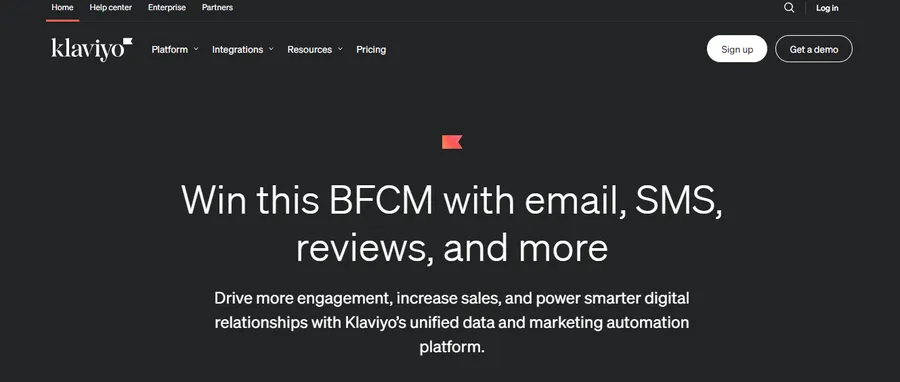
Klaviyo is the email automation software most serious ecommerce brands eventually land on, and for good reason. It was built from the ground up for online stores, not retrofitted like many general-purpose platforms.
What Klaviyo does well
The data model is the biggest differentiator. Klaviyo pulls in Shopify, WooCommerce, BigCommerce, and Magento order data at the SKU level. That means you can trigger flows based on what someone bought, what they browsed, how many times they have ordered, and even predicted lifetime value. Building a “VIP customers who have not bought in 90 days” segment takes about four clicks.
The pre-built flow library covers the core ecommerce sequences out of the box: welcome series, abandoned cart, post-purchase, browse abandonment, and win-back. Each flow comes with tested default timing and split logic that you can adjust without starting from scratch.
After setting up Klaviyo across several mid-market Shopify brands, the observation that stands out most is how quickly the attribution reporting becomes useful. Unlike some platforms that attribute revenue loosely, Klaviyo lets you set a custom attribution window and see exactly which flows and campaigns are driving revenue.
Where it falls short
Klaviyo is not cheap. The free tier supports up to 250 contacts and 500 sends per month, which is enough to test the product but not enough to run real campaigns. Pricing climbs steeply as your list grows, and SMS costs are additional. For a 50,000-contact list with email and SMS active, expect to budget $700 to $1,000 per month.
The learning curve is also steeper than Mailchimp or MailerLite. If you have never built automation flows before, plan for at least a week of onboarding before you feel comfortable.
Best for
Ecommerce brands on Shopify or WooCommerce that are generating consistent monthly revenue and need data-driven segmentation. If you are looking for support from an ecommerce email marketing agency, Klaviyo is the platform most agencies are fluent in.
Pricing: Free up to 250 contacts. Paid plans start at $20/month for 500 contacts (email only).
Mailchimp
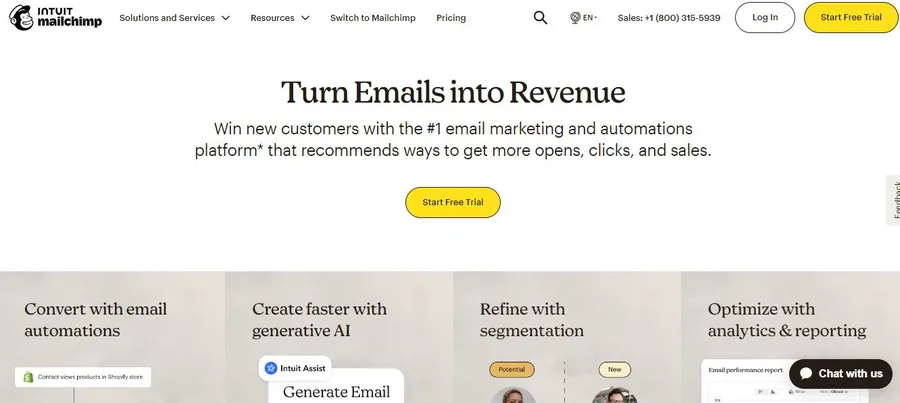
Mailchimp is the most recognized name in email software, and it earned that position by making email accessible to people with no marketing background. It is not the most powerful tool on this list, but it is the easiest to get started with.
What Mailchimp does well
The drag-and-drop email builder is genuinely one of the best in the market for non-designers. Templates are clean, the editing experience is fast, and you can publish a professional-looking campaign in under an hour without touching code.
Mailchimp has also expanded significantly beyond email. The platform now includes landing pages, social media scheduling, basic CRM, and a website builder. For very small businesses that want one tool for multiple channels, that consolidation has real value.
The free plan is the most generous of any platform at this scale: up to 500 contacts and 1,000 sends per month, which makes it one of the better free email marketing tools for businesses just starting to build their list.
Where it falls short
Automation is where Mailchimp shows its limits. The journey builder exists and works, but the trigger options are narrower than ActiveCampaign or Klaviyo. For example, behavior-based triggers like “visited a specific product page” are not natively available without third-party integrations. Ecommerce brands doing serious segmentation will hit the ceiling quickly.
Mailchimp’s pricing also jumped significantly in recent years. The free plan was reduced from 2,000 to 500 contacts in 2023, which pushed many small businesses to look elsewhere.
Best for
Freelancers, content creators, nonprofits, and early-stage small businesses that need a simple, polished email marketing platform for small business use without a steep learning curve.
Pricing: Free up to 500 contacts. Essentials plan starts at $13/month.
ActiveCampaign
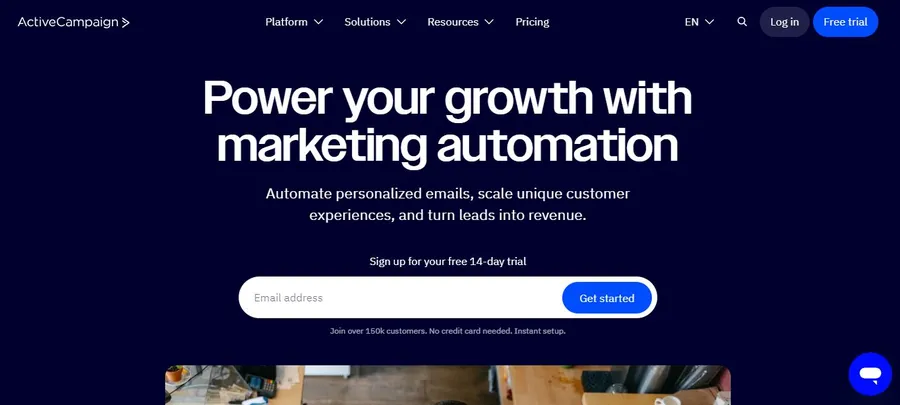
ActiveCampaign is the go-to choice when your automation needs get complex. It sits in the middle ground between simple email tools and full marketing suites, with automation depth that rivals enterprise platforms at a fraction of the price.
What ActiveCampaign does well
The automation builder is the strongest in this category for non-ecommerce businesses. You can build conditional logic, goal tracking, and multi-channel sequences (email, SMS, and site messaging) in one canvas. Triggers include form submissions, page visits, link clicks, deal stage changes, and custom events pushed via API.
The built-in CRM is another major advantage. Unlike tools that bolt on a CRM as an afterthought, ActiveCampaign’s CRM and email are genuinely integrated. A deal moving from “proposal sent” to “closed won” can trigger a specific onboarding email sequence automatically. That kind of native handoff between sales and marketing is rare at this price point.
Contact scoring is available on all plans above the Lite tier, and it works well for lead qualification. After running campaigns for a B2B SaaS client on ActiveCampaign, what became clear is that the scoring model is flexible enough to weight multiple behaviors without needing a developer to configure it.
Where it falls short
The interface has improved over the years but still feels busier than Mailchimp or MailerLite. New users often need a few days to understand where everything lives. The email builder is functional but not as polished as Mailchimp’s for pure design work.
Ecommerce integration exists but is not as deep as Klaviyo. It works well for WooCommerce stores, but Shopify merchants with advanced segmentation needs will likely want to compare both carefully.
Best for
B2B companies, SaaS businesses, service businesses, and agencies that need advanced automation and a CRM in one platform. Also a strong option as an email marketing platform for small business use when the business has a multi-step sales cycle.
Pricing: Starts at $15/month for the Lite plan (1,000 contacts). Pricing scales with contact count.
Brevo (formerly Sendinblue)
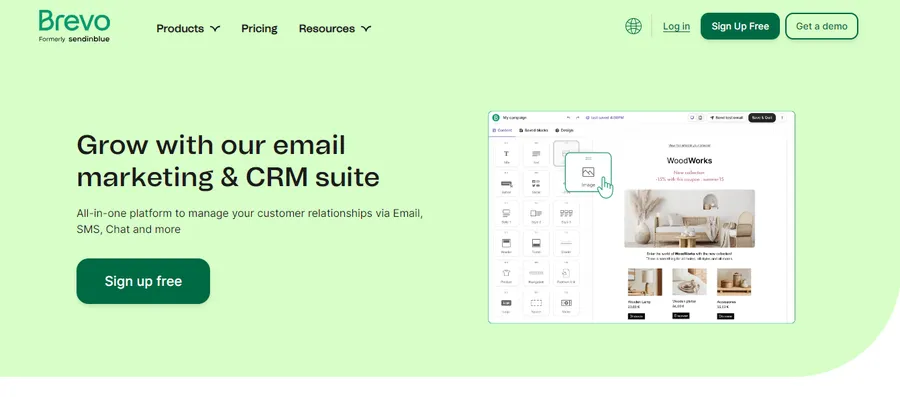
Brevo rebranded from Sendinblue in 2023 but kept what made the platform worth recommending: a pricing model based on email sends rather than contact count, which makes it one of the most affordable options for businesses with large lists.
What Brevo does well
The contact-count-free pricing model is genuinely unique among major platforms. You pay for the number of emails you send per month, not how many contacts you store. A business with 100,000 contacts that sends one monthly campaign pays far less on Brevo than on most competitors. This is a meaningful advantage for businesses with large, low-frequency email marketing lists.
Transactional email is another strength. Brevo handles both marketing email and transactional email (order confirmations, password resets, account notifications) from the same platform with the same reliability. Many businesses run two separate tools for these use cases and pay twice.
The free plan includes 300 emails per day with unlimited contacts, making it one of the strongest free email marketing tools available for businesses with active lists that are still in the early sending stage.
Where it falls short
The automation builder is less intuitive than ActiveCampaign and the flow templates are fewer than Klaviyo. Advanced ecommerce segmentation based on purchase behavior requires more manual configuration than purpose-built eCommerce platforms.
Reporting is functional but not deep. Granular revenue-per-email attribution requires supplementing with an external analytics tool.
Best for
Businesses with large contact lists that send campaigns at lower frequency. Also well-suited for teams that need transactional and marketing email under one roof without doubling their software spend.
Pricing: Free plan includes 300 emails/day. Starter plan begins at $9/month for 5,000 emails/month.
HubSpot Marketing Hub
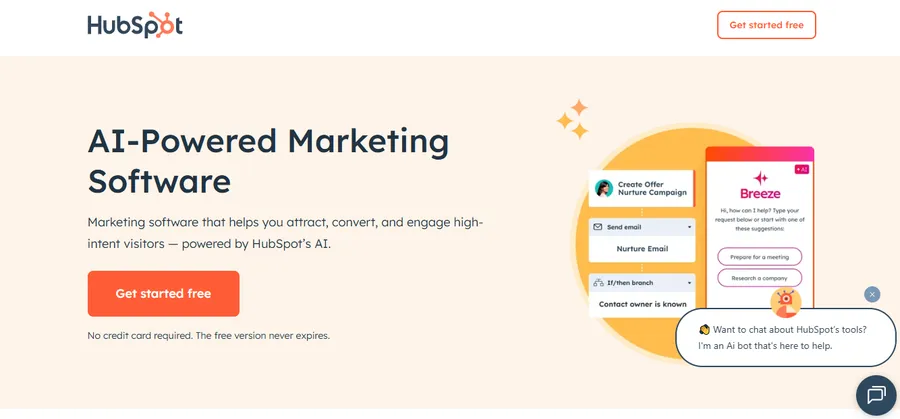
HubSpot Marketing Hub is enterprise-grade marketing automation software with a free tier that is genuinely useful for small businesses. The catch is that its most powerful features sit behind a significant paywall.
What HubSpot does well
The depth of the platform is hard to match. HubSpot combines email, landing pages, forms, ads, social media, SEO tools, and a full CRM in a single platform. If your team wants to run and measure every marketing channel from one dashboard, HubSpot is the closest thing to a complete solution.
The CRM is the backbone of everything else, and it is free with no contact limit. Contacts are enriched automatically with company data, social profiles, and behavior tracking, which makes segmentation much easier than on platforms that rely purely on what users fill in on forms.
The email automation builder in Marketing Hub Professional is one of the most complete in the market. Branching logic, goal-based branching, A/B tests within flows, and multi-touch revenue attribution are all included. After configuring Marketing Hub Professional for a mid-sized B2B company, what stood out was how clean the handoff from marketing automation to the sales pipeline is, with no manual data entry needed between the two.
Where it falls short
Pricing is the biggest barrier. The free tools are useful, but the moment you need marketing automation beyond basic sequences, you are looking at the Professional tier at $800/month (billed annually). That is not a typo. The jump from Starter ($20/month) to Professional is steep enough that many small businesses choose a purpose-built email marketing platform for small business use instead.
Ecommerce integration has improved but still requires more configuration than Klaviyo for Shopify-specific flows.
Best for
Mid-market and enterprise companies with dedicated marketing teams, a B2B sales motion, and the budget to match. Also a good fit for companies that want a unified marketing and sales CRM and can justify the Professional tier cost.
Pricing: Free CRM and basic email tools. Starter at $20/month. Professional at $800/month.
Drip
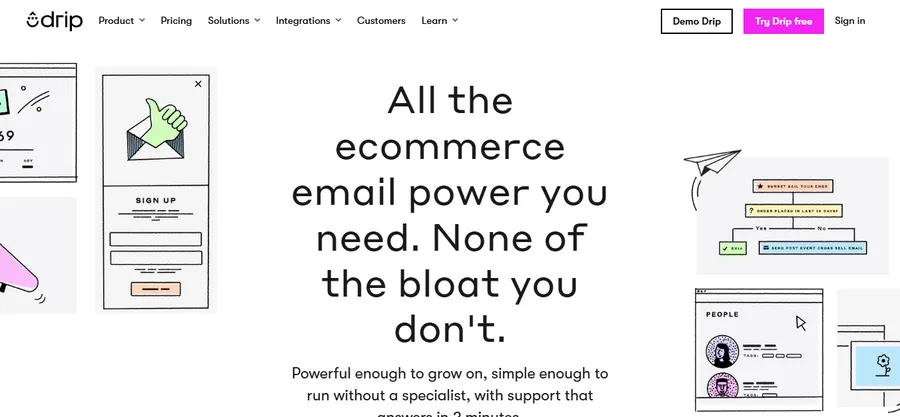
Drip positions itself as the email automation software built specifically for ecommerce brands, with a particular focus on Shopify and WooCommerce stores that want Klaviyo-level data depth at a lower starting price.
What Drip does well
Drip’s ecommerce CRM tracks every customer touchpoint: what someone browsed, what they added to cart, what they purchased, and how often they return. That data feeds into segmentation that goes beyond basic RFM (recency, frequency, monetary) analysis. You can build a segment of “customers who have bought twice, spent over $200 total, and opened at least three emails” in a few minutes.
The visual workflow builder is one of the cleaner ones in this list. Each step shows you how many people have passed through it, which makes it easy to spot where contacts are dropping out of a sequence without digging through reports.
Email personalization using Liquid templating is supported natively, which is a meaningful feature for brands that want to include dynamic product recommendations or personalized copy blocks without paying for an add-on.
Where it falls short
The template library is thinner than Mailchimp or Klaviyo. Building a well-designed email from scratch in Drip takes longer unless you are working from a custom HTML template. The SMS feature, added more recently, is functional but not as robust as Klaviyo’s.
Reporting is solid but lacks the revenue attribution depth of Klaviyo for large-scale ecommerce operations.
Best for
Small to mid-size ecommerce brands on Shopify or WooCommerce that want strong automation depth and ecommerce data integration at a lower entry price than Klaviyo.
Pricing: Starts at $39/month for up to 2,500 contacts. No free plan, but a 14-day trial is available.
MailerLite
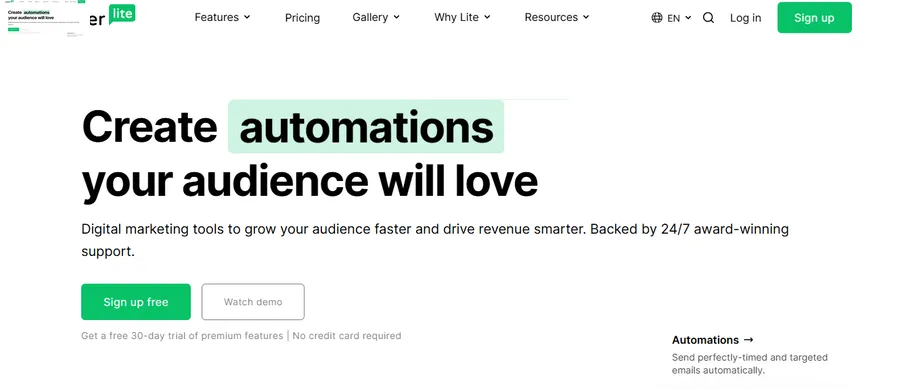
MailerLite is the simplest tool on this list that still offers real automation. It is not trying to compete with Klaviyo or ActiveCampaign on depth, but for small businesses and content creators who want a clean, affordable email marketing platform for small business use, it does almost everything they need.
What MailerLite does well
The interface is the fastest to learn. Most users can build a complete welcome sequence within an hour of signing up. The drag-and-drop builder is clean, the automation editor is uncluttered, and the template library covers the most common use cases without overwhelming you with choices.
MailerLite includes landing pages, pop-ups, forms, and a basic website builder on all plans, including the free tier. The free plan supports up to 1,000 subscribers and 12,000 emails per month, which is one of the most generous limits among free email marketing tools in this price range.
Deliverability on MailerLite is consistently good. The platform maintains a strong sender reputation partly because it reviews new accounts before allowing bulk sending, which reduces spam on their shared IP infrastructure.
Where it falls short
Automation logic is limited compared to ActiveCampaign or Klaviyo. You can build linear sequences with basic conditional splits, but multi-branch journeys with goal tracking are not available. Ecommerce integration exists for Shopify and WooCommerce but does not pull in SKU-level product data.
Advanced segmentation is missing. You cannot build behavior-based segments beyond basic event triggers. For businesses that rely on behavioral segmentation for personalization, MailerLite will feel constraining.
Best for
Bloggers, coaches, newsletters, and small service businesses that want reliable, affordable email automation without a steep setup curve. A strong pick as a free email marketing tool for businesses under 1,000 subscribers.
Pricing: Free up to 250 subscribers. Paid plans start at $10.80/month.
Omnisend
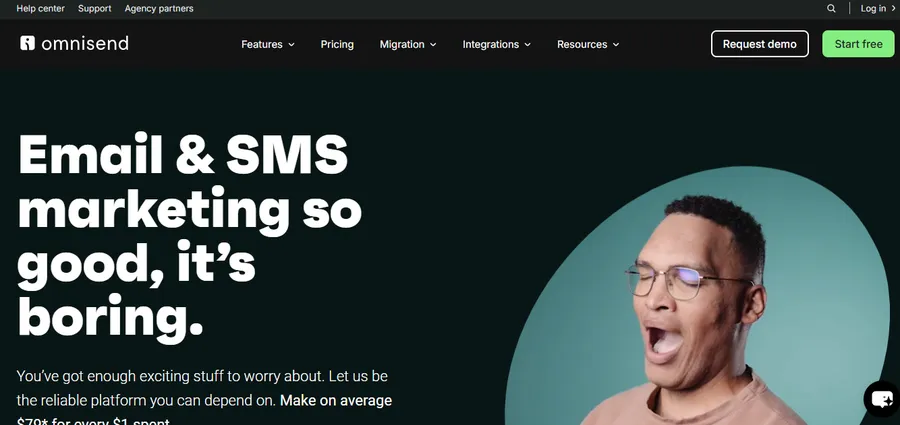
Omnisend is built for ecommerce and focuses specifically on multi-channel automation: email, SMS, and push notifications all managed from one platform. It runs particularly well on Shopify and is a common alternative to Klaviyo at smaller send volumes.
What Omnisend does well
The multi-channel workflows are the headline feature. A single automation flow can send an email, wait, send an SMS if the email was not opened, and then push a browser notification, all triggered by the same ecommerce event. That kind of channel coordination used to require two separate tools and manual syncing between them.
Pre-built ecommerce workflows are well designed. The abandoned cart sequence, for example, includes SMS timing recommendations based on Omnisend’s aggregate data from thousands of ecommerce stores. You can deploy it in about ten minutes and see results before you have time to second-guess the setup.
The free plan includes up to 250 contacts and 500 emails per month, and importantly, it includes access to multi-channel automation on the free tier, which most competitors reserve for paid plans. That makes it one of the better free email marketing tools for Shopify brands getting started.
Where it falls short
Segmentation is less flexible than Klaviyo for complex ecommerce use cases. The data model does not go as deep into product-level attributes, so campaigns based on specific purchased product categories or SKU combinations require more workarounds.
The email builder’s template selection is smaller than Mailchimp’s, and the design customization options are not as granular for brands with strict visual standards.
Best for
Small to mid-size Shopify stores that want email and SMS automation in one tool without the complexity or price of Klaviyo. A natural starting point for brands that eventually want to grow into an ecommerce email marketing agency relationship.
Pricing: Free up to 250 contacts. Standard plan starts at $16/month for 500 contacts.
How to Choose the Right Email Marketing Platform for Small Business
The decision comes down to three things: your business model, your current list size, and how much automation complexity you actually need today (not the complexity you imagine needing someday).
Here is a quick decision framework.
- If you are a content creator, newsletter, or service business with under 5,000 contacts: Start with MailerLite or Mailchimp. Both offer free email marketing tools that are more than enough for basic sequences and campaigns. You can always migrate later.
- If you run a Shopify or WooCommerce store and are generating consistent monthly revenue: Go straight to Klaviyo or Omnisend. The ecommerce data integration will pay for itself quickly through better abandoned cart recovery and post-purchase flows. If you are evaluating whether to work with an ecommerce email marketing agency, most agencies will be able to manage either platform.
- If you are a B2B company or have a multi-step sales process: ActiveCampaign is the strongest email automation software at a mid-market price. HubSpot is the better choice if you need a unified CRM and can justify the Professional tier budget.
- If your list is large but your send frequency is low: Brevo’s contact-count-free model will save you real money every month.
Before migrating from your current email software to a new platform, export a clean version of your email marketing lists first. Remove hard bounces, unsubscribes, and contacts who have not opened an email in over 18 months. Starting fresh with a clean list improves deliverability and avoids paying for dead contacts on a per-subscriber pricing model.
FAQs
What is the difference between email marketing and marketing automation?
Email marketing refers to sending campaigns to a list, whether that is a newsletter, a promotional blast, or a product announcement. Marketing automation is a broader category that includes email but also covers behavior-triggered sequences, lead scoring, CRM updates, and multi-channel coordination. Most email automation software today includes both, but the automation depth varies significantly between platforms.
Are free email marketing tools good enough for small businesses?
Free plans from MailerLite, Mailchimp, Brevo, and Omnisend are genuinely useful for businesses under 500 to 1,000 contacts. They cover welcome emails, basic sequences, and occasional campaign sends. The main limitations on free plans are subscriber caps, daily send limits, and the absence of advanced automation logic. Once your list grows past 1,000 contacts or you need behavioral triggers, a paid plan becomes worth the investment.
How do I clean my email marketing lists?
Start by removing all hard bounces and unsubscribes, which your email platform should be doing automatically. Then run a re-engagement campaign targeting contacts who have not opened an email in 12 to 18 months. Anyone who does not respond to a final re-engagement message should be suppressed or deleted. A clean list improves deliverability, lowers your platform costs (on per-subscriber pricing), and gives you more accurate performance data. Most platforms include list hygiene tools under their audience or contacts management section.
Should small businesses hire an ecommerce email marketing agency or manage email in-house?
It depends on your team’s bandwidth and current revenue. Most businesses can manage email in-house up to about $500K to $1M in annual ecommerce revenue using a platform like Klaviyo or Omnisend. Beyond that, the complexity of segmentation, flow optimization, and deliverability management often justifies the cost of working with an ecommerce email marketing agency. A good agency typically pays for itself through improved flow revenue and better campaign performance within the first two to three months.
Read more: What is Conversion Rate Optimisation (CRO)?
Contact US | ThimPress:
Website: https://thimpress.com/
Fanpage: https://www.facebook.com/ThimPress
YouTube: https://www.youtube.com/c/ThimPressDesign
Twitter (X): https://x.com/thimpress_com