Choosing from the sea of coaching website templates available today can feel overwhelming, especially when your website is often the first impression a potential client gets of your practice. Whether you are a life coach, a business mentor, or a wellness consultant, the template you pick affects how visitors read your credibility, how easily they book a session, and how well your site performs in search results.
This guide walks through the coaching website templates worth your attention in 2026, from free minimalist options to premium WordPress themes built specifically for coaches, so you can launch a site that actually converts visitors into clients.
Eduma – Education WordPress Theme
We provide an amazing WordPress theme with fast and responsive designs. Let’s find out!
What makes a good coaching website template

A coaching website is not a portfolio site and it is not an online store. It sits somewhere in between: part personal brand, part service page, part booking tool. Before comparing specific coaching website templates, it helps to know what separates a template that works from one that just looks nice in a demo.
Booking and scheduling built in
Coaches live and die by their calendar. A template that forces you to bolt on three separate plugins just to let someone book a discovery call is going to cost you leads. Look for coaching website templates that either include a built-in booking widget or integrate cleanly with tools like Calendly or Amelia. After testing several coach website templates on a staging site, the ones with a dedicated booking section right on the homepage consistently produced more completed bookings than templates that buried the calendar three clicks deep on a separate page.
Trust signals above the fold
Testimonials, client logos, certifications, and a clear headshot need to appear early. Visitors decide within seconds whether to keep scrolling, and a coach’s authority is harder to establish than a product’s price tag. The best coaching website templates place a short bio and a credibility strip (media mentions, certifications, years in practice) directly under the hero section.
Mobile performance
Most coaching inquiries now start on a phone, often from a social media link in a bio. A template that looks polished on a laptop but stacks awkwardly or loads slowly on mobile will quietly lose you leads you never see in your analytics. Run any shortlisted coach website template through Google PageSpeed Insights on the mobile tab before committing, and pay attention to Largest Contentful Paint (LCP). Anything above 2.5 seconds on a typical 4G connection is worth investigating before launch.
A clear content management system
WordPress remains the practical choice here. As of mid-2026, WordPress still powers roughly 41 percent of all websites according to W3Techs, far ahead of any single competitor, which means a much larger pool of coaching-specific plugins, page builders, and support resources than any closed platform can offer.
Design elements every coaching website template should include
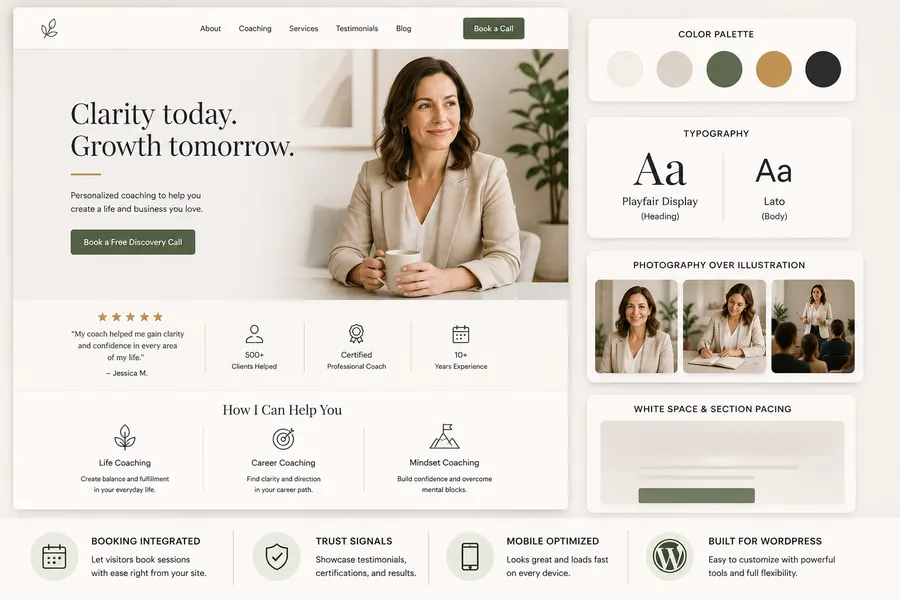
Beyond booking and trust signals, the visual details of a template shape how a visitor feels within the first few seconds of landing on your site. Coaching is a personal, relationship-driven service, so the design choices carry more weight than they would on a typical product page.
Color and tone
Warm, muted color palettes tend to outperform bright, saturated ones for coaching brands, since they read as calm and trustworthy rather than promotional. A common pattern across strong coaching website templates is a neutral background (cream, soft grey, or white) paired with a single accent color used sparingly for buttons and links. Avoid templates that ship with five or six accent colors already applied throughout the demo. Stripping a busy template down to a clean palette takes far longer than customizing a template that starts minimal.
Typography that signals expertise
Serif fonts in headings paired with a clean sans-serif body font remain a reliable combination for coaching and consulting sites, since the pairing reads as established and considered rather than trendy. Whatever pairing you choose, confirm the template lets you adjust heading size independently from body text, since many page builders link these settings by default in a way that makes small tweaks unnecessarily fiddly.
Photography over illustration
Stock illustrations of generic business people shaking hands are one of the fastest ways to make a coaching site feel impersonal. The strongest coach website templates leave clear, generous space for real photography: a professional headshot, a few lifestyle shots of the coach in their working environment, and, where relevant, photos from workshops or speaking engagements. If a template’s demo relies heavily on illustration rather than photo placeholders, budget extra time for a photo shoot before launch rather than falling back on generic stock images.
White space and section pacing
Templates built for e-commerce or agencies often pack sections tightly to showcase as many features as possible. Coaching website templates work better with more breathing room between sections, since the goal is to build trust gradually rather than convert a visitor in a single scroll. When testing a template’s demo, count how many distinct calls to action appear before the fold ends. More than one usually means the layout was built for a different kind of business and will need trimming.
Life coaching website templates: what to look for
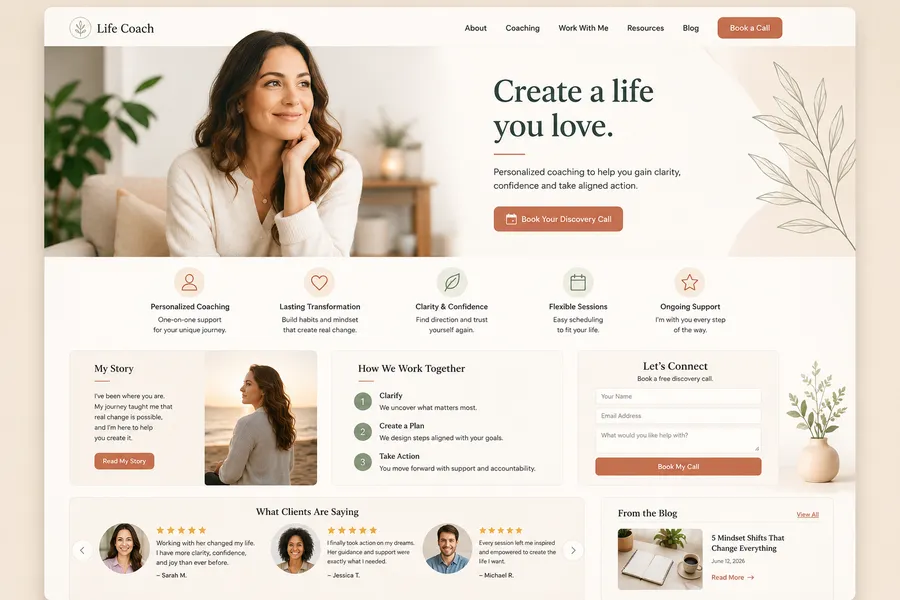
Life coaching website templates carry a slightly different job than templates built for business consultants. The tone needs to feel warmer, the imagery more personal, and the path to booking a first session shorter. A life coach is usually selling transformation and trust rather than a specific deliverable, so the template has to carry emotional weight without tipping into vague, generic language.
Good life coaching website templates typically include:
- A hero section built around a photo of the coach rather than a stock illustration
- Space for a short origin story, since life coaches are often hired based on personal resonance
- A simple, low-friction contact or discovery call form
- Blog or resources section to demonstrate ongoing expertise
- Client story or testimonial carousel with real names and photos where possible
If you are coaching around a specific niche such as career transitions, relationships, or wellness, prioritize templates with flexible header and section layouts. A rigid template built for, say, real estate agents will fight you every time you try to reframe the copy around emotional outcomes instead of transactions.
Best coach website templates for WordPress in 2026
The table below compares coaching website templates and page-builder kits worth shortlisting this year. Pricing reflects standard single-site licenses at the time of writing and can change, so always confirm current pricing before purchase.
| Template | Best for | Booking integration | Price |
|---|---|---|---|
| Coaching – Life and Business Mentoring WP Theme | Life and business coaches wanting a ready-made, polished site | Built-in booking sections, Elementor compatible | One-time purchase |
| Divi coaching layout packs | Coaches who already use Divi and want flexibility | Calendly embed | Included with Divi |
| Astra + coaching starter templates | Budget-conscious coaches, fast page speed | Third-party plugin required | Free core theme, paid add-ons |
| GeneratePress + coach blocks | Developers or agencies building custom coach sites | Manual integration | Free core theme, paid premium version |
| Eduma | Coaches who also sell structured courses or group programs | LearnPress course booking and enrollment | One-time purchase |
If your goal is a dedicated speaker or life coach site with minimal setup time, the Coaching – Life and Business Mentoring WordPress Theme is worth a close look. It ships with layouts built specifically for coaches and speakers, including sections for booking, testimonials, and event listings, so you spend your setup time customizing copy and photos instead of rebuilding the page structure from scratch.
Coaches who plan to sell structured programs, cohort-based courses, or certification tracks alongside one-on-one sessions should also consider Eduma. It is built around the LearnPress plugin, which handles course enrollment, quizzes, and student progress, making it a practical fit for a coach whose business model has grown past single sessions into a full curriculum.
Key features to compare before you buy
When shortlisting any coach website template, check these details on the live demo rather than relying on the marketing screenshots alone:
- Page builder compatibility. Elementor and Gutenberg are the two most common choices for coaching website templates. Confirm the template you like works natively with the builder you already know.
- Update frequency. Check the changelog on the theme’s marketplace page. A theme with no updates in over a year is a warning sign, especially given how often WordPress core and PHP versions change.
- Support response time. Read recent reviews for mentions of support turnaround, not just design praise.
- Demo import reliability. Some coach website templates ship with a one-click demo importer that frequently breaks on shared hosting. Test this on a staging environment before you commit real client-facing content to it.
Free minimalist WordPress blog themes for coaches
Not every coach needs a full page-builder theme on day one. If you are just starting out and want to publish content, build an email list, and establish authority before investing in a paid theme, free minimalist WordPress blog themes are a sensible starting point.
Why minimalist works for early-stage coaches
A minimalist theme keeps the focus on your writing and your voice, which matters more than flashy animation when you are still proving out your niche. Minimal design also tends to load faster, which helps both your Core Web Vitals scores and your search rankings, since page experience remains a ranking factor in Google’s algorithm.
Free minimalist WordPress blog themes worth testing
Each of these free minimalist WordPress blog themes gives you a clean base you can migrate away from later without losing your content, since your posts and pages stay in the WordPress database rather than locked inside a proprietary builder format.
- Astra – lightweight, starts nearly blank, and pairs well with the free Starter Templates plugin for a simple coaching landing page.
- GeneratePress – built by a developer known for prioritizing speed over decoration; the free version covers most of what a coach needs before scaling to paid add-ons.
- Neve – includes a handful of free starter sites, several suited to consultants and personal brands, with a drag-and-drop customizer.
- Blocksy – a newer block-based theme that works well with the native WordPress Site Editor if you want to avoid a heavier page builder altogether.
- OceanWP – free core theme with a large extension library if your needs grow later, without forcing a full theme switch.
Best free blog templates WordPress offers for coaching content
Content marketing is one of the most reliable ways coaches build an audience before they can afford paid ads. The best free blog templates WordPress makes available today are built with readability and SEO structure in mind, not just visual style.
When picking from the best free blog templates WordPress currently offers, prioritize:
Typography and readability
Coaching content is often long-form: reflective essays, client success stories, frameworks explained in detail. A template with generous line height, a readable body font size (16px minimum), and clear heading hierarchy will keep readers scrolling longer, which signals engagement to search engines.
Built-in schema and SEO hooks
Some of the best free blog templates WordPress offers pair naturally with SEO plugins like Rank Math or Yoast, exposing clean heading structure and metadata fields without extra code. Test this by installing your SEO plugin of choice and confirming the plugin’s on-page analysis runs without errors on the template’s default post layout.
Category and tag support
If you plan to write across multiple coaching topics (mindset, productivity, relationships, career), pick a template with a clean archive page design. A cluttered or broken archive page undermines the topical authority you are trying to build, since it is often the page Google sends new visitors to first.
Coaching website examples for inspiration
Looking at real coaching website examples before you commit to a template saves you from redesigning six months in. A few patterns show up again and again across strong coaching website examples worth studying:
- A single, clear call to action per page. Sites that ask visitors to “book a call,” “join the newsletter,” and “buy the course” all on the homepage tend to convert worse than sites with one primary action per page.
- Video introductions on the homepage. Coaching is a trust-based purchase, and a 60 to 90 second video of the coach speaking directly to the camera consistently outperforms a static photo alone in engagement.
- Case studies over generic testimonials. The strongest coaching website examples replace one-line quotes with short before-and-after narratives: what the client’s situation looked like before coaching, what changed, and what result they achieved.
- A visible, simple pricing or process page. Even coaches who work on a custom-quote basis benefit from laying out their process (discovery call, proposal, kickoff) so visitors know what to expect before reaching out.
Browsing the demo galleries of the templates listed earlier in this guide is a fast way to see these patterns applied to real coaching website examples rather than generic business layouts.
How to choose the right coaching website template for your practice
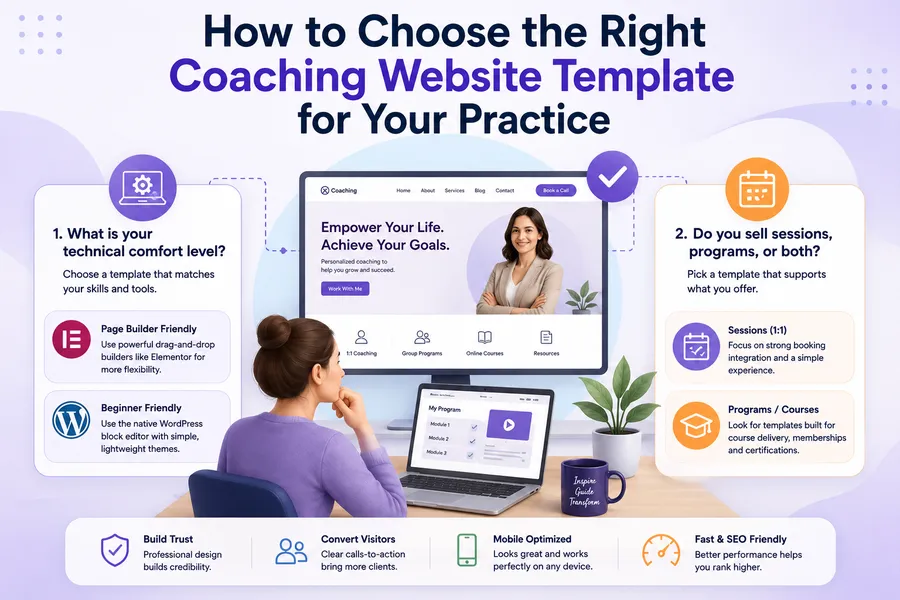
With so many coaching website templates available, the decision usually comes down to three practical questions.
What is your technical comfort level?
If you are comfortable with a page builder like Elementor, a fuller-featured template such as the Coaching – Life and Business Mentoring theme saves setup time. If you would rather write in the native WordPress block editor and keep things simple, a free minimalist theme paired with a starter template plugin is the lower-friction path.
Do you sell sessions, programs, or both?
A coach selling only one-on-one sessions needs strong booking integration above everything else. A coach building out group programs, cohorts, or certifications benefits more from a theme built around course delivery, which is where a theme like Eduma earns its place, since it was built around the LearnPress plugin from the ground up rather than bolting course functionality onto a generic layout.
How much content will you publish?
If content marketing is central to your growth strategy, weight your decision toward templates with strong blog and archive layouts, even if that means sacrificing some homepage flash. If your growth comes mainly from referrals and speaking engagements, a template that emphasizes credibility sections and a strong hero will serve you better than one optimized purely for blog scanning.
Common mistakes coaches make when choosing a website template
Even with a strong shortlist of coaching website templates, a few recurring mistakes show up again and again when coaches move from demo to live site.
Picking a template before defining the offer
It is tempting to fall in love with a design first and figure out the messaging later. In practice, this usually means rewriting large sections of copy to fit a layout that was never built for your specific offer. Before browsing coach website templates, write a single sentence describing who you help and what result you deliver. Keep that sentence next to you while comparing templates, and reject any layout that cannot accommodate it clearly in the hero section.
Overloading the homepage
Many coaches try to cram every service, every credential, and every testimonial onto the homepage out of fear that visitors will not click through to other pages. This usually backfires, since a long, unfocused homepage buries the one action you actually want visitors to take. A better approach, and one supported by most well-built life coaching website templates, is a focused homepage with clear links to dedicated services, about, and blog pages.
Ignoring page speed until after launch
It is far easier to choose a fast template from the start than to optimize a slow one after launch. Heavy page builders with dozens of unused modules, oversized hero images, and auto-playing background video are common culprits behind slow coaching sites. Before finalizing a template, load the demo on a throttled mobile connection (Chrome DevTools has a built-in throttling option) and see how it actually feels, not just how it scores in a lab test.
Skipping a mobile booking test
A template can look flawless on desktop and still have a booking widget that is nearly unusable on a small screen, with tiny tap targets or a calendar that requires horizontal scrolling. Always complete a full mock booking flow on an actual phone before considering a coach website template finalized, not just a visual scroll-through.
Forgetting to plan for growth
A template that fits a solo coach perfectly on day one might not support a future team page, a group program section, or a membership area. If you expect to expand your offer within the next year or two, favor coaching website templates built on a flexible page builder or, for course-based growth, a theme like Eduma that already has enrollment and membership structures built in, rather than a rigid single-purpose layout you will need to replace later.
FAQs
What is the best free coaching website template for beginners?
Astra paired with the free Starter Templates plugin is a practical starting point for most new coaches. It loads quickly, works with both Elementor and the native block editor, and includes starter layouts you can adapt for a coaching homepage without writing custom code.
Do coaching website templates include booking systems?
Not always. Some coaching website templates ship with a booking section that simply embeds a third-party tool like Calendly, while others include native booking sections built into the theme itself, as seen in dedicated coach-focused themes. Always check the live demo’s booking flow before purchasing rather than assuming it works the way the screenshots suggest.
Can I use a life coaching website template for a business coaching site?
Yes, in most cases. The underlying layout, spacing, and functionality are usually flexible enough to work for both. The main adjustments are tone of copy and imagery: business coaching content tends to favor case studies and results-driven language, while life coaching content favors personal story and emotional resonance.
How much does a professional coach website template cost?
Free minimalist WordPress blog themes cost nothing beyond hosting, while premium coach website templates on marketplaces like ThemeForest typically run as a one-time purchase for a single-site license. Ongoing costs to budget for separately include hosting, a booking plugin if it is not included, and any premium page builder add-ons.
Conclusion
The right coaching website template depends less on which one looks best in a demo and more on how well it fits your actual workflow: how you book clients, how much you write, and whether your business model is built around sessions, programs, or both. Start with a free minimalist WordPress blog theme if you are still validating your niche, and move to a dedicated coach website template once you have a clear sense of what your visitors need to see to book a call. Whichever path you choose, prioritize booking flow, mobile speed, and clear trust signals over decorative extras, since those three factors do more to turn visitors into paying clients than any color scheme ever will.
Read more: 10 Best Educational Apps for Students
Contact US | ThimPress:
Website: https://thimpress.com/
Fanpage: https://www.facebook.com/ThimPress
YouTube: https://www.youtube.com/c/ThimPressDesign
Twitter (X): https://x.com/thimpress_com