An AEO CMS platform (Answer Engine Optimization Content Management System) is a website building and management tool specifically designed to structure data, automate schema, and format content so that large language models (LLMs) and AI search tools can easily discover, understand, and cite your brand.
This technical infrastructure is critical because the very nature of search is shifting. We are witnessing the rapid rise of AI search tools like ChatGPT, Google’s AI Overviews, and Perplexity, coupled with a drastic decline in traditional website clicks.
In 2026, data shows that roughly 68% to 72% of all Google searches now end without a single click to an external website, and when an AI Overview is present, that zero-click rate can soar to 83%.
Traffic is disappearing, and user intent is being satisfied directly on the search engine results page (SERP).
Choosing the right CMS determines whether your content gets cited or ignored by AI.
Eduma – Education WordPress Theme
We provide an amazing WordPress theme with fast and responsive designs. Let’s find out!
What Is an AEO CMS Platform?
Simple Definition
An AEO CMS platform is a content management system built specifically to make your website easily readable by AI models.
It goes beyond simple webpage storage by automatically applying structured data, prioritizing entity relationships, and breaking content down into bite-sized, extractable “chunks” that answer engines prefer to use when generating direct responses.
How It Differs From Traditional CMS
Traditional content management systems were built for human readers and traditional search crawlers.
In a standard CMS, your content is generally stored as one massive, monolithic HTML block.
A human can scroll through it and find what they need, but an AI model struggles to isolate a specific definition or fact from the surrounding fluff.
Traditional platforms also lean heavily on keyword-based optimization, meaning they focus on matching exact phrases rather than understanding the underlying concepts.
An AEO CMS shifts the paradigm entirely.
Instead of focusing merely on keywords, it relies on entity-based content modeling, building a web of relationships between topics, authors, and your brand to establish expertise.
Furthermore, an AEO CMS enforces AI-first formatting.
It breaks content out of the HTML monolith and into semantic chunks—discrete, self-contained modules like Q&A blocks, tables, and concise definitions.
This ensures that when an AI model looks for a quick, authoritative answer, your content is perfectly packaged for instant extraction.
Why AEO CMS Matters in the Zero-Click Era
The Shift From Search Engines to Answer Engines
Search engines historically functioned as digital librarians: you asked a question, and they handed you a list of 10 promising books (links) to read.
Today, answer engines act as the experts themselves: you ask a question, and they synthesize a definitive answer directly on the screen. Generative AI tools and AI Overviews have effectively replaced traditional SERPs for informational queries.
In this new ecosystem, a brand’s primary goal must shift.
The new metric of success is citation > click.
If a user never visits your website because AI answered their question first, your brand must be the authoritative source cited by that AI.
Being referenced by ChatGPT or Perplexity is the modern equivalent of ranking position one.
What Happens Without AEO Optimization
If your CMS cannot support modern AEO strategies, the consequences in 2026 are severe.
First, you face a complete loss of visibility. When your content lacks structured data and semantic chunking, AI models will bypass your site in favor of competitors whose information is easier to parse.
Second, you will experience reduced traffic quality. As informational queries increasingly end in zero clicks, the clicks that do make it through are usually transactional or highly complex.
If your site structure is poor, you lose out on educating the buyer during their research phase.
Finally, you suffer from missed AI citations, effectively erasing your brand from the modern discovery journey.
Core Features of a High-Performance AEO CMS Platform
To bridge the gap between traditional web management and the demands of large language models, a top-tier AEO CMS platform must possess specific technical capabilities.
Structured Data Automation
Schema markup is the native language of answer engines.
A true AEO CMS automates the generation of JSON-LD schema for every piece of content you publish.
Whether you are posting an article, an FAQ page, or a product specification, the CMS should automatically inject the correct structured data.
This AI-readable layer removes ambiguity, telling the LLM exactly what the content is about, who wrote it, and when it was published.
Entity-Based Content Modeling
Modern AI search relies on entities (people, places, concepts) rather than isolated keywords. An AEO platform excels at mapping these relationships.
By linking an author’s profile to their verified credentials, previous publications, and related subject matter, the CMS sends strong authority and expertise signals to answer engines.
Answer-Focused Content Formatting
Because AI models are fundamentally question-answering machines, your CMS should make it effortless to provide answers.
The best platforms offer native Q&A sections and formatting rules that prompt creators to place direct, concise answers immediately below clear headings.
Semantic Content Chunking
Long-form walls of text are an LLM’s worst enemy.
An AEO CMS facilitates semantic content chunking, breaking your articles into self-contained, highly structured blocks.
By isolating a definition, a numbered list, or a step-by-step guide into its own data module, the CMS drastically improves the speed and accuracy of extraction by LLMs.
Content Freshness & Version Control
AI models are programmed to avoid hallucinations and outdated facts.
Therefore, recency signals are a massive factor in AI trust.
A modern CMS includes automated version control and workflows that notify content managers when high-performing answers haven’t been updated in several months, ensuring your site remains the freshest source available.
AI Visibility Tracking
Traditional rank tracking is no longer sufficient. An advanced AEO platform includes dashboards to measure your Share of AI Voice.
Instead of tracking where you rank on a page of blue links, these tools measure how frequently your brand is cited by AI engines, which prompts trigger your content, and the sentiment of those citations.
Quick Comparison: Top AEO CMS Platforms
| CMS Platform | Ideal User | Core AEO Strength | Starting Price |
| HubSpot Content Hub | Marketers & SMBs | Native AEO visibility tracking, automated schema, and deep CRM integration. | Free / $9/month |
| Sanity | Developers | Programmatic content lake with highly flexible entity modeling. | Free / $15/month |
| Strapi | DevOps Teams | Open-source customization with flattened APIs for easy AI extraction. | Free / $45/month |
| Contentful | Enterprises | Multi-channel API delivery and high-scale structured data modeling. | Free / $300/month |
| WordPress | Bloggers & SMBs | Massive ecosystem of third-party plugins for schema and AEO extensions. | Free (Open Source) |
5+ Best AEO CMS Platform Options
Not every business requires the same architecture. Here is a breakdown of the best AEO CMS platforms categorized by their ideal use case.
1. HubSpot Content Hub: Best for Marketers & SMBs
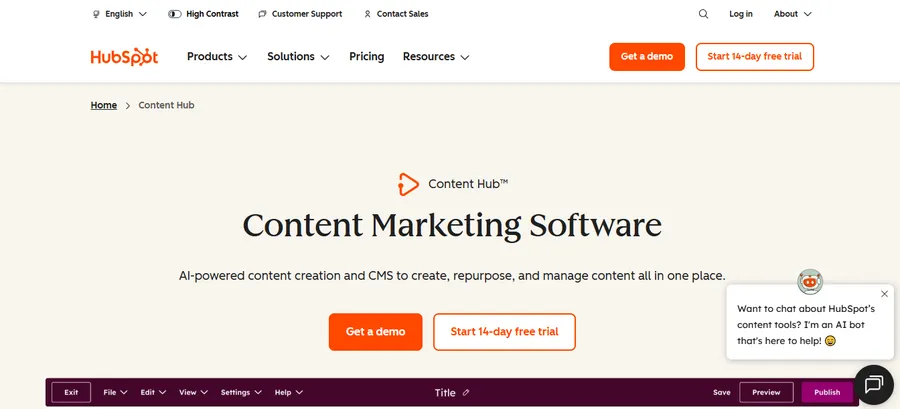
For marketing teams who need to scale their AEO efforts without a team of developers, HubSpot Content Hub is the premier choice. It offers an all-in-one approach to AEO and marketing.
The platform features native AEO tools, deep CRM integration, and the Breeze AI suite. It automatically handles structured data (like FAQPage and Article schemas) and allows marketers to track their brand’s AI visibility and Share of Voice directly against competitors.
2. Sanity: Best for Developers & Custom Builds
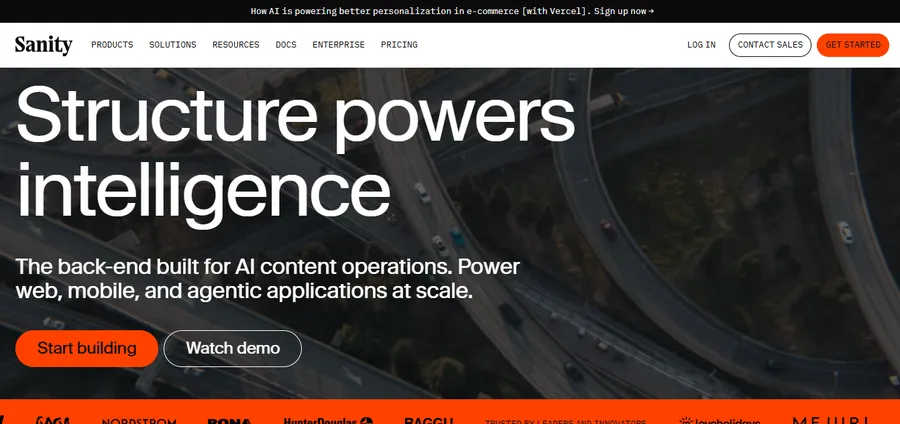
Sanity is a headless, API-first “Content Operating System.” It treats content as pure data, allowing developers to build custom, programmatic content lakes that perfectly map to a brand’s specific entity relationships.
Because it doesn’t force fixed templates, LLMs can pull precise data chunks via GROQ/GraphQL APIs with zero friction.
3. Strapi: Best for Developers & Custom Builds
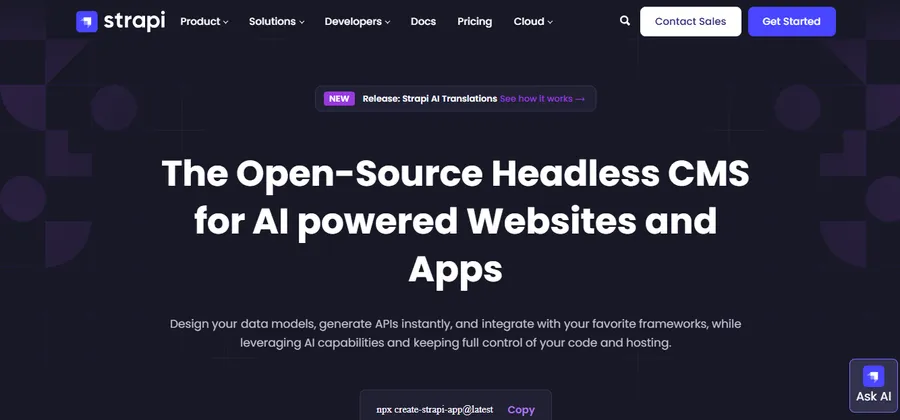
Strapi is an open-source, headless CMS that gives developers complete self-hosted control. Its massive plugin ecosystem and heavily flattened API responses make it incredibly easy for AI bots to parse backend data without getting bogged down in nested HTML.
4. Contentful: Best for Enterprise & Scalability
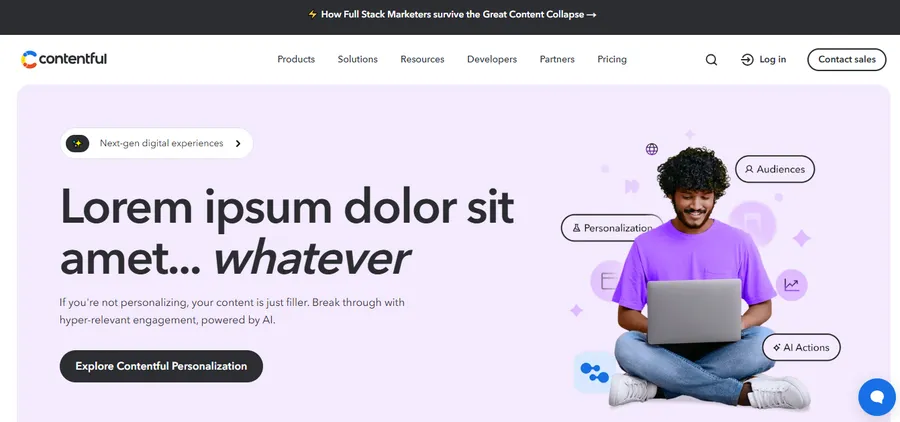
When global enterprises need to manage massive amounts of structured content across dozens of languages and devices, Contentful leads the pack.
Its headless architecture and robust content modeling capabilities allow enterprises to deliver perfectly structured, AI-ready data across any channel via multi-channel API delivery.
5. WordPress: Best Traditional CMS With AEO Extensions
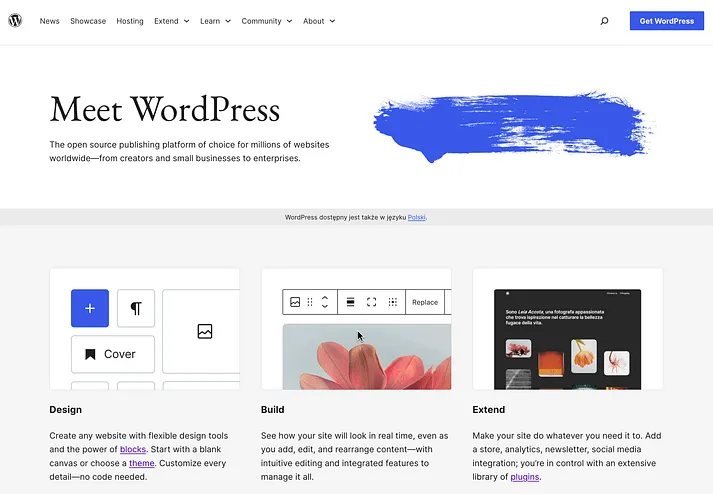
While WordPress was built for the traditional SEO era, it remains highly viable due to its massive plugin ecosystem.
WordPress itself does not natively support advanced semantic chunking out of the box, but by utilizing specialized schema plugins, custom fields, and AEO-focused extensions, traditional bloggers and SMBs can effectively retrofit their WordPress sites to compete in AI search.
How to Choose the Right AEO CMS Platform
Key Evaluation Criteria
When assessing a platform for your brand, evaluate it against these four pillars:
- Schema automation: Does the platform require manual coding for JSON-LD, or does it apply structured data automatically based on the content type?
- Scalability: Can the system maintain strict entity consistency and structural integrity as your content library grows into the thousands of pages?
- AI integration: Does the CMS offer native tools to measure AI visibility or generate answer-first content?
- Content modeling flexibility: Can you easily build custom content blocks (like Q&A modules) that separate data from design?
Quick Decision Guide
- If you are a marketer or an SMB looking for an all-in-one system with native visibility tracking, choose HubSpot Content Hub.
- If you are an enterprise needing to push consistent, structured data to multiple global touchpoints, choose Contentful.
- If you are a developer who wants to build a highly customized, open-source, or programmatic content data lake, choose Sanity or Strapi.
How to Optimize Content Using an AEO CMS
Having the right tool is only half the battle; how you input the data matters just as much. Here is how to maximize your platform’s potential.
Create Answer-First Content
AI models look for immediate relevance. When structuring a page, put the most direct, concise answers immediately under your H2 or H3 headings.
Do not bury the definition in the third paragraph. State the fact clearly in 40–60 words, and use the subsequent paragraphs for context and deep dives.
Use Entity Linking
Connect the dots for the AI. Use your CMS to explicitly link authors to their credentials, brands to their parent companies, and core topics to your pillar pages.
By establishing these semantic relationships, you build a topical map that signals deep expertise to the answer engine.
Structure for AI Extraction
Format your content using elements that are universally understood by machines. Build native Q&A sections, utilize properly coded HTML tables for data comparisons, and rely heavily on bulleted or numbered lists.
Information formatted this way is dramatically easier for an LLM to extract and display in an AI Overview.
Maintain Content Freshness
Set up workflows in your CMS to flag content that is older than six months. Update statistics, refresh examples, and modify the “last updated” date in your metadata.
Answer engines heavily prioritize recent, accurate information to avoid hallucinating outdated facts.
AEO vs SEO: What’s the Difference?
While they share the same foundational goal of digital visibility, traditional SEO and modern AEO require different strategic mindsets.
Traditional SEO
Traditional Search Engine Optimization is a game of rankings and clicks. Success is measured by how high a page appears on a SERP and what percentage of users click through to the website (CTR). It relies heavily on keyword density, backlinks, and comprehensive long-form content designed to keep a human reader engaged on the page.
AEO (Answer Engine Optimization)
Answer Engine Optimization is a game of citations and AI visibility. Success is measured by your “Share of Model”—how frequently an LLM trusts your brand enough to synthesize your data into a direct answer. It relies on structured data, semantic chunking, entity relationships, and extreme conciseness.
Why You Need Both
These are completely complementary strategies. Traditional SEO captures the high-intent, transactional clicks where users still want to browse (e.g., “buy CRM software”). AEO captures the top-of-funnel, informational queries that are now entirely zero-click (e.g., “what is CRM software”). An integrated approach ensures you dominate both the click and the conversation.
FAQs About AEO CMS Platform
Do I need a new CMS for AEO?
Not necessarily, but your current CMS must support automated structured data, flexible content modeling, and custom metadata without requiring heavy developer intervention. If your platform makes it difficult to add JSON-LD or create chunked Q&A blocks, replatforming to an AEO-native system will dramatically improve your AI visibility.
How long does AEO take to work?
AEO changes often show an impact much faster than traditional SEO. Because large language models and answer engines frequently crawl and update their training data or real-time indexes (like Perplexity), properly structured, entity-rich content can be picked up and cited in a matter of weeks, rather than the months it takes to climb traditional search rankings.
Who should manage AEO in a company?
AEO is a cross-functional effort. Content marketing teams should own the “Answer” portion, creating concise, expert-led content. Technical SEO or web development teams should own the “Engine” portion, managing schema markup, CMS architecture, and entity mapping. Often, this sits within a broader Growth or RevOps department.
Can WordPress support AEO?
Yes, WordPress can support AEO, but it is not AEO-native out of the box. To compete in AI search visibility, WordPress users must rely heavily on a combination of advanced SEO plugins, custom field architectures, and dedicated schema tools to replicate the automated semantic chunking found in modern headless or AEO-specific platforms.
Conclusion: Winning AI Search With the Right CMS
AI search is growing at a staggering pace, and the era of relying solely on organic clicks for brand discovery is over.
To survive and thrive in a zero-click ecosystem, your website’s visibility now depends on structure just as much as it depends on the quality of the content itself.
“The best AEO CMS platform is the one that helps AI understand, trust, and cite your content.”
Read more: How to Install WordPress on Subdomain for Beginners
Contact US | ThimPress:
Website: https://thimpress.com/
Fanpage: https://www.facebook.com/ThimPress
YouTube: https://www.youtube.com/c/ThimPressDesign
Twitter (X): https://x.com/thimpress_com