Machine learning is a branch of artificial intelligence in which software learns patterns from data to make predictions, identify structures, or generate outputs. Instead of manually specifying every decision rule, developers choose an algorithm, provide suitable data, and evaluate whether the resulting model performs its task on examples it has not seen before.
The practical machine learning meaning is easiest to understand through a familiar problem. An email service needs to separate spam from legitimate messages. A developer could write thousands of rules, or train a model using labeled examples. The trained model can then estimate which category a new message belongs to.
This introduction explains machine learning definition basics, the main learning approaches, and a complete workflow for developers. You will also work through a simple Python example and learn why a successful experiment is only the beginning of a reliable application.
Eduma – Education WordPress Theme
We provide an amazing WordPress theme with fast and responsive designs. Let’s find out!
Machine Learning Meaning: What Does “Learning” Actually Mean?
In machine learning, learning means adjusting a model using data and a defined objective. It does not imply human understanding, awareness, or an ability to discover the truth automatically.

Imagine a system that estimates delivery time. Its inputs might include distance, shipping method, and the day of the week. Training finds relationships between those inputs and historical delivery times. The model applies those relationships when predicting a new shipment.
Developers still write software. They decide how to represent the data, which algorithm to try, what counts as an error, and when performance is acceptable. “Learning without being explicitly programmed” refers to learning the predictive relationship, not eliminating programming or human decisions.
Google’s introduction to machine learning provides a concise foundation. For readers approaching the subject from everyday applications, our AI guide for beginners explains the broader starting point.
Machine Learning, AI, and Deep Learning Are Related Terms
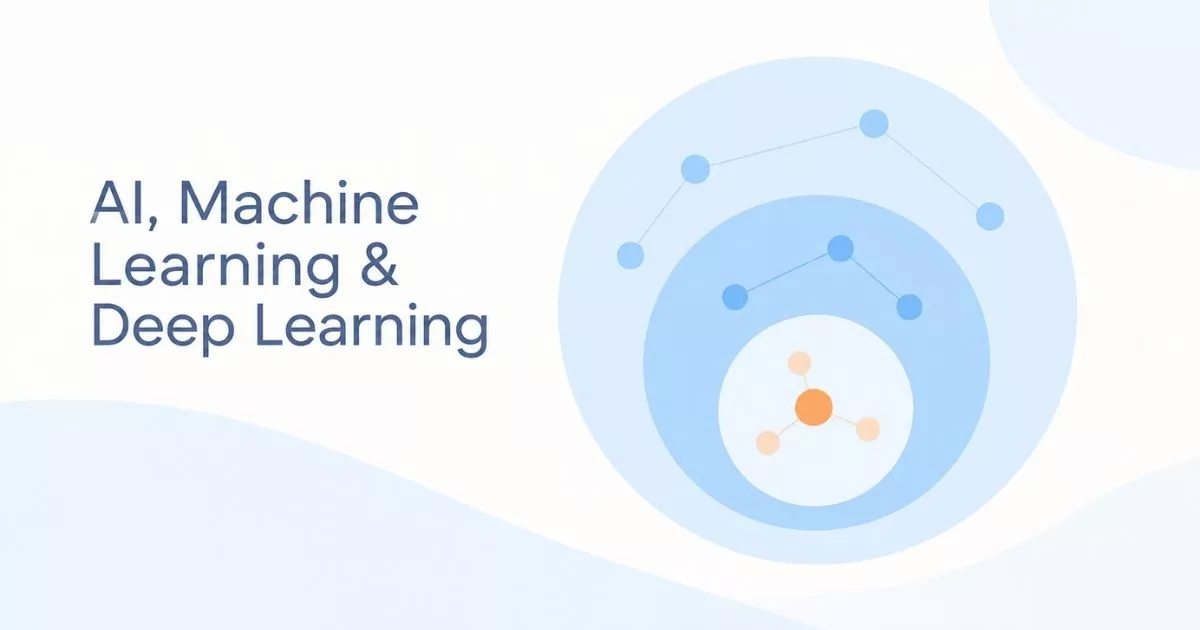
- Artificial intelligence is the broader field.
- Machine learning is one approach within it.
- Deep learning is a family of machine learning methods based on neural networks with multiple layers.
A simple regression model can be machine learning without being deep learning. A rule-based expert system can fall within AI without learning its rules from training data. This distinction prevents the common mistake of calling every automated process a learning system.
Generative AI describes a capability: producing content such as text, images, or audio. Modern generative systems commonly use deep learning, but “generative” and “supervised” describe different aspects of a system rather than mutually exclusive categories.
Our comparison of machine learning versus AI explores the relationship. For the complete hierarchy, read artificial intelligence, machine learning, and deep learning explained.
How Machine Learning Differs From Traditional Programming
With traditional programming, a developer supplies explicit instructions for transforming inputs into outputs. For example, an order receives free shipping when its eligible subtotal reaches a defined threshold. A clear business rule handles that task directly.
With supervised machine learning, developers supply examples containing inputs and known outcomes. A training procedure produces a model that can estimate outcomes for new inputs. The output is an inference, not an automatically correct fact.
Consider support ticket routing. A fixed rule can send messages containing an order number to an order-support queue. A learned classifier might recognize more varied language, but it also introduces uncertain predictions, training requirements, and monitoring work.
Use the simpler approach when it meets the requirement. Our automation versus AI comparison helps frame that choice. A scheduled workflow can use a trained model without the scheduler itself learning anything.
Essential Machine Learning Terms for Developers
You can follow an intro machine learning tutorial more easily once the vocabulary connects to concrete objects. Think of a dataset as a table, a feature as an input column, and a label as the outcome you want to predict in a supervised task.
| Term | Meaning | Delivery-time example |
|---|---|---|
| Example | One observation used for learning or evaluation | One historical shipment |
| Feature | An input available when making a prediction | Distance or shipping method |
| Label or target | The known outcome in supervised learning | Actual delivery duration |
| Model | The learned mapping or representation | A fitted delivery-time predictor |
| Parameter | A value learned during training | A coefficient associated with distance |
| Hyperparameter | A setting chosen outside ordinary parameter fitting | A decision tree’s maximum depth |
| Inference | Using a trained model | Predicting a new shipment’s duration |
A loss function measures prediction error during training. An evaluation metric measures a property you care about when assessing performance. They can be related without being identical.
For example, a regression model might optimize squared error while a report also shows average absolute error in days. The latter can be easier for an operations team to interpret. Google’s supervised learning overview introduces these core relationships, while our explanation of how AI learning works offers additional context.
Main Types of Machine Learning
Supervised Learning: Learn From Labeled Examples
Supervised learning uses examples paired with expected outputs. Classification predicts a category, such as a ticket’s department. Regression predicts a numerical quantity, such as estimated delivery duration.
The labels need a consistent meaning. If two agents classify the same ticket differently, the model receives conflicting examples. Fixing those definitions may help more than replacing the algorithm.
A model also needs inputs that exist at prediction time. If you want to predict whether an order will be late when it is placed, the actual delivery date cannot be an input. It becomes known after the decision you are trying to support.
Unsupervised Learning: Explore Structure Without Target Labels
Unsupervised learning methods investigate patterns without a provided answer label for each example. Clustering can group customers with similar recorded behavior; dimensionality reduction can represent data using fewer dimensions.
A cluster is a mathematical grouping, not an automatically valid customer persona. You still need to inspect the result and decide whether it is stable, understandable, and useful for your purpose.
When exploring practical applications, our overview of AI tools for data analysis introduces related workflows. A product category does not tell you which algorithm a specific tool uses, so consult its documentation before making technical assumptions.
Reinforcement Learning: Learn Through Actions and Feedback
Reinforcement learning concerns an agent interacting with an environment and learning a policy from rewards or penalties. The challenge includes how an action affects later outcomes, not simply predicting a label for an existing row.
A simulated game is a useful introductory setting because actions and rewards can be defined and experiments repeated. Real business environments create additional difficulties around exploration, delayed feedback, and unintended behavior.
Do not confuse an application that calls a model with reinforcement learning. Our discussion of AI agent builders covers software for assembling workflows; an “agent” product label does not establish how its underlying model was trained.
Machine Learning Step by Step: A Practical Workflow
Step 1: Define the Decision and Success Criteria
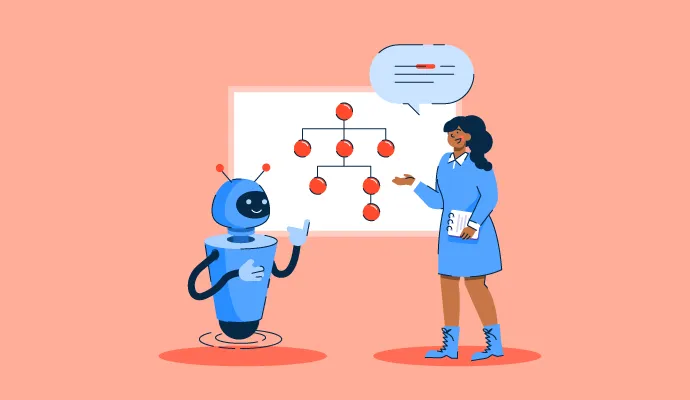
Write the problem as an operational question. “Use AI for customer support” is too broad. “Suggest one of four ticket categories before an agent opens the ticket” is specific enough to evaluate.
Specify the user, input, output, and acceptable response time. Decide what happens when the model is uncertain or unavailable. A system that makes a useful suggestion can have different requirements from one that acts without review.
Our guide to building an AI application provides a broader project framework. Keep the first experiment narrow enough that you can tell whether it helped.
Step 2: Collect Data That Matches the Real Task
Determine where the data comes from, what you are permitted to use, and how each field was recorded. Check missing values, duplicate examples, inconsistent units, and labels that changed meaning over time.
Represent the population you expect to encounter. A ticket classifier trained only on short English requests may perform differently on long messages or other languages. More rows from the same narrow source may not solve that mismatch.
Keep a short data note describing origin, collection dates, exclusions, and known limitations. It will make the experiment easier to reproduce and explain when another developer inherits it.
Step 3: Separate Training, Validation, and Test Data
Training data fits the model. Validation data supports choices such as hyperparameters. A final test set provides an assessment after those choices are fixed.
The split must match deployment. Random splitting can suit some independent observations, but time-dependent tasks may need an earlier-to-later split. Records from the same customer or document may need to stay together to avoid unrealistic overlap.
The scikit-learn cross-validation guide explains evaluation strategies. Repeatedly choosing changes based on the same test score turns that test set into part of your selection process.
Step 4: Build a Baseline Before Adding Complexity
A baseline tells you what a simple approach can achieve. For classification, one baseline always predicts the most frequent class. For a numerical target, another predicts a typical training-set value.
Suppose 90% of tickets belong to general support. A model with 90% accuracy may offer no improvement over always choosing that category. Compare the results that matter for each class before celebrating the headline score.
Use a simple model first. It is usually easier to debug data preparation and evaluation when you are not simultaneously managing a large neural network and an unfamiliar infrastructure stack.
Step 5: Train and Evaluate a Reproducible Pipeline
A pipeline keeps preprocessing and prediction steps together. Fit preprocessing using training data, then apply the learned transformation to validation or test examples. Learning a scaling transformation from the full dataset can leak information into evaluation.
Record the split, model settings, dependency versions, and dataset version. Reproducibility helps you distinguish a meaningful improvement from an accidental change in the experiment.
Consult scikit-learn’s common pitfalls guide when checking leakage and preprocessing. An organized notebook is useful, but a rerunnable script makes hidden execution-state problems easier to catch.
Step 6: Inspect Errors Before Choosing the Next Experiment
Look at wrong predictions. Are they concentrated in one class, source, language, or time period? A single average can hide a model that works for frequent cases and fails on the cases users care about most.
For classification, inspect a confusion matrix and task-appropriate precision or recall. For regression, examine error size and distribution. Choose metrics around the consequence of the error rather than whichever number looks highest.
Scikit-learn’s model evaluation documentation explains available measures. Change one meaningful part of the experiment, document the reason, and compare against the same baseline.
A Simple Machine Learning Example in Python
This example predicts an iris species from four flower measurements using the built-in Iris dataset. It demonstrates supervised classification, a holdout split, a baseline, and a preprocessing pipeline. It is an educational example, not a production flower-identification service.
Install scikit-learn in your Python environment with python -m pip install scikit-learn. Then run the following script locally or in a notebook. The dataset loads from the library, so you do not need to obtain a separate CSV file.
from sklearn.datasets import load_iris
from sklearn.dummy import DummyClassifier
from sklearn.linear_model import LogisticRegression
from sklearn.metrics import accuracy_score, confusion_matrix
from sklearn.model_selection import train_test_split
from sklearn.pipeline import make_pipeline
from sklearn.preprocessing import StandardScaler

iris = load_iris()
X_train, X_test, y_train, y_test = train_test_split(
    iris.data, iris.target,
    test_size=0.2, random_state=42, stratify=iris.target
)

baseline = DummyClassifier(strategy="most_frequent")
baseline.fit(X_train, y_train)

model = make_pipeline(
    StandardScaler(),
    LogisticRegression(max_iter=1000)
)
model.fit(X_train, y_train)
predictions = model.predict(X_test)

print("Baseline accuracy:", accuracy_score(y_test, baseline.predict(X_test)))
print("Model accuracy:", accuracy_score(y_test, predictions))
print("Confusion matrix:\n", confusion_matrix(y_test, predictions))
print("First predicted species:", iris.target_names[predictions[0]])
What the Example Does
The load_iris() function provides 150 labeled observations with four numerical features. The split reserves 20% for testing. Stratification preserves class proportions, while the random seed makes this split reproducible.
The baseline predicts the most frequent training label. The other pipeline standardizes features and trains logistic regression. Despite its name, logistic regression is used here as a classifier.
The pipeline fits scaling statistics on the training subset and reuses them during prediction. That matters because preprocessing belongs inside the training procedure, not in a separate step that has already examined every row.
The dataset and APIs are documented in scikit-learn’s Iris dataset reference and getting-started guide. If you prefer a browser-based workspace, review our online code editor comparison and confirm that your chosen environment supports Python and package installation.
How to Interpret the Output
In our execution with the fixed split above, baseline accuracy was approximately 0.33 and model accuracy approximately 0.93. The model classified 28 of 30 held-out examples correctly. Your results can vary with library versions or changes to the code and split.
This result supports a limited statement: the model performed well on this particular small holdout. It does not prove that it can identify every iris species, handle photographs, or remain reliable with inaccurate measurements.
The input is a four-number measurement vector, not an image. Recognizing that boundary is an important developer habit. A model’s capabilities are constrained by its task definition, training data, representation, and evaluation.
Common Mistakes That Make ML Results Misleading
Data leakage occurs when information unavailable in the real prediction setting influences training or evaluation. Examples include preprocessing before splitting, duplicate records across partitions, or using fields created after the outcome.
Overfitting occurs when a model captures training-specific patterns that do not generalize well. Increasing complexity can improve training performance while hurting performance on new examples. Google’s overfitting explanation describes this distinction.
Weak baselines make modest results appear impressive. Compare against a realistic existing process, not only a deliberately poor model. If a simple rule already solves the problem, the trained system needs a clear additional benefit.
Unreviewed generated code can hide these mistakes behind a working script. Our practical AI-at-work guide and overview of AI productivity tools provide adjacent ways to use assistance, but you remain responsible for understanding the experiment.
From a Notebook to a Working Application
Production requires more than saving the trained model. Validate incoming data, preserve feature order, track the model version, and define behavior when inputs are missing or the prediction service fails.
Measure latency and resource use under realistic traffic. Decide whether batch predictions are sufficient or whether the user needs an immediate response. Store enough evaluation information to investigate problems while respecting data access and retention requirements.
Monitor data changes and obtain outcome feedback when possible. A model does not automatically improve because people use it. Updating it requires a deliberate process for training, evaluation, approval, and deployment.
Google’s production ML systems module introduces the surrounding components. When connecting a model to other software, our AI automation tools overview can help you explore workflow options without confusing orchestration with model training.
Where You Can Recognize Machine Learning Applications
Content generation, document processing, and educational software offer approachable examples of different output types. Compare our overview of generative AI tools with the guide to AI image generators: both concern creation, while prediction is not always the user-facing task.
Document extraction offers a different perspective. Our image-to-text converter comparison introduces OCR applications. Extraction accuracy, document layout, and downstream validation matter more than whether the interface looks intelligent.
Education creates further evaluation questions. Explore AI tools for educators and AI-powered LMS platforms as application areas. A generated lesson, a recommendation, and a learner-risk score require different evidence; one successful capability does not validate all the others.
How to Design Your First Independent ML Project
Choose a small problem where you can inspect the examples yourself. A labeled collection of support messages, public measurements, or product descriptions can be more instructive than a large dataset whose fields you do not understand. Confirm the dataset’s permitted use before beginning.
Write a project brief containing the prediction time, available inputs, target definition, baseline, evaluation split, and metric. Add a simple statement explaining who would use the output and what they would do with it. This prevents an experiment from becoming a search for any impressive score.
Keep one manageable question for the next iteration. For a ticket classifier, you could compare whether the subject line alone is sufficient or whether the message body adds useful information. Use only fields that would exist when a real ticket arrives, and keep the evaluation procedure consistent.
Document negative findings as carefully as successful ones. If the model cannot beat a simple rule, explain what you tested and why the result may have occurred. That is valuable engineering evidence, especially if it prevents an unnecessary production integration.
Finish with a short model note: intended use, excluded uses, data limitations, performance by relevant group, and known failure cases. Another developer should be able to rerun your experiment and understand why you would or would not deploy it. A clear explanation of the boundaries makes the project more useful than an unexplained accuracy screenshot.
An Introduction to Machine Learning for Developers: What to Learn Next
Practice Python data handling, basic statistics, and one complete supervised project. Repeat the workflow on a new dataset before adding more advanced algorithms. Explain the baseline, split, metric, and limitations in a short project note.
Our machine learning learning roadmap can guide further study. The AI developer guide connects that work with software engineering skills, and the AI and ML certification overview introduces structured learning options. Choose training that addresses a demonstrated gap in your project.
FAQs: Machine Learning Meaning
What Is Machine Learning in Simple Words?
Machine learning is a way to train software using examples so it can identify patterns and produce useful outputs for new inputs. A spam classifier learns from labeled messages; a delivery model learns from historical shipments. Neither should be assumed correct without evaluation.
Is Machine Learning the Same as AI?
No. AI is the broader field, while machine learning is one approach within it. Deep learning is a specialized family of ML methods. A system can combine explicit rules, learned models, and ordinary software without every component being machine learning.
Can Developers Start Machine Learning Without Advanced Math?
Developers can complete introductory projects using existing libraries while learning the relevant mathematics. Basic statistics, probability, and algebra help explain model behavior and evaluation. Deeper mathematical knowledge becomes more important as you develop algorithms or handle more demanding applications.
Does a Machine Learning Model Keep Learning After Deployment?
Not necessarily. Many deployed models remain fixed until a separate training process updates them. Some systems support online learning, but that behavior must be designed and monitored. New user interactions alone do not guarantee that a model changes or improves.
What Is a Useful Summary of Machine Learning?
Define a task, collect relevant data, separate training from evaluation, build a baseline, train a model, and inspect performance on unseen examples. If you deploy it, monitor both the inputs and outcomes. The purpose is useful generalization, not memorizing the training set.
Conclusion
The central machine learning meaning is learning useful patterns from data and checking whether they work beyond the training examples. Developers still define the task, prepare the inputs, select a method, and decide whether the evidence justifies using the result.
Start with a small problem and a baseline. Build a reproducible experiment, inspect its errors, and explain its limits. Those habits will help you evaluate a new technique more reliably than choosing a more complicated model before you understand the data.
Read More: Non Profit Organization Website: A Complete Guide
Contact US | ThimPress:
Website: https://thimpress.com/
Fanpage: https://www.facebook.com/ThimPress
YouTube: https://www.youtube.com/c/ThimPressDesign
Twitter (X): https://x.com/thimpress_com