Data privacy regulations affect the everyday decisions behind a website: what a contact form asks, which analytics scripts load, how customer records are stored, and what happens when someone requests deletion. A privacy page helps explain those decisions, but the website’s actual behavior must support its promises.
For WordPress businesses, the challenge often starts with visibility. Your hosting provider, plugins, payment gateway, email platform, and embedded content may each handle information differently. A website owner needs a clear picture of that activity before choosing policy wording or adding a consent banner.
This guide explains data protection and privacy, the purpose of a privacy policy, and the practical differences between a privacy statement and contractual terms. It also outlines a website review process you can use to prepare accurate disclosures and identify issues for specialist advice. Legal requirements depend on jurisdiction and circumstances; this article provides general information rather than a complete compliance assessment.
Eduma – Education WordPress Theme
We provide an amazing WordPress theme with fast and responsive designs. Let’s find out!
What Are Data Privacy Regulations?
Data privacy regulations are rules governing how organizations handle personal information. Depending on the applicable law, they can address collection, use, disclosure, security, retention, individual rights, and accountability. The relevant obligations depend on factors such as your activities, audience, location, and the information involved.
Personal information extends beyond names and email addresses. An account identifier, online identifier, order history, or combination of details may identify or relate to a person. Information that looks anonymous in isolation may become identifiable when connected with another record.
For a website owner, start with the actual activity. A newsletter form collects a subscription address. An online store processes order details. A course platform may record progress and assessment results. A support system stores messages that visitors choose to submit.
Write those activities down before searching for a template. That inventory gives your privacy work a concrete starting point and helps prevent disclosures that describe a different business.
Data Protection and Privacy: How They Work Together
Data protection and privacy describe closely connected responsibilities. Privacy concerns how people experience and control the use of information about them. Data protection includes the decisions, safeguards, and processes used to handle that information responsibly.
Security supports both, but a secure system can still create privacy problems. An encrypted database may hold information that the business never needed. An account protected by a strong password may still provide an employee with excessive access.
The FTC’s business security guidance recommends considering collection, retention, access, and protection from the start. Apply that principle by examining each form field and asking who uses it and why it remains necessary.
On WordPress, permissions deserve particular attention. ThimPress’s guide to WordPress user roles explains the access model. Pair suitable permissions with appropriate WordPress security tools and regular operational reviews.
Which Data Privacy Regulations Could Apply to Your Website?
Data privacy regulations differ between jurisdictions. There is no single global checklist that covers every website. Assess the laws relevant to your organization and activities, then document why you believe they apply. The following examples introduce major frameworks; they do not cover every country, state, sector, or special category of information.
European Union: GDPR

The General Data Protection Regulation applies to processing within its territorial scope. This includes relevant activities of an EU establishment and, in specified circumstances, organizations outside the EU offering goods or services to people in the EU or monitoring their behavior there.
Articles 12–14 address transparency and information provided to individuals. Relevant disclosures can include the controller’s identity, purposes, lawful bases, recipients, retention, applicable rights, and transfer information. The details depend on how the information is obtained and processed.
A website being accessible from Europe does not alone settle the territorial-scope question. Review your actual targeting and activities. Do not assume every activity requires consent; identify the appropriate lawful basis for each purpose where the GDPR applies.
United Kingdom: UK GDPR and Related Rules
UK obligations require their own review. The UK GDPR and Data Protection Act 2018 form part of the framework, while separate electronic-communications rules can affect cookies and marketing.
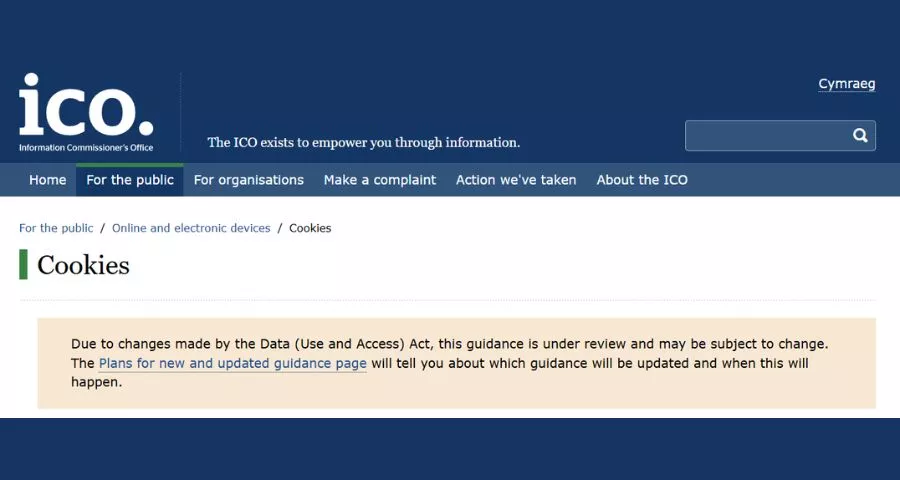
The ICO’s privacy notice guidance for smaller organizations explains that a notice should describe actual practices in understandable language. The ICO also flags that guidance is being reviewed following the Data (Use and Access) Act. Check the current guidance relevant to your processing before finalizing UK-specific wording.
For a business serving several regions, keep a clear record of which notice sections address which audience. Avoid combining EU and UK references so loosely that visitors cannot identify their relevant rights or contact route.
California: CCPA as Amended by CPRA
The California Consumer Privacy Act, as amended by the California Privacy Rights Act, applies to qualifying businesses and covered activities. It does not automatically apply to every website with a California visitor.
The California Attorney General’s CCPA overview explains covered businesses and consumer rights. Depending on the circumstances, rights can include access, deletion, correction, and opting out of selling or sharing personal information. Specific rules also concern sensitive personal information.
The California Privacy Protection Agency’s current laws and regulations page includes current statutory and regulatory materials. Use those materials to check applicable notices, thresholds, opt-out handling, and implementation dates. Advertising integrations deserve close review because the legal concept of sharing can extend beyond exchanging a customer list for money.
Privacy Policy Laws in Other Locations
Other jurisdictions and specialized activities may introduce additional obligations. A business handling children’s information, health-related details, or financial records should investigate the rules relevant to those activities before adopting a general website template.
Create a short scoping record: where the business operates, which audiences it targets, which services it provides, and what information those services require. Share that record with a qualified adviser when the application of a law is unclear.
Treat expansion as a review trigger. Opening a new market, introducing behavioral advertising, or adding a new category of customer information can change the questions you need to resolve.
Privacy Statement Definition: What Does the Term Mean?
A practical privacy statement definition is a public explanation of how an organization handles personal information. Websites often use “privacy statement,” “privacy notice,” and “privacy policy” for similar visitor-facing documents, although terminology can vary between organizations and legal frameworks.
An internal privacy policy serves a different audience. It may tell staff how to approve a new vendor, respond to requests, or delete records. Visitors need an explanation they can understand without access to those internal procedures.
The purpose of a privacy policy is to make relevant data practices understandable and help people find information about their choices and rights. It should identify the organization and explain what happens to information in recognizable situations, such as subscribing, buying, or contacting support.
A visitor should be able to answer a simple question: “If I submit this form, who receives my information, what will they do with it, and how can I contact them?” Write with that reading task in mind.
Privacy Policy vs Terms and Conditions
The distinction between privacy policy vs terms and conditions matters because the documents answer different questions. One describes information handling; the other addresses the contractual rules for using or purchasing a service.
| Document | Main question it answers | Typical subjects |
|---|---|---|
| Privacy policy or statement | How does this organization handle personal information? | Collection, purposes, recipients, retention, rights, contact routes |
| Terms and conditions | What rules govern the service or purchase? | Account use, payments, licenses, prohibited conduct, liability |
| Cookie notice and controls | What storage or access technologies operate here? | Purposes, providers, duration, and applicable choices |
| Internal data-handling procedure | What must staff do? | Access approvals, deletion tasks, vendor review, escalation |
Keep the documents easy to find and cross-reference them where useful. A contractual acceptance checkbox does not automatically create valid consent for every processing activity. Likewise, a visitor reading a privacy policy does not by itself authorize all possible uses of their information.
Use clear labels in the footer and account screens. ThimPress’s sample privacy policy guide can help structure an initial draft, but the final wording must reflect your own services and applicable obligations.
Privacy Policy Requirements: What Should You Address?
The exact privacy policy requirements depend on the laws and activities involved. The following drafting questions provide a practical starting framework rather than a universal legal checklist. Validate the required content for your circumstances.
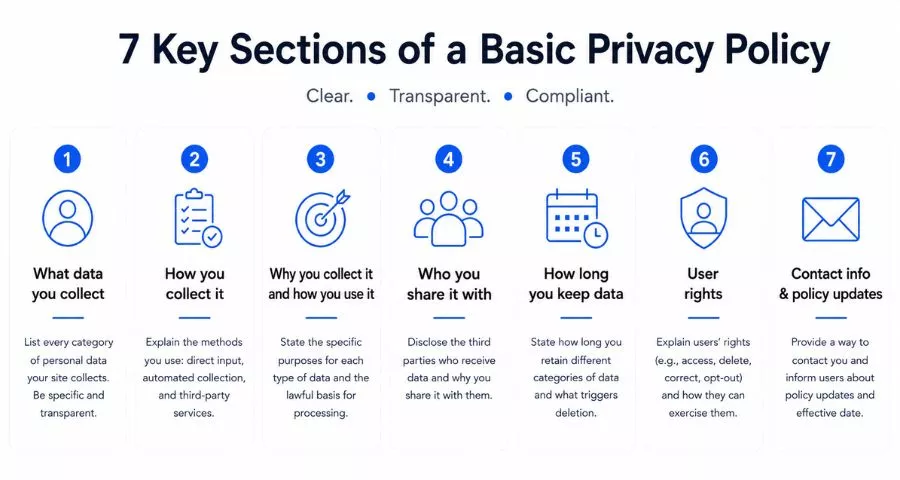
The ICO’s detailed guidance on privacy information to provide distinguishes disclosures that are always required under its framework from those that depend on the situation. Use that distinction to avoid inserting irrelevant promises or omitting information that matters.
Identify the Organization and Contact Route
Use the correct legal or organizational identity and a monitored contact method. A brand name alone may leave visitors unsure who is responsible for the service they use.
If several companies operate related services, explain the relevant arrangement accurately. Do not list an employee as a data protection officer simply because that person manages the website. Confirm whether that formal role exists and what contact details should appear.
Test the contact address. Send a sample request and confirm that someone receives it, recognizes the subject, and knows where to direct it.
Describe Information and Purposes Clearly
Organize information by recognizable activity: account creation, purchases, support, newsletters, and website measurement. Explain the information involved and the reason for handling it.
Avoid vague wording that could describe any company. “We use contact details to reply to your support request” gives readers more useful information than a broad statement about improving services.
Where the applicable framework requires lawful-basis information, connect it to the relevant purpose. Keep an internal record of the reasoning so that future editors do not change a basis merely to make a paragraph shorter.
Explain Sharing and International Handling
List relevant recipients or recipient categories with enough context to be useful. A visitor should understand the role of payment processing, hosting, customer support, or email delivery where those activities apply.
Check vendor settings before writing. A service’s standard documentation may describe optional functions that your website has disabled, or omit custom integrations your developers added.
Investigate where information is handled and which transfer requirements apply. Avoid broad claims that data never leaves a country unless you have checked hosting, backups, support access, and subprocessors.
Describe Retention and Individual Requests
Explain retention periods or meaningful criteria, as required for the relevant processing. The phrase “as long as necessary” gives little practical guidance when the business already has a defined deletion schedule.
Different records can need different treatment. An abandoned inquiry, an active account, and a transaction record should not automatically share one deadline. Establish the operational schedule before publishing specific promises.
Explain the rights and request routes that apply to the audience. Avoid promising unconditional deletion of every record when legal retention duties or other valid exceptions may affect the response.
How to Review Your Website Against Data Privacy Regulations
Step 1: Map Every Collection Point
Start with the public website and walk through its main journeys. Submit a test inquiry, register an account, place a test order where appropriate, and subscribe to a newsletter. Use test information rather than a real customer’s details.
Record every field, the service receiving it, and the people who can view it. Include messages and uploads, which may contain more personal information than the form labels suggest.

Review your contact form plugin options with collection needs in mind. A form asking for a telephone number should have a reason for needing it. Remove unnecessary fields instead of adding policy language to justify avoidable collection.
Step 2: Inventory Plugins, Scripts, and Embedded Services
Create a list covering plugins, theme integrations, tag managers, chat widgets, video embeds, advertising scripts, and analytics. Record which functions are active, who owns them, and which settings affect information handling.
A plugin’s presence does not establish that every available feature is enabled. Test the website’s actual configuration and confirm unclear behavior with the vendor or developer.
Pay special attention to measurement tools. ThimPress’s guides to Google Analytics plugins for WordPress and setting up Google Site Kit help identify common integrations. Your privacy review should document the configuration you actually use.
Step 3: Connect the Notice to Real Storage Locations
Follow a submission beyond WordPress. It may appear in an administrator inbox, an email platform, a help desk, an export, and a backup. Assign an owner to each location.
The aim is to make practical questions answerable. Who can find a customer’s record? Which system is authoritative? What happens when a copy is downloaded? How will staff avoid restoring an old deletion into an active database?
Review WordPress backup options as part of that map. Backups support recovery, and their access controls and retention also deserve deliberate decisions.
Step 4: Use WordPress Privacy Features Carefully
WordPress includes privacy-related settings and personal-data export and erasure tools. The official WordPress privacy documentation explains their role and limitations.
Review the available privacy-policy suggestions, but treat them as drafting assistance. Plugins and external services may store information outside the records covered by a core tool or a particular integration.
Test the process with a controlled account. Confirm which records an export includes, which records an erasure affects, and which systems require a separate task. Document the gaps so staff do not describe a partial result as a complete response.
Step 5: Publish, Test, and Assign Ownership
Place the privacy statement where visitors can find it, and provide relevant information near collection points. A footer link helps navigation, while a short explanation beside a form can answer an immediate question.
Read the page on mobile and check every request link. Confirm that the document remains accessible without requiring an account. Ask a colleague unfamiliar with the project to explain what happens after submitting a form.
Assign an owner and a review date. Update the notice when practices change, and keep an internal record of what changed. ThimPress’s guide to preventing data leaks in WordPress plugins and themes offers useful technical context for the implementation review.
Cookie Consent and Tracking Need Their Own Review
A privacy statement explains practices; consent controls manage particular choices where consent is required. Publishing a policy does not itself make a tracking setup lawful.
Review storage and access technologies by purpose and jurisdiction. Necessary functions and advertising technologies may be treated differently, and exemptions depend on the applicable rules. The ICO’s storage and access technology guidance explains the UK framework and the need to assess relevant exceptions.
Test the visitor journey before making claims about control. Check what loads before a choice, what changes after rejection, and how someone revisits settings. Repeat the test after adding tags or integrations.

ThimPress’s comparison of WordPress cookie consent plugins can help you evaluate implementation options. A plugin’s marketing description cannot confirm that your specific website configuration meets its obligations.
Keep a Record of Website Changes
Add privacy questions to your normal website change process. When someone proposes a new plugin, ask what information it receives, which settings control that activity, and who will review the published notice if the proposal goes live.
Keep a short change log with the date, feature owner, systems affected, and follow-up tasks. This record helps future editors understand why a disclosure exists. It also prevents a familiar problem: removing a service from the website while leaving its description in the policy, or launching a new integration without checking what visitors are told.
Common Privacy Statement Mistakes
Copying another organization’s policy is a frequent mistake. It can introduce vendors you do not use, rights procedures you cannot operate, or claims about data locations that do not match your infrastructure.
Another problem is making absolute security promises. Explain relevant practices accurately without suggesting that any system eliminates all risk. Check the operational reality behind statements about restricted access, deletion, and encryption.
Also avoid assuming that a small website collects nothing. Server logs, contact messages, and account records can still involve personal information. The correct response is to map those activities and assess obligations rather than publish an unsupported “no data collection” claim.
Finally, review the gaps between tools. ThimPress’s article on website security gaps plugins do not fully cover is a useful reminder to examine people, hosting, configuration, and processes alongside installed software.
A Practical Example: An Online Course Website
Imagine a WordPress course business that accepts registrations, sells lessons, sends optional newsletters, and handles support requests. Start with four separate activities instead of writing one broad paragraph about all customer information.
For registration, document account details and administrative access. For purchases, distinguish order information stored on the website from payment information handled by the payment provider. For newsletters, check subscription and unsubscribe behavior. For support, identify where messages and attachments are retained.
Then test a realistic request. A learner asks for a copy of their information and wants their account closed. The responsible staff member should know which systems to check, which identity verification is appropriate, and which records need a separate retention review.
Use the exercise to find missing ownership and unclear wording. This is an operational test, not a determination of the learner’s legal rights. Resolve the applicable requirements before turning the scenario into a published promise.
FAQs About Data Privacy Regulations
Does Every Website Need a Privacy Policy?
Requirements depend on applicable laws, information handling, and sometimes platform or service agreements. Review your actual activities before assuming an exemption. A simple blog may still use forms, analytics, advertising, or third-party embeds that need assessment.
Can a Privacy Policy Generator Make My Website Compliant?
A generator can help organize a draft. It cannot independently discover every active integration, verify your retention process, or determine every legal obligation. Review its output against your data map and implementation before publishing it.
Is a Privacy Statement the Same as Consent?
No. A statement provides information. Consent, where required and appropriate, concerns a person’s valid choice for a particular purpose. Do not treat a policy link or a blanket acceptance sentence as proof that every activity has been authorized.
How Often Should a Privacy Policy Be Updated?
Review it when data practices, vendors, audiences, or relevant requirements change. A scheduled review helps catch overlooked changes, but waiting for that date is inappropriate if the published explanation no longer matches the service.
What Is the Main Purpose of a Privacy Policy?
The main purpose is to explain relevant personal-information practices clearly and provide information about applicable choices, rights, and contact routes. Its usefulness depends on accuracy: the explanation should match what the organization actually does.
Conclusion
Begin with a data map, assess the rules relevant to your activities, and write a statement based on verified facts. Connect each public promise to a real setting, responsible person, or documented procedure. For WordPress websites, review forms, plugins, analytics, access, backups, and request handling together. Accurate disclosures and workable controls make privacy information useful to visitors and easier for your team to maintain as the website grows.
Read More: TOP 6 Best Backlink Finder Tools (Tested)
Contact US | ThimPress:
Website: https://thimpress.com/
Fanpage: https://www.facebook.com/ThimPress
YouTube: https://www.youtube.com/c/ThimPressDesign
Twitter (X): https://x.com/thimpress_com