Every search engine result page presents a digital battleground where domains compete for visibility and traffic. Success requires knowing exactly what target audiences search for and what rival websites do to capture those specific clicks. The most effective method to achieve this competitive advantage involves utilizing a robust keyword gap analysis tool.
By employing a dedicated keyword gap analysis tool during the initial planning stages of search engine optimization (SEO), marketers can systematically uncover the exact search terms that rival sites currently rank for.
This comprehensive guide details the mechanics of performing a successful keyword gap analysis, outlines the necessary steps to implement these findings, and explains how to translate raw analytical data into a measurable increase in organic traffic.
Eduma – Education WordPress Theme
We provide an amazing WordPress theme with fast and responsive designs. Let’s find out!
What Is a Keyword Gap Analysis?
A keyword gap analysis is a highly strategic evaluation process involving the comparison of the search engine ranking profile of one primary website against the ranking profiles of its top competitors. The primary objective is to identify relevant, high-value search terms that competing websites currently rank for, but the target website does not.
Integrating this analysis into a broader SEO strategy is an absolute requirement for sustained digital growth. It directly highlights missed opportunities, exposes vulnerabilities in the current content marketing strategy, and acts as a foundational pillar for generating data-backed content ideas.
By strategically creating brand new landing pages—or comprehensively updating existing blog posts—to target these newly discovered terms, a website can substantially enhance its overall visibility.
Keyword Gap Analysis vs. Content Gap Analysis
While these specific industry terms are frequently used interchangeably by marketing professionals, a keyword gap analysis and a content gap analysis focus on distinctly different strategic elements of audience acquisition.
- Keyword Gap Analysis: This process strictly identifies specific, isolated search queries, individual phrases, and exact match terms.
- Content Gap Analysis: This process focuses on uncovering broader overarching topics, deep thematic clusters, and general user intents across the entirety of the customer journey, from initial brand awareness to final purchase.
To illustrate this highly critical difference clearly, consider a digital platform specializing in selling Learning Management System (LMS) plugins and education-focused WordPress themes.
During a standard competitor keyword gap analysis, the extracted algorithmic data might reveal several highly specific, high-volume transactional terms that competitors rank for, such as:
- “best education WordPress theme”
- “buy LMS plugin for WordPress”
- “online course builder WordPress software”
These are direct, query-based gaps that a robust keyword gap analysis tool will instantly highlight and quantify. However, by taking a step back and conducting a broader, more holistic content gap analysis based on the actual, real-world pain points prospective educators and developers experience, entirely new, highly lucrative thematic opportunities emerge. Examples of these broader topics include:
- How to securely set up an e-learning platform from scratch using open-source tools?
- Which payment processing gateways integrate best with high-volume online courses?
- How to systematically manage student enrollment data and privacy compliance effectively?
Understanding this specific, nuanced distinction is crucial for long-term SEO success. When an organization asks the pertinent question, “which keyword tool can find content gaps?”, the optimal answer involves utilizing comprehensive software platforms like Semrush. These elite platforms not only list raw search terms in massive spreadsheets but also offer advanced semantic grouping and highly intelligent clustering features to automatically build overarching, authoritative topics.
Why Perform a Competitor Keyword Gap Analysis?
Executing a thorough competitor keyword gap analysis and subsequently implementing the actionable findings is one of the most mathematically sound methods for improving search rankings.
This analytical practice is strictly necessary for maintaining a competitive edge within any specific niche. In the complete absence of proactive competitor tracking, prospective customers are statistically far more likely to discover a rival’s website, resulting in severe lost revenue.
Furthermore, discovering high-value search terms that currently benefit competitors can yield massive advantages for paid advertising initiatives.
Deciphering Search Intent in Gap Analysis
When users type specific queries into a search engine interface, they always operate with a specific goal, underlying motivation, or desired outcome in mind. Deeply understanding these underlying goals is an absolute, critical necessity when evaluating the massive volumes of results provided by a keyword gap analysis tool. Modern search engines heavily prioritize matching the format of the content strictly to the intent of the query.
Search intent is broadly categorized into four primary pillars:
- Informational Intent: The searcher explicitly wants to learn something specific, find a detailed answer to a complex question, or gather comprehensive background information before making any decisions. Content matching this intent should be highly educational, well-structured, and devoid of aggressive sales pitches.
- Navigational Intent: The searcher is looking for a highly specific website, branded portal, or direct login page. They already know exactly where they want to go, and the search engine merely acts as a rapid conduit.
- Commercial Intent: The searcher is actively researching various available options, comparing competing products, reading professional reviews, or evaluating pricing tiers before making a final purchasing decision. This traffic is highly valuable and requires persuasive, comparative content.
- Transactional Intent: The searcher has fully completed their exhaustive research phase and is ready to make a concrete purchase immediately. This intent requires highly optimized, frictionless product pages or highly direct call-to-action landing pages.
If a meticulous keyword gap competitor comparison reveals that rival sites are thoroughly dominating terms with exceptionally high commercial or transactional intent, aggressive corrective action must be taken immediately. Capturing this highly qualified, bottom-of-the-funnel traffic is absolutely essential for generating a high return on investment and sustaining business profitability.
How to Find Keyword Gap Opportunities Using Semrush
Understanding exactly how to find keyword gap opportunities requires a highly methodical approach. By following a structured process utilizing Semrush, organizations can seamlessly transition from raw data collection to actionable content creation.
Step 1: Select the Correct Competitors
Selecting the absolute most appropriate competitors is the crucial, foundational step of the entire methodology. Targeting search terms based on the arbitrary performance of massive, globally authoritative companies that operate far outside of the specific niche will rarely, if ever, result in meaningful organic traffic improvements.
Begin the rigorous process by carefully evaluating known, traditional commercial competition. However, marketers must always remember that traditional, offline commercial rivals are not always the primary organic search competitors.
Often, a massive portion of digital market share is quietly captured by highly optimized informational blogs, affiliate review sites, or specialized industry directories.
To ensure pinpoint accuracy, follow this diagnostic procedure:
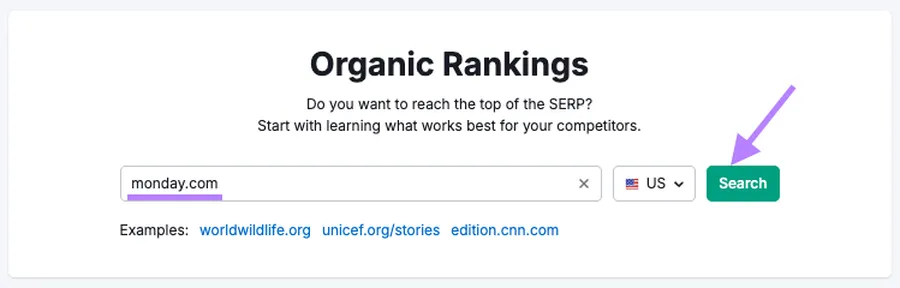
- Access and utilize the dedicated Semrush Organic Research dashboard.
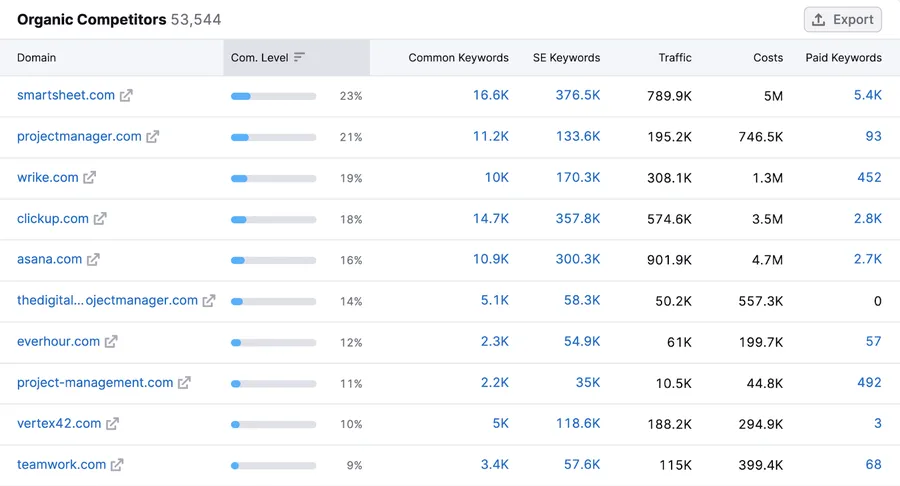
- Enter the primary root domain into the system to generate a highly comprehensive, algorithmically verified list of top organic competitors.
- Carefully review highly vital metrics, such as the total number of shared keywords, the precise competitive positioning map, and the estimated monthly organic traffic flowing to those specific rival domains.
Step 2: Configure the Keyword Gap Analysis Tool
Once a definitive, highly accurate list of three to four highly relevant competitors is firmly established, navigate directly to the Semrush Keyword Gap tool interface.
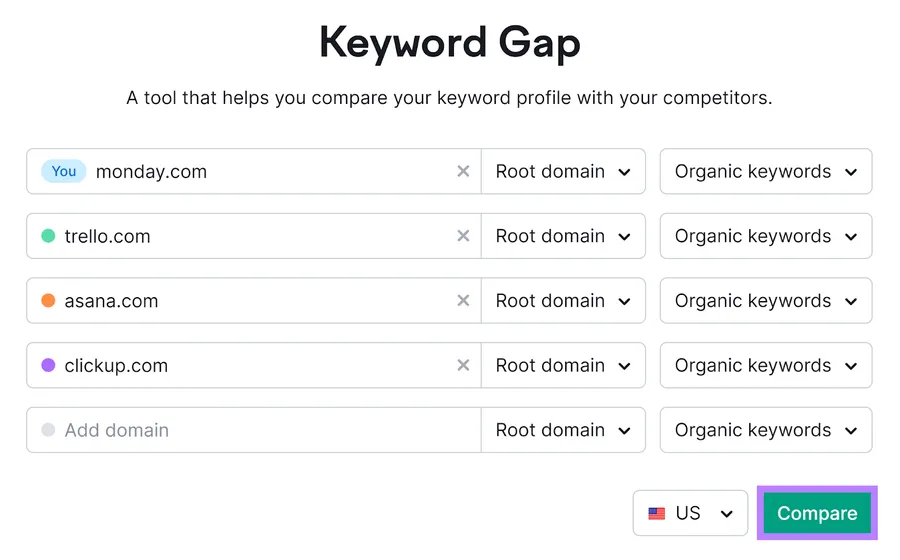
Enter the primary root domain alongside the carefully selected competitor domains into the provided input fields. Before executing the automated comparison sequence, it is absolutely critical to properly configure the tool’s advanced parameters to ensure pristine data accuracy and relevance:
- Location Settings: Always ensure the regional database perfectly matches the specific target market. For example, selecting the United States database is mandatory if the target audience resides strictly within the USA, as search volumes, user behaviors, and ranking algorithms fluctuate wildly between different geographic territories.
- Domain Level vs. Subfolder Analysis: Adjust the designated drop-down menu to evaluate highly specific sections of a competitor’s site rather than the entire domain. Selecting the “Subfolder” option is highly ideal for meticulously evaluating only the competitor’s informational blog section, ensuring product pages do not skew the informational analysis.
- Keyword Types Selection: Modern keyword gap analysis tool platforms allow for the granular selection and comparison of Organic keywords, Paid keywords (Google Ads), and Product Listing Ads (PLA) via Google Shopping.
Step 3: Analyze the Keyword Gaps Methodically
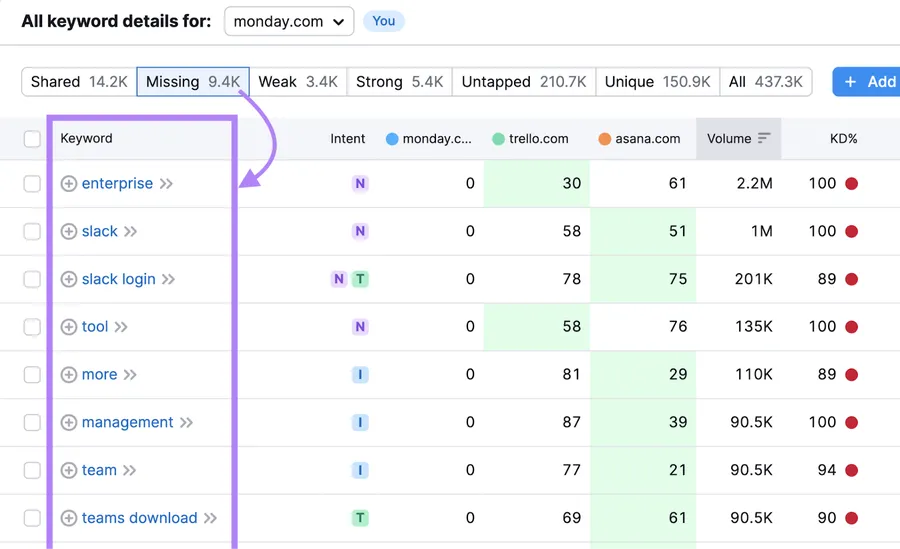
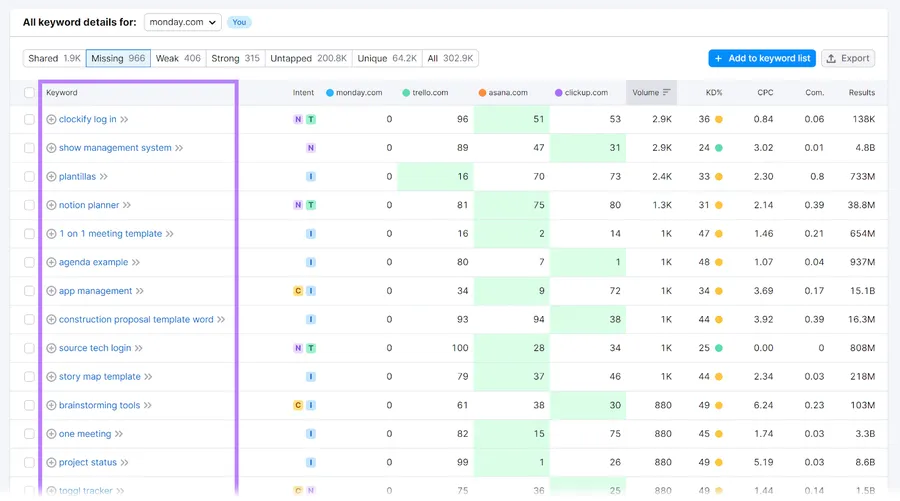
With the raw analytical data successfully generated by the software, careful, highly structured interpretation is immediately required. The Semrush platform interface features a highly detailed, interactive table automatically categorized by highly specific intersection types.
Click directly on the “Missing” tab as the primary starting point for any new campaign. This specific, highly valuable tab displays a highly curated list of lucrative search terms that all analyzed competitor domains currently rank for, but the primary domain completely lacks.
To effectively and efficiently narrow down the massive list of opportunities, digital marketers must apply advanced filtering protocols:
- The Position Filter: Focus strictly and exclusively on terms where competitors are already actively ranking within the top 10 search results. These represent proven, high-traffic terms that are actively driving clicks right now.
- The Keyword Difficulty (KD) Filter: For newer domains or domains lacking massive backlink profiles, filter results strictly based on Keyword Difficulty. Set a manual KD range from 0 to 49 to display missing search terms that are mathematically relatively easy to rank for with standard, high-quality optimization efforts.
While meticulously evaluating the newly filtered list, consistently assess the estimated monthly search volume alongside the underlying search intent of every single phrase to ensure maximum strategic alignment.
Step 4: Select and Save Relevant Keywords
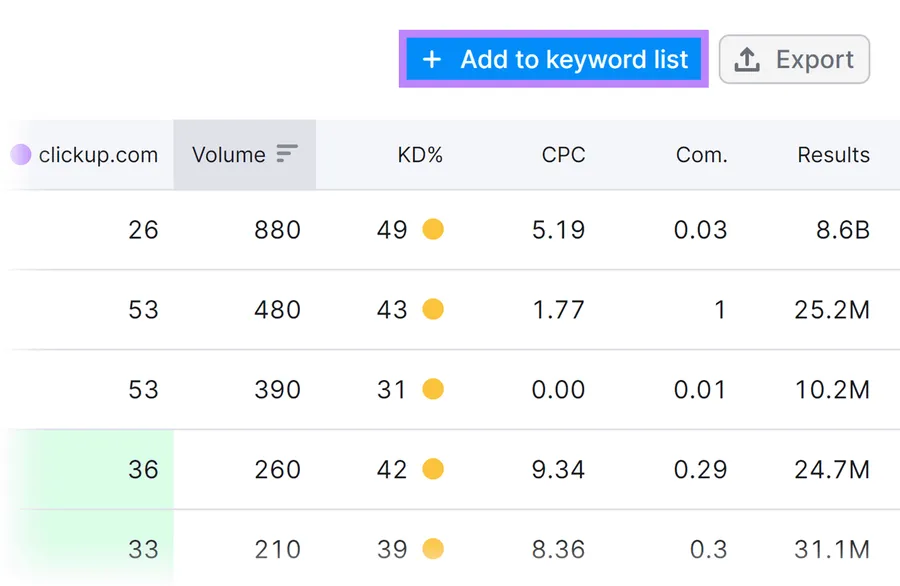
The subsequent organizational step involves sorting the desired search terms into actionable lists. Manually review the filtered list of terms and individually select the options most relevant to the organization’s specific services or products.
Save these strategic selections directly within the platform by adding them to a dedicated, clearly named keyword list. This precise selection process must be repeated across various data intersections:
- The Weak Tab: Highlights search terms where competitors actively outperform the primary domain. Existing content requires immediate updating or deeper technical optimization.
- The Untapped Tab: Displays search terms where at least one specific competitor holds a ranking, but the primary site is entirely absent.
After compiling a robust list, the finalized data can be easily exported to standard file formats like Excel or CSV for offline analysis.
Step 5: Group Keywords into Strategic Topic Clusters
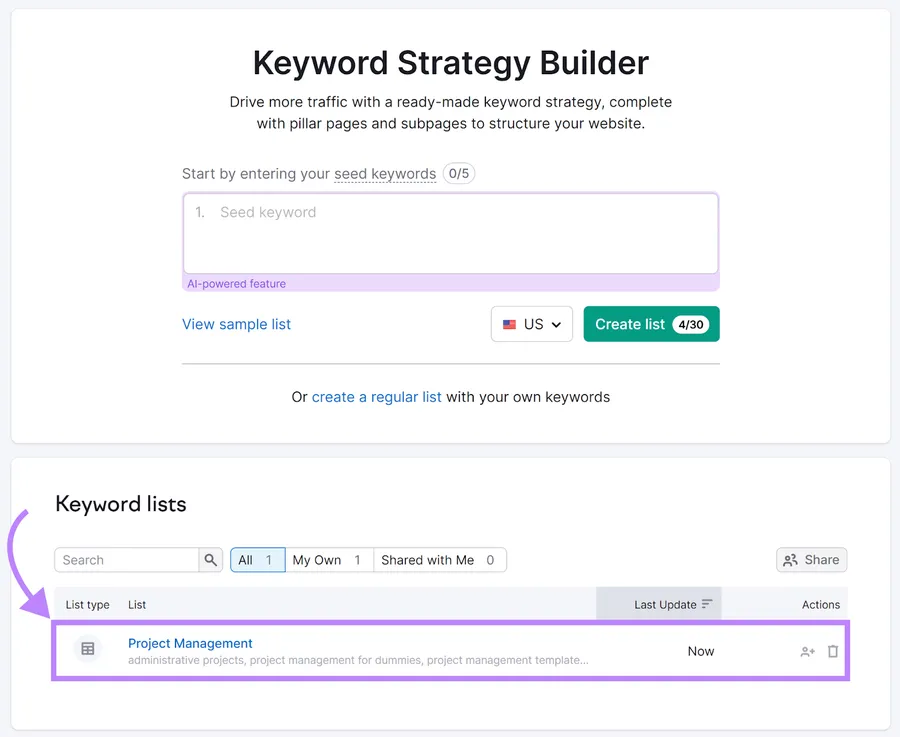
Raw, unorganized lists of search terms require proper structural organization. Modern search engine algorithms rely heavily on the advanced concept of topical authority.
A standard topic cluster consists of a broad “pillar page” supported by highly specific “subpages,” heavily interconnected through strategic internal linking.
- Pillar Page: Targets a broad, high-volume topic serving as the ultimate resource.
- Subpages: Target highly specific, long-tail variations of the main topic.
Using the integrated Semrush Keyword Strategy Builder automatically organizes raw keyword lists into distinct pillar and subpage categories based on overlapping search engine result pages. Prioritize clusters tagged with a high ranking potential indicator.
Step 6: Create New Content and Optimize Existing Pages
Equipped with meticulously grouped, highly strategic topic clusters, the rigorous content creation phase officially begins. Draft entirely new, highly authoritative, deeply informative articles for untapped opportunities and heavily revise existing legacy pages that currently suffer from weak, underperforming rankings.
Integrate the Semrush SEO Writing Assistant into the daily writing workflow to provide real-time, data-driven feedback strictly based on the exact algorithmic parameters required to rank well. Drafted content is generally evaluated stringently across four highly critical categories:
- Readability Metrics: Ensuring the written text is easily digestible for the specific target demographic, avoiding overly complex jargon where inappropriate.
- SEO Parameters: Verifying the natural, unforced presence of target search terms in primary headers, meta descriptions, image alt text, and body paragraphs, strictly avoiding any semblance of manipulative keyword stuffing.
- Originality Verification: Guaranteeing the newly drafted text is completely, undeniably unique to absolutely avoid severe duplicate content penalties enforced by search engines.
- Tone of Voice Consistency: Maintaining a highly consistent, brand-appropriate level of formality across all published materials.
Step 7: Monitor Ranking Changes Continuously
Search engine optimization is an ongoing, never-ending process that requires unrelenting, daily vigilance. After highly optimized new pages are published and weak pages are updated, the resulting impact on organic search visibility must be carefully, meticulously tracked.
Import the exact, highly specific target search terms directly into the Semrush Position Tracking module to closely observe daily, micro-level fluctuations across completely different devices, operating systems, and highly specific geographic locations. Continuous, rigorous monitoring allows specialized marketing teams to quickly troubleshoot potential algorithmic updates and immediately spot new, aggressive competitive threats.
Exploring Advanced Features of a Keyword Gap Analysis Tool
To truly master competitor gap analysis, standard top-level overlapping is not enough. A top-tier keyword gap analysis tool provides a granular, side-by-side comparison of multiple competing domains simultaneously.
Understanding Complex Keyword Overlap Intersections
The core value of the tool resides entirely in the detailed keyword table. Mastering these exact categories allows for targeted optimization campaigns.
| Intersection Type | Technical Definition | Strategic Action |
| Shared | Search terms where every analyzed domain currently holds a ranking position. | Monitor closely to ensure current market share is not lost. |
| Missing | Search terms where all analyzed competitors possess rankings, but the primary site has zero visibility. | Create entirely new, comprehensive content immediately. |
| Weak | Search terms where the primary site ranks at a noticeably lower position than competing domains. | Perform deep on-page technical optimization and acquire relevant backlinks. |
| Strong | Search terms where the primary site currently outranks all analyzed competitors successfully. | Maintain these pages carefully; they are vital drivers of organic traffic. |
| Untapped | Search terms where the primary site has no ranking, but at least one specific competitor does rank. | Investigate the search intent to determine if adding a highly specific new page is worthwhile. |
| Unique | Search terms where strictly only the primary site ranks, and competitors do not rank at all. | Capitalize heavily on these exclusive terms to dominate specific niches. |
Advanced Filtering for Granular Insights
Beyond simple Keyword Difficulty metrics, premium tools offer advanced filters to refine the research process.
- Custom Position Ranges: Setting a custom range (e.g., positions 11 to 20) instantly identifies lucrative “striking distance” keywords. Minor optimizations to these pages can quickly push them onto the first page.
- Search Intent Targeting: Instantly sort massive datasets based on the specific underlying intent (Informational, Navigational, Commercial, Transactional).
- Granular Metric Filters: Filtering by exact Search Volume or Competitive Density ensures marketing budgets are intelligently allocated.
- Word Inclusion/Exclusion: Adding a strict word inclusion filter immediately strips away irrelevant informational noise from the final report.
Leveraging Keyword Gap Competitor Data for Paid Campaigns
A comprehensive competitor keyword gap analysis is equally invaluable for Pay-Per-Click (PPC) advertising research.
By adjusting the tool’s core parameters to compare Paid and PLA (Google Shopping) metrics, organizations can uncover highly lucrative ad strategies. Identifying specific search terms where a keyword gap competitor ranks highly organically—but where there is zero active paid advertising competition—allows a business to launch an extremely cost-effective campaign.
Reporting and Exporting Capabilities
High-end tools allow for the seamless exportation of extensive keyword lists into Excel or CSV formats for complex spreadsheet modeling. Additionally, exporting directly to a formatted PDF generates polished documents containing visual widgets like Top Opportunities charts, ideal for presenting competitive insights to executive leadership teams.
Conclusion
Relying on guesswork to generate website traffic is no longer a viable digital strategy. To consistently and predictably increase organic visibility, modern organizations must operate strictly based on hard data. A dedicated keyword gap analysis tool completely removes the immense uncertainty from complex content planning.
By systematically comparing competing domain profiles, analyzing the precise overlap intersections, meticulously filtering for actionable metrics, and rigorously tracking the daily results, any website can methodically capture valuable market share from its competitors. Mastering this workflow is the ultimate master key to achieving sustainable, long-term SEO success.
Frequently Asked Questions (FAQs)
1. What is the exact primary purpose of a keyword gap analysis?
The primary purpose of a keyword gap analysis is to strategically compare a website’s exact search engine rankings directly against its top competitors. This methodical process identifies highly valuable search terms that rival domains currently rank for, highlighting immediate opportunities to create content and capture lost organic search traffic.
2. Which keyword tool can find content gaps most effectively?
When asking which keyword tool can find content gaps, the most accurate answer involves utilizing premium software that features advanced automated clustering. Professional suites like Semrush that feature a dedicated keyword gap module paired with a keyword strategy builder transition raw search queries into comprehensive thematic topics, uncovering broad content gaps across the entire customer journey.
3. How does a keyword gap competitor comparison directly improve PPC campaigns?
A meticulous keyword gap competitor comparison clearly reveals exactly which specific search terms rivals successfully utilize to drive traffic. For PPC campaigns, identifying high-value terms where a competitor ranks organically—but where no one currently runs paid advertisements—provides a highly cost-effective opportunity to capture that exact audience through targeted sponsored ad placements.
4. What are the clear steps on how to find keyword gap opportunities?
To properly understand how to find keyword gap opportunities, professionals must follow a structured process: First, precisely identify direct organic competitors. Second, input their respective domains alongside the primary domain into a professional keyword gap analysis tool. Third, rigorously filter the resulting data set by intersection type (focusing on “Missing” or “Weak” terms) and keyword difficulty. Finally, export these carefully selected terms to create SEO-optimized website content.
5. Why is a competitor keyword gap analysis absolutely necessary for brand new websites?
A thorough competitor keyword gap analysis is absolutely critical for brand new websites because it prevents massive amounts of wasted resources. By utilizing advanced filters to find “Missing” search terms with very low Keyword Difficulty scores, new websites can strategically target easily achievable queries, allowing them to safely build crucial domain authority without attempting to compete for impossibly difficult terms immediately upon launch.
Read more: AEO vs SEO: What’s the Difference in the AI Search Era?
Contact US | ThimPress:
Website: https://thimpress.com/
Fanpage: https://www.facebook.com/ThimPress
YouTube: https://www.youtube.com/c/ThimPressDesign
Twitter (X): https://x.com/thimpress_com