The best digital marketing courses online for a beginner are the ones that match a clear goal and include work you can practice. Start with a broad introduction if you are new to marketing, choose focused SEO training if search traffic is your priority, and add analytics so you can evaluate what you change.
A course certificate can document learning, but practical work shows whether you can use it. You should finish your first learning cycle with something concrete: a researched content brief, an improved web page, a simple campaign, or a report that explains performance.
This guide compares five established learning options and gives you a manageable path for learning SEO online. It also explains how to connect search optimization with content, email, and business outcomes. Course access, assessment rules, and pricing can change, so check the provider’s enrollment page before registering.
Eduma – Education WordPress Theme
We provide an amazing WordPress theme with fast and responsive designs. Let’s find out!
What Should Beginners Learn About Online Marketing First?
Online marketing uses digital channels to reach people, communicate an offer, and encourage useful actions. Those actions might be purchases, trial sign-ups, inquiries, or newsletter subscriptions. Traffic is valuable when it brings the right audience closer to the business goal.
Begin with the audience and offer. Who needs the product or service? What problem are they trying to solve? Why would they choose this option? The 4Ps of marketing provide a useful framework for thinking about product, price, place, and promotion before choosing a channel.
For example, a beginner promoting weekend photography classes needs to understand the learners’ skill level, location, available time, and budget. Those details influence search topics, landing-page copy, promotional messages, and enrollment expectations.
Understanding SEO marketing comes next. SEO helps relevant pages become discoverable in organic search. Read our introduction to SEO marketing for the business context and the guide to what SEO is for the basic vocabulary.
Paid search is a different mechanism: you pay to participate in advertising auctions and attract clicks. Our explanation of search engine marketing focuses on that paid-search use of the term. Some courses use SEM more broadly, so check how an instructor defines it.
How to Choose an Online Course in Marketing
Choose based on the work you want to perform after studying. A broad marketing introduction, an SEO course, and product-specific advertising training can all be useful, but they solve different learning problems.
Review the syllabus before looking at the badge. Does it explain audience research, channel selection, measurement, and practical execution? For SEO, look for search intent, keyword research, content quality, crawlability, links, and performance review.
Check the level of instruction. Beginners need explanations of why a task matters, not a video that clicks through a dashboard without context. More experienced learners may benefit from assignments, feedback, or access to detailed case studies.
Also separate course access from certificate access. A provider may offer free lessons but charge for an assessment, subscription, or downloadable credential. Our overview of Google learning and certification options can help you explore paths, but verify the conditions for the individual program you choose.
Finally, estimate your total commitment. A course may require a practice website, software access, or several hours of assignments each week. Select something you can complete and use. Enrolling in three overlapping programs usually creates more unfinished lessons than useful experience.
Five Digital Marketing Courses and Learning Platforms to Consider
The options below cover different needs. These are editorial recommendations based on their published focus and suitability for the learning paths discussed here; they are not a claim that every course has been independently completed or tested.
| Learning option | Best starting use | Access consideration |
|---|---|---|
| Google Digital Marketing & E-commerce Certificate | A structured career-oriented introduction | Check Coursera enrollment and subscription terms |
| HubSpot Academy Digital Marketing Certification | Broad inbound marketing fundamentals | Free certification course with account access |
| Ahrefs SEO Course for Beginners | Focused introductory SEO learning | Free course; optional tools are separate |
| Semrush Academy | Topic-specific marketing and SEO training | Free courses; software subscriptions are separate |
| Google Skillshop | Google product and measurement training | Check the selected learning and assessment path |
1. Google Digital Marketing & E-commerce Certificate
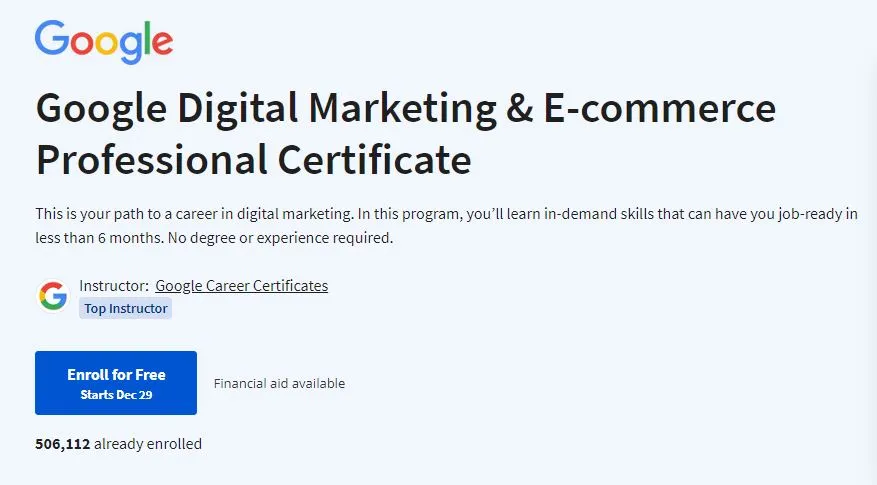
Google’s certificate is a structured program for learners entering digital marketing and eCommerce. The official overview welcomes learners without prior experience and covers work such as attracting customers, managing campaigns, and selling products online. It directs enrollment to Coursera.
Best for: someone who wants a broader career-oriented learning sequence rather than a short SEO introduction. Review the current curriculum and expected workload before subscribing, especially if you are studying alongside a full-time job.
The main consideration is breadth. You may spend time on topics outside your immediate task, and focused SEO practice will still be useful afterward. Check regional pricing and any trial or financial-aid conditions on the enrollment page.
For practice, choose one small business and draft an audience profile, channel plan, landing-page outline, and measurement plan. Use the same project throughout your learning so your assignments become a coherent case study.
2. HubSpot Academy Digital Marketing Certification
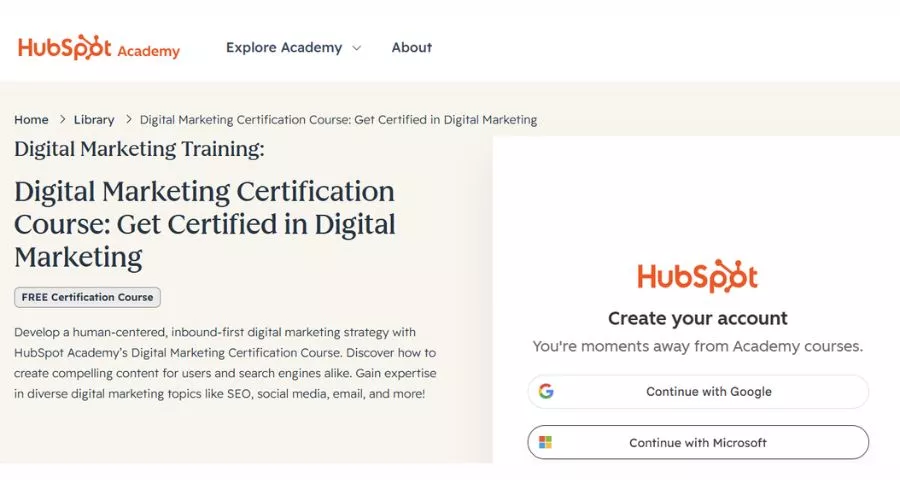
HubSpot Academy offers a free digital marketing certification course centered on an inbound approach. Its published topics include SEO, content, social media, and email. This makes it a useful starting option for understanding how several channels support one customer journey.
Best for: beginners who need a broad introduction before specializing. Create an account, review the course structure, and work through the lessons with a real or clearly labeled practice business in mind.
The limitation is depth. Introductory coverage can help you understand how channels connect, but it will not make you independently proficient in every platform discussed. Add focused training when your work requires more detailed execution.
For practice, describe a customer’s problem, outline one helpful article, and write an email that points readers to a relevant next step. Explain why those pieces belong together instead of treating each channel as a separate activity.
3. Ahrefs SEO Course for Beginners
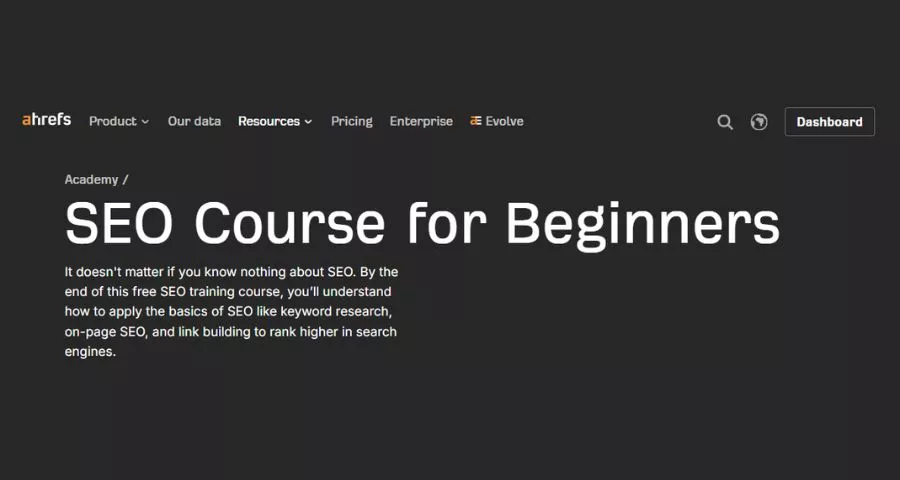
Ahrefs provides a free SEO course for beginners. Its curriculum introduces core work including keyword research, on-page SEO, link building, and technical SEO. It is a focused option when you want to learn SEO online rather than start with an entire marketing program.
Best for: website owners, junior marketers, and content writers who want a structured introduction to organic search. Learn the principles first, then apply them to a page you can edit.
As with any vendor’s training, distinguish the general method from the provider’s interface. A lesson may illustrate a task with Ahrefs, while your own research can start with available free resources. Taking a course does not require treating every demonstrated feature as an essential purchase.
For practice, choose a narrow topic, examine the search results, map the likely intent, and write a content brief. Explain what the page should help someone do and how you will evaluate its performance.
4. Semrush Academy
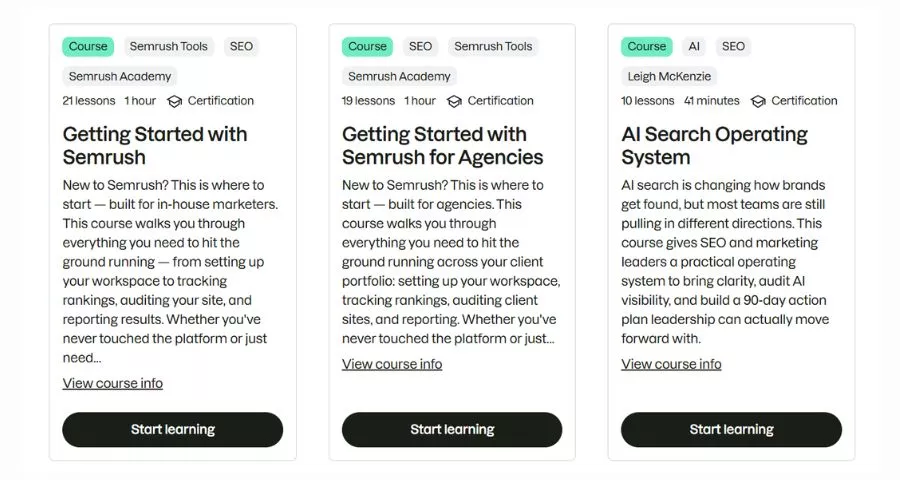
Semrush Academy offers free training across SEO and other marketing topics. The catalog includes focused instruction on areas such as on-page optimization, content, and search visibility, making it useful when you already know which skill you want to develop next.
Best for: learners who prefer a sequence of shorter, topic-specific courses. Choose one relevant course rather than working through unrelated certificates simply because they are available.
Some lessons demonstrate Semrush workflows. Separate the learning material from paid software access and check whether you can reproduce the exercise with your available tools. If you later need software, compare Semrush alternatives around the task and budget you actually have.
For practice, audit a small group of pages and rank issues by impact. Record the evidence, recommended change, and expected benefit for each issue. A prioritized audit is more useful than a long list of warnings without a plan.
5. Google Skillshop
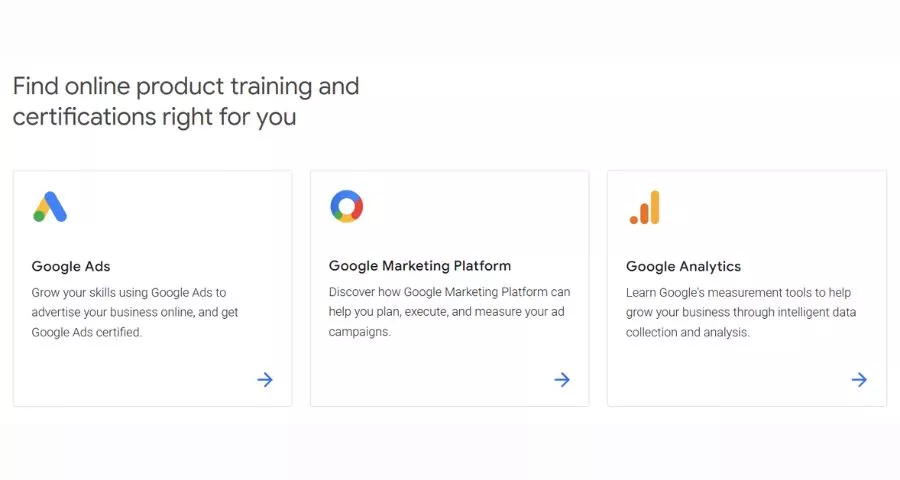
Google Skillshop provides online training for Google products, including Google Ads and Google Analytics. It is a useful option when you need product-specific instruction and want to understand the tools you will use for advertising or measurement.
Best for: learners ready to connect marketing decisions with platform setup and reporting. Choose the path that supports your immediate work instead of trying to learn every advertising product at once.
Skillshop is not a substitute for a complete SEO curriculum. Product knowledge can help you measure outcomes or run ads, but organic search also requires content judgment, technical understanding, and realistic prioritization.
For practice, create a measurement plan for a hypothetical site: what counts as success, which actions need tracking, and which reports would help you decide what to change. Completing training should not require launching a paid campaign before you understand the budget and objective.
The Best Way to Learn SEO Is to Apply Each Lesson
A practical way to learn SEO is to study one concept, use it on a small website, record the change, and review the evidence. Watching tutorials without applying them can make familiar terms feel like skills you have not yet developed.
Use a personal site, a volunteer project with permission, or a practice website. If it is a test environment, label the work honestly and avoid claiming customer results. A useful project can demonstrate your reasoning even before it generates substantial traffic.
Set one clear objective, such as improving a relevant service page or building a small informational section. Our discussion of why SEO matters to a business can help you connect learning with a meaningful outcome.
Keep a change log with dates, pages, actions, and observations. If you modify the title, rewrite the introduction, and improve navigation on the same day, record all three. Without that record, later performance changes are harder to interpret.
Understand Crawling, Indexing, and Search Results
Before asking how to increase a website’s Google ranking, establish whether Google can discover and index the page. Discovery, inclusion in the index, and visibility for a relevant query are separate questions.
Google’s explanation of how Search works describes crawling, indexing, and serving results. Use that framework to diagnose problems instead of assuming every low-traffic page needs more keywords.
A page might be blocked, marked noindex, duplicated, or simply not competitive for the query. For your practice site, inspect an important URL in Search Console and compare the reported status with your intention.
Read the Google Search Essentials alongside your course. Third-party tools can suggest issues, but official documentation helps you distinguish technical requirements from a provider’s proprietary score.
Research Search Intent Before Writing
Search intent is the task behind a query. Someone searching for a beginner photography course may want local classes, an online program, or a free tutorial. Examine the actual results and query wording before deciding which page to create.
Choose a manageable topic connected to the site’s offer. Record the main query, related questions, likely audience, and appropriate page type. Our comparison of free keyword research tools can help you find starting ideas.
Treat search-volume estimates as directional data. A low-volume query can still be useful if it matches a real customer need. Paid-ad competition is also different from organic ranking difficulty, so read the metric definition before using it to choose topics.
Build one strong page for a coherent intent rather than separate pages for every slight wording variation. Our step-by-step SEO strategy guide provides a wider framework for connecting this research with implementation.
Improve the Page Before Adding More Pages
Write a clear title, an introduction that answers the main question, and sections that help the reader complete the task. Add examples, evidence, and limitations where they improve the answer.
Link to relevant supporting pages using descriptive anchor text. Make the next action clear, whether that means comparing a course, requesting information, or downloading a resource. Review images for usefulness, accessibility, and load performance.
Google’s SEO Starter Guide is a reliable reference for basic optimization. Our collection of practical SEO tips gives you additional topics to investigate as your project develops.
When people ask how to build SEO, the useful answer is to build a repeatable workflow. Research the need, publish a suitable page, make it technically accessible, connect it to the site, and evaluate it. Repeating a keyword is not a substitute for that work.
Learn Technical Checks and Prioritization
Start with issues that can prevent access or undermine a key user task. Check indexing settings, broken navigation, redirects, mobile usability, and whether the main content is available. Do not begin by chasing every minor warning in an audit report.
Use our guide to free Google SEO tools to explore a starter toolkit. Compare SEO audit tools when your project requires a broader site review, while remembering that a reported issue still needs interpretation.
Learning basic web development can help you understand what a page contains and how changes are implemented. Our discussion of web development and digital marketing learning explains why these areas can support each other.
For each issue, write the affected page, evidence, proposed fix, and priority. This habit makes your recommendations easier to act on and prepares you for working with developers or site owners.
A Six-Week Learning Plan for Online Marketing Beginners
The following schedule is a suggested practice plan, not a guarantee that you will master marketing or achieve rankings in six weeks. Adjust it to your available time and the complexity of the website.
| Week | Focus | Deliverable |
|---|---|---|
| 1 | Audience, offer, and marketing fundamentals | A one-page audience and channel brief |
| 2 | Search intent and keyword research | A prioritized topic map and content brief |
| 3 | Page content and on-page SEO | One published or revised page |
| 4 | Technical accessibility and measurement | A short audit and measurement plan |
| 5 | Email or another supporting channel | A small campaign with a defined next step |
| 6 | Performance review and documentation | A case study with observations and next actions |
In the first two weeks, choose a broad course or focused SEO introduction and use it to inform your brief. During the middle weeks, spend more time applying lessons than collecting additional videos. In the final week, explain the decisions you made and what remains uncertain.
Before launching a larger project, review our guide to planning an SEO campaign. Keep the initial scope small enough that you can complete implementation and review it, rather than leaving a large strategy document unused.
How to Measure SEO Progress Without Chasing Rankings Alone
Use metrics that match the objective. Search visibility, website engagement, and business outcomes answer different questions. A rise in impressions does not automatically mean more sales, and a ranking change for one query does not describe the whole project.
Search Console helps you examine clicks, impressions, click-through rate, and average position. Its Performance report documentation explains these measures. Compare relevant pages, countries, devices, and periods rather than treating a sitewide average as a precise diagnosis.
For conversions, decide which actions matter and verify tracking before interpreting results. A purchase, a qualified inquiry, and a newsletter sign-up have different business value. Check whether a traffic increase reaches pages that support those actions.
Our comparison of SEO reporting tools can help you organize evidence. If you need consistent monitoring for specific queries and locations, review keyword position checker tools alongside broader page-level data.
Account for seasonality, promotions, and other website changes. Record what you observed without automatically claiming that your last edit caused it. A useful report explains the evidence, limitations, and next action, even when the result is inconclusive.
Connect SEO With Email, Content, and the Customer Journey
SEO can bring visitors to a useful page, but the rest of the experience determines what happens next. Clear offers, appropriate calls to action, and helpful follow-up content connect discovery with a business outcome.
Choose a small toolkit around those tasks. Our guide to digital marketing tools covers useful categories. You do not need a paid platform for every category when beginning a small practice project.
Email can support a longer decision process. Compare free email marketing platforms if your project includes an opt-in newsletter. Provide useful messages, respect consent requirements, and make unsubscribing straightforward. Buying a list does not create a relevant audience.
For example, a photography course page could answer beginner questions and invite interested visitors to request a class schedule. A follow-up email could explain equipment requirements. Each piece should help the same audience make a clearer decision.
Common Mistakes When Learning Internet Marketing
The first mistake is replacing practice with certificate collection. Finish one course, apply it, and identify the next skill you need. Ten badges with no work samples give you less to discuss than one well-documented project.
The second is expecting tools to decide strategy. An audit score, estimated difficulty, or AI suggestion needs context. Learn what the metric means before treating it as a target.
The third is using AI output without verification. AI can help draft a brief or summarize notes, but check sources, examples, and recommendations. Our guide to using AI for SEO in WordPress explores possible workflows; responsibility for the published content remains with you.
Finally, avoid abandoning the foundations for every new search trend. Our AEO versus SEO comparison introduces related concepts. Study them after you can research an audience, publish useful pages, maintain technical accessibility, and evaluate evidence.
FAQs About Digital Marketing Courses Online
What Are Good Online Marketing Courses for Beginners?
A broad introduction such as HubSpot’s digital marketing course can help you understand the channels. Google’s certificate offers a more structured career-oriented path. If SEO is your immediate priority, begin with focused introductory training such as Ahrefs, then choose additional courses based on the skills your project requires.
Can I Learn SEO Online for Free?
Yes. Free courses, official documentation, and available tools can support introductory learning and small projects. Some providers charge separately for software, assessments, or credentials. You may also need a practice website. Check access conditions and focus on completing useful exercises before purchasing a larger toolkit.
How Long Does It Take to Learn SEO?
You can learn basic concepts in a short introductory course, but independent judgment develops through repeated practice. Technical issues, content decisions, and performance interpretation take longer to understand. Use the six-week plan as an initial learning cycle, then continue with more demanding projects and feedback.
Will an SEO Course Increase My Website’s Google Ranking?
A course can improve your ability to identify and implement useful changes. Rankings still depend on the website, query, competition, content, technical accessibility, and other factors. Check indexing, improve relevant pages, and measure outcomes. No certificate or template guarantees a particular ranking.
Do I Need Coding Skills to Start Digital Marketing?
You can begin with audience research, content, and basic reporting without programming. Understanding HTML, website structure, and publishing systems becomes useful when implementing SEO changes. Learn enough to recognize an issue and communicate it clearly, then deepen your technical skills as your work requires.
Conclusion
Choose digital marketing courses online around the work you want to do. A broad introduction can help you understand the channels, while focused SEO and analytics training can support a specific website project. Check the syllabus, access conditions, and practical exercises before enrolling.
Start with one course and one manageable project. Research the audience, improve a relevant page, and document your decisions and observations. Use that experience to identify what you need to learn next. Over time, this gives you both stronger working skills and concrete examples to discuss with employers or clients.
Read More: How to Do a Resume for a Job: A Step-by-Step Guide
Contact US | ThimPress:
Website: https://thimpress.com/
Fanpage: https://www.facebook.com/ThimPress
YouTube: https://www.youtube.com/c/ThimPressDesign
Twitter (X): https://x.com/thimpress_com